Best Posture Correction Exercises for Men and Women
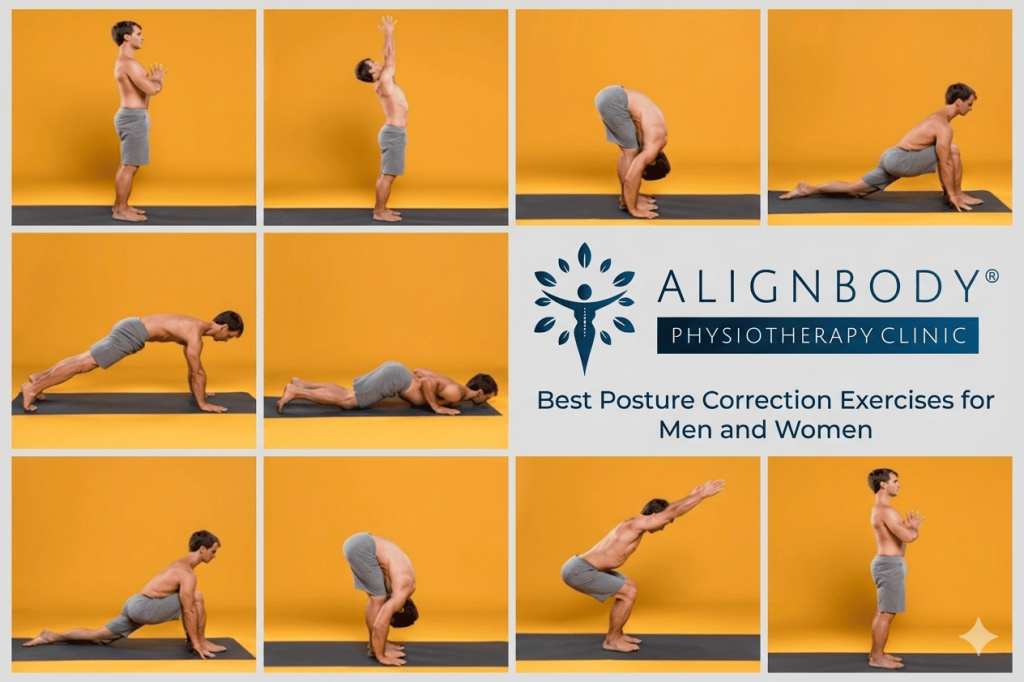
Best Posture Correction Exercises for Men and Women- A Delhi Physiotherapist’s Complete Guide
Let me tell you what I see every single week at my clinic in East Delhi.
A patient walks in – let’s say a 32-year-old software developer from Noida – with chronic neck tension, occasional headaches, and a dull ache between his shoulder blades that never fully goes away. He’s already tried a posture corrector brace. He’s done some YouTube exercises for a few weeks. He sits on an ergonomic chair. Nothing has made a lasting difference. That’s when he starts looking for posture correction physiotherapy Delhi specialists who can identify the real cause of his posture imbalance and provide a personalized treatment plan instead of temporary fixes.
And then I run a proper postural assessment. Within minutes, the picture is clear. His pectorals are tight. His deep cervical flexors are almost completely switched off. His lower trapezius is weak. His hip flexors are short from years of sitting. He has Upper and Lower Crossed Syndrome simultaneously, which, honestly, describes probably 70% of Delhi’s desk-working population.
The exercises he was doing? They weren’t wrong. They just weren’t targeted. They were treating posture like a single problem. But posture is a system — and systems need specific, sequenced interventions.
This guide gives you that.
I’m Dr. Richa Gupta, founder of AlignBody — physiotherapy clinics in Jagriti Enclave, East Delhi and Vasant Vihar, South Delhi. This is the same posture correction framework I use with every patient, whether they’re 22 or 62, gym-going or sedentary, male or female.
Why Most Posture Exercises Don’t Work
Before we get into the exercises, I want to clear something up — because this is where most people waste months.
Posture is not a habit problem. It’s a structural problem.
When your pectorals are short and stiff, they physically pull your shoulders forward. No amount of “trying to sit straight” overcomes that pull. The pectorals are stronger than your willpower. Every time you stop concentrating, your shoulders go right back to where the tight muscles want them.
This is why the sequence matters as much as the exercises themselves. You must first release the tight muscles before you can successfully strengthen the weak ones. Doing it backwards — strengthening first — just increases the imbalance.
The pattern behind most postural problems has a name: Upper Crossed Syndrome (above the waist) and Lower Crossed Syndrome (below it). Together, they create the familiar picture — head forward, shoulders rounded, lower back arched. Back pain keeping you down? Discover the core strengthening exercises for back pain that our Delhi physiotherapists prescribe.
| Muscle | Status | Postural Effect |
|---|---|---|
| Chest muscles (pectorals) | Overactive — too tight | Rounds shoulders forward |
| Upper trapezius | Overactive — too tight | Elevates and rounds the shoulders |
| Suboccipital muscles | Overactive — too tight | Compresses neck, triggers headaches |
| Deep cervical flexors | Underactive — too weak | Head drifts forward; can’t stay neutral |
| Lower and middle trapezius | Underactive — too weak | Shoulder blades drift apart and forward |
| Rhomboids | Underactive — too weak | Can’t retract or stabilise shoulder blades |
| Glutes | Underactive — too weak | Pelvis tilts forward; lower back overloads |
| Hip flexors | Overactive — too tight | Pulls pelvis into anterior tilt |
The Core Posture Correction Exercises (For Everyone)
These six exercises are the foundation. They work for men and women both. Master these first. The gender-specific sections after this build on top of them.
1. Chin Tuck — Your First Exercise, Your Daily Habit
This is the single most prescribed posture exercise in evidence-based physiotherapy. It activates the deep cervical flexors — the small but critical muscles at the front of your neck — and directly reverses the forward head drift that causes neck pain, tension headaches, and upper back strain.
How to do it: Sit or stand upright. Without tilting your chin down, slide your head straight backwards — as if making a double chin. Hold for 5 seconds. Release gently. 10 reps, 3 times a day.
A 2022 study in the Journal of Physical Therapy Science confirmed that consistent chin tuck practice significantly reduces both forward head posture and cervicogenic headache frequency. Most of my patients in Delhi notice a reduction in daily neck tension within 2–3 weeks of doing this correctly. Struggling with leg pain or numbness? Discover effective sciatica pain treatment in Delhi.
2. Doorway Chest Stretch — Release Before You Strengthen
You cannot strengthen your way out of tight pectorals. Before any upper back strengthening exercise can be properly activated, the chest muscles pulling your shoulders forward must be released. The doorway stretch does this better than almost anything else.
How to do it: Stand in a doorway. Place your forearms on the frame — elbows at shoulder height. Step one foot through and gently lean your body weight forward until you feel a stretch across the front of your chest and shoulders. Hold 30 seconds. 3 reps. Do this before every other exercise in this guide.
If you have a significant forward head, you can also do an upper doorway stretch — same position but elbows raised above shoulder height — to specifically target the pectoralis minor, which contributes to shoulder forward tilt.
3. Wall Angel — Retrain How Your Shoulders Sit
Most people with rounded shoulders can’t get their arms overhead without their lower back arching or their arms peeling off the wall. That restriction tells you exactly which muscles need work. The wall angel addresses all of them simultaneously.
How to do it: Stand with your back flat against a wall. Feet a few inches forward. Head, upper back, and hips all touching the wall. Arms out in a goalpost shape — elbows at 90 degrees, backs of hands touching the wall. Slowly slide your arms upward until nearly straight, then back down. Keep everything in contact with the wall throughout. 3 sets of 10. Take the first step towards relief—know more about arthritis treatment today.
4. Bird-Dog — Build the Stability That Holds Posture
Good posture isn’t passive. It requires constant low-level activation of the deep spinal stabilizers — the multifidus, transverse abdominis, and associated muscles. The bird-dog is the gold standard for training this system without loading the spine under compression.
How to do it: On all fours, hands under shoulders, knees under hips. Gently brace your core. Extend your right arm forward and your left leg back simultaneously — keeping your hips level, no rotation. Hold 5 seconds. Switch sides. 3 sets of 10 each side.
If your lower back arches or your hips tilt, reduce the range of motion. The modified version (arm only, or leg only) is completely valid. In our physiotherapy clinic in East Delhi, we start almost every postural programme here before adding any loading.
5. Glute Bridge — Fix the Lower Half
If you sit for more than 6 hours a day — and most people in Delhi do — your glutes have been progressively inhibited. Weak glutes allow the pelvis to tip forward, the hip flexors to shorten, and the lower back to overarch. The glute bridge switches them back on.
How to do it: Lie on your back, knees bent, feet flat and hip-width apart. Drive your hips upward by squeezing your glutes — not your lower back. Your body should form a straight line from shoulders to knees. Hold 5 seconds at the top. Lower slowly. 3 sets of 15.
This is also one of the best exercises for lower back pain relief, which is usually connected to the same postural imbalance that causes poor posture.
6. Scapular Squeeze — The Desk Break That Changes Everything
Simple, takes 10 seconds, and you can do it at your desk every hour. Squeeze your shoulder blades together and downward — like you’re trying to hold a pencil between them. Hold 5 seconds. Release fully. 15 reps.
This is an hourly micro-habit I prescribe to every single desk worker who walks into AlignBody. It doesn’t replace the full programme — but it interrupts the forward shoulder drift before it becomes locked in. Over weeks, it changes the resting position of your shoulder blades.
Best Posture Correction Exercises for Women
The exercises above work well for women. But if you’ve had a pregnancy, if you carry a bag habitually on one shoulder, or if you’re over 40, specific things are happening in your body that the generic programme doesn’t fully address.
I work with a lot of women at AlignBody, and the pattern I see most often is this: pelvic floor underactivation driving poor core function, a thoracic spine stiff from months of feeding and carrying posture, and lateral muscle imbalances from asymmetric loading. These aren’t minor details. They are often the actual root cause of the back pain, neck tension, and shoulder ache that brings women to our clinic.
W1. Diaphragmatic Breathing with Pelvic Floor Activation
This is the foundation of women’s posture rehabilitation — and probably the most overlooked exercise in general fitness. The pelvic floor, diaphragm, deep abdominals, and multifidus form a pressure cylinder that stabilizes the entire spine. If the pelvic floor isn’t coordinating properly — which is common post-pregnancy and often after difficult deliveries — the whole system is compromised from the ground up.
How to do it: Lie on your back, knees bent. Breathe in slowly through your nose — feel your ribcage expand sideways. As you exhale, gently lift your pelvic floor upward (as though stopping the flow of urine — but gently, not gripping). Hold the pelvic floor engagement through the full exhale. Release completely on the inhale. 10 breaths, twice daily.
Start this before addressing any other exercise. For women who’ve had a baby — whether recently or years ago — this is the essential first step. Our pre and post natal physiotherapy programme always begins here.
W2. Thoracic Extension on a Rolled Towel
The thoracic spine — the mid-back — is where women accumulate the most stiffness. Months of breastfeeding posture, carrying babies on one hip, and desk work round the thoracic spine into fixed flexion. No amount of shoulder strengthening compensates for this if the thoracic spine physically cannot extend. This exercise directly restores that mobility.
How to do it: Roll a bath towel into a firm cylinder. Lie on your back with the towel placed horizontally across your mid-back — roughly at bra-strap level. Support your head with your hands. Let gravity extend you backwards over the roll. Hold 10 seconds. Move the roll up one vertebra at a time, working from mid-back toward the upper back. 3–5 minutes daily.
W3. Side-Lying Clamshell — Pelvic Stability and Hip Strength
Women who carry children, heavy bags, or anything consistently on one side develop lateral pelvic tilt and asymmetric hip loading. The clamshell directly targets the gluteus medius — the hip muscle responsible for keeping your pelvis level — which is typically weak in this pattern.
How to do it: Lie on your side, hips and knees bent at 45 degrees, feet together. Keeping your pelvis completely still, rotate your top knee upward — like a clamshell opening. Don’t let your hips roll backward. Hold 3 seconds. 3 sets of 15 each side. Progress by adding a resistance band above the knees.
W4. Cat-Cow with Pelvic Floor Sync
The standard cat-cow is good for everyone. For women, coordinating it with pelvic floor engagement adds a layer of spinal stability training that directly addresses the post-natal core disconnection many women experience.
How to do it: On all fours. Inhale — let your belly drop (cow). As you exhale, round your spine toward the ceiling (cat) and simultaneously engage your pelvic floor gently upward. Hold the engagement at the top of the exhale for 2 seconds. Release on the inhale. 10 cycles, twice daily.
A Note on Posture for Women Over 40
After perimenopause, declining estrogen accelerates bone density loss in the thoracic vertebrae. This is the stage where thoracic kyphosis — the rounding of the upper back — progresses from a postural habit into a structural change that is genuinely harder to reverse.
The exercises above remain appropriate and important. Additionally, prioritize weight-bearing activity (brisk walking, resistance training), do the thoracic extension exercise daily without skipping, and get your Vitamin D and calcium levels checked — deficiency is extremely common in Delhi’s office-working population who have limited outdoor exposure. Physiotherapy and orthopaedic treatment aren’t the same — and knowing the difference helps you heal faster.
Best Posture Correction Exercises for Men
Something I want to say directly to men reading this:
You can exercise five times a week and still have terrible posture.
I see it constantly. A man in his 30s comes in with shoulder impingement and chronic lower back pain. He’s been to the gym regularly for years. He benches, he presses, he squats. And his posture is a disaster.
The reason is almost always the same: the gym is feeding the imbalance, not correcting it. Every pressing exercise tightens the pectorals further. Every heavy squat without hip mobility work shortens the hip flexors more. The muscles that are already dominating get stronger. The ones that are already weak fall further behind.
The exercises below fix what the gym misses. They’re also, frankly, more useful for posture correction than most chest and shoulder work. For the full picture on exercise and physical recovery, see our sports physiotherapy guide.
M1. Face Pull — The Exercise Most Men Skip
If you could only add one exercise to your routine for posture, make it the face pull. It targets the posterior deltoid, external rotators, and mid-to-lower trapezius simultaneously — the exact muscles destroyed by chest-dominant training.
How to do it: Attach a resistance band to a fixed point at eye height. Hold with both hands, palms facing in. Pull the band directly toward your face, driving your elbows outward and upward — they should finish level with or slightly above your hands. Your knuckles should be beside your ears at the end of the movement. 4 sets of 15.
M2. Prone Y Raise — Activate Your Lower Traps
The lower trapezius is responsible for depressing and rotating the shoulder blade — movements that are essential for correct shoulder positioning. It is consistently undertrained and overlooked in most gym programmes. Weak lower traps mean the upper traps dominate, pulling the shoulder blades upward and creating the characteristic neck-and-shoulder tension that so many desk-working men in Delhi live with.
How to do it: Lie face down, arms stretched overhead in a Y shape, thumbs pointing upward. Keeping your arms straight, lift them slightly off the surface by pulling the shoulder blades downward and together — not by shrugging. Hold 3 seconds at the top. 3 sets of 12. Start with zero weight; add light dumbbells only when the bodyweight version is effortless.
M3. Hip Flexor Lunge Stretch — The Most Neglected Daily Habit
Tight hip flexors — specifically the psoas and iliacus — drag the pelvis forward into anterior tilt and hyperextend the lower back. This pattern is universal in men who sit heavily and squat or deadlift heavily without equivalent hip mobility work. The lunge stretch is non-negotiable and should be done daily.
How to do it: Step into a half-kneeling position — right foot forward, left knee on the floor. Keep your torso tall and your glutes lightly squeezed. Push your hips gently forward until you feel a deep stretch in the front of the left hip. Hold 45 seconds. 3 rounds each side. Daily.
You should feel this in the front of the hip, not in the lower back. If you feel lower back pain, tuck your tailbone slightly before pushing forward — you’re probably tilting the pelvis forward instead of shifting it forward.
M4. Thoracic Rotation Stretch — Unlock the Upper Back
Men’s thoracic spines are often significantly stiffer in rotation and extension than women’s. This stiffness forces the lower back and neck to compensate during every movement — adding stress to the wrong structures and creating chronic pain that doesn’t respond to conventional treatment.
How to do it: Sit on a chair. Place your right hand behind your head, elbow out. Rotate your right elbow upward toward the ceiling — initiate the movement from your upper back, not your lower back. Keep your gaze following the elbow. Return to the start. 12 reps each side, 3 sets. Do this as a warm-up before any upper-body training session.
Your Weekly Posture Routine — Realistic and Practical
Having great exercises means nothing without a routine that actually fits your life. Here’s how to structure the week — this applies to both men and women, with the gender-specific exercises added on top of the universal foundation.
| Day | Focus | Time |
|---|---|---|
| Monday / Thursday | Chin tuck · Bird-dog · Glute bridge · Dead bug (men) or Pelvic floor breathing (women) | 30 min |
| Tuesday / Friday | Face pull (men) or Clamshell (women) · Prone Y · Wall angel · Scapular squeeze | 25 min |
| Wednesday | Doorway chest stretch · Thoracic extension on towel · Hip flexor lunge stretch · Cat-cow | 20 min — mobility only |
| Every single day | Chin tuck × 10 · Scapular squeeze × 10 · Hip flexor stretch (30 sec each side) | 5 min — desk breaks |
| Sunday | Rest or 30-45 min walk — no formal exercise | Active recovery |
Timeline reality check: You’ll feel better within 2–3 weeks. Visible postural change takes 8–12 weeks. Full structural correction — where good posture is your default, not something you think about — takes 3–6 months. That’s not a flaw in the programme. That’s how long muscle imbalances that took years to develop take to reverse.
When to See a Physiotherapist Instead of Self-Managing
These exercises work. But they’re not appropriate for everyone at every stage, and there are situations where self-directing your rehabilitation is the wrong call.
See us at AlignBody if:
- Your pain has lasted more than 3–4 weeks without meaningful improvement from daily exercises
- You have numbness, tingling, or weakness radiating into an arm or leg
- Your headaches occur more than twice per week — especially headaches that start at the base of the skull
- You’ve been told you have cervical spondylosis, disc bulge, scoliosis, or kyphosis — these need clinical management before generic posture exercises are appropriate
- You’re post-pregnancy and dealing with pelvic instability, abdominal separation, or persistent back and hip pain
- Your pain is worsening rather than plateauing or improving
At our clinics in East Delhi (Jagriti Enclave) and South Delhi (Vasant Vihar), our postural correction programme combines manual therapy, dry needling, IASTM Therapy, and personalized exercise — not a generic set of movements, but a programme built around your specific postural pattern. We also offer physiotherapy at home for patients who can’t easily visit the clinic.
For post-natal women specifically, please read our dedicated guide to pre and post natal physiotherapy before starting any exercise programme. Getting this wrong early in recovery can slow down an already challenging process significantly.
FAQ’s About Posture Correction Exercises
Q: What is the best posture correction exercise?
A: The chin tuck is the single most evidence-backed posture correction exercise. It directly targets the deep cervical flexors — the muscles that hold your head in neutral — and consistently produces measurable improvement in forward head posture within 3 to 4 weeks of daily practice. Do 10 reps, holding 5 seconds each, three times a day.
Q: Are posture correction exercises different for men and women?
A: The foundational exercises — chin tuck, wall angel, bird-dog, glute bridge — are the same for both. The differences come from the distinct root causes. Women more commonly need to address pelvic floor coordination, thoracic stiffness from pregnancy and carrying posture, and asymmetric hip loading from one-sided habits. Men more commonly need to correct anterior shoulder dominance from chest-heavy gym training, hip flexor shortness from sitting combined with heavy lower body work, and thoracic rotation restriction. This guide provides dedicated sections for both.
Q: How long does posture correction take?
A: Most people feel noticeably less tension and fewer headaches within 2 to 3 weeks of consistent daily practice. Visible postural improvement — the kind other people notice — typically takes 8 to 12 weeks. Full correction, where good posture becomes your natural resting position without thinking about it, generally takes 3 to 6 months. The timeline depends on how long the imbalance has been established and how consistently the exercises are done.
Q: Can you fix decades of bad posture with exercises?
A: Yes — though it takes longer. The spine and associated muscles respond to progressive loading and stretching at any age. Research consistently shows postural improvement is achievable into the 60s and 70s with the right programme. The caveat is that if structural changes have occurred — such as significant kyphosis in older women or advanced disc degeneration — a physiotherapy assessment is important before self-directing exercise.
Q: Do posture corrector braces work?
A: Not as a standalone solution. Braces provide passive external support — the moment you remove them, the muscles holding the posture have the same strength and length as before. Over time, dependency on a brace can actually weaken postural muscles further. Exercises that actively strengthen the muscles are always superior for lasting correction.
Q: Is physiotherapy needed for posture correction, or can I do it myself?
A: Mild to moderate postural problems in otherwise healthy people can be effectively addressed with the exercises in this guide. However, if your posture problems are accompanied by pain, stiffness, neurological symptoms (numbness or tingling), or are connected to a diagnosed spinal condition, a professional physiotherapy assessment is the right starting point. Self-management without a proper structural assessment can sometimes address the wrong muscles and delay real improvement.
Q: I sit 10 hours a day in Delhi. Is my posture fixable?
A: Absolutely. The majority of posture correction patients at AlignBody are full-time desk workers — IT professionals, finance staff, government employees — who sit for 9 to 12 hours a day. The exercises in this guide, combined with ergonomic adjustments and movement breaks, work within that reality. You don’t need to change your work schedule. You need to change what you do with the rest of your time.
The Takeaway
Here’s the truth about posture correction.
It’s not complicated. It’s not expensive. It doesn’t require a gym membership or a lot of time. What it requires is understanding the actual problem — the specific muscles that are too tight and too weak in your body — and doing the right exercises consistently enough for the system to rebalance.
The six foundational exercises in this guide work for everyone. The women’s section addresses the specific patterns that desk work, pregnancy, and hormonal changes create. The men’s section addresses what the gym misses and what sitting creates. Together, they cover the full picture of why posture goes wrong and exactly how to fix it.
If you want personalised guidance — a proper assessment, a clinical programme, and the kind of hands-on work that exercises alone can’t fully replicate — come and see us. We’re at Jagriti Enclave in East Delhi and Vasant Vihar in South Delhi. We also offer home visit physiotherapy across Delhi NCR for those who can’t easily travel.
Your posture took years to arrive where it is. With the right programme, it will take months — not years — to change.
| Book Your Consultation at AlignBody Physiotherapy Clinic
Expert posture correction — drug-free, evidence-based, Delhi-tested East Delhi: Jagriti Enclave | South Delhi: Vasant Vihar +91 9310 014 226 | alignbody.in/contacts/ |
| Written by
Dr. Richa Gupta — Founder & MD, AlignBody Physiotherapy Clinic, Delhi NCR 14+ years of clinical experience in postural rehabilitation, chronic pain, manual therapy, dry needling, and pre/post-natal physiotherapy. Certified APBC practitioner (USA & Thailand), Diploma in Osteopathy (Ontario, Canada), certified Mat Pilates Instructor (Ireland). Founder of AlignBody — Delhi’s trusted physiotherapy clinic across East Delhi (Jagriti Enclave) and South Delhi (Vasant Vihar). 20,000+ patients treated across Delhi NCR. Medically reviewed and accurate as of April 2025. |