Physiotherapy vs Orthopedic Treatment
What Is Orthopaedic Treatment?
At AlignBody, orthopaedic treatment focuses on diagnosing, preventing, and managing conditions that affect the bones, joints, muscles, ligaments, and tendons. An orthopaedic doctor – also called an orthopedist or bone specialist – uses a range of approaches, including medicines, injections, braces, minimally invasive procedures, and surgery, depending on the severity of the condition.
Modern orthopaedic care has advanced significantly. Minimally invasive surgeries, joint replacement procedures, and regenerative therapies like PRP and stem cell treatment now offer patients faster recovery and better long-term outcomes than ever before.
Common orthopaedic treatment methods include:
- Clinical assessment, X‑ray, MRI, and blood tests for diagnosis.
- Medications such as painkillers, anti‑inflammatories, or disease‑modifying drugs for arthritis.
- Injections (steroid, viscosupplementation) for joint pain.
Casts, braces, splints for fractures, ligament injuries, and spinal issues.
What Is Physiotherapy?
Physiotherapy – jise physical therapy bhi kaha jata hai – ek evidence-based healthcare discipline hai jo movement disorders, chronic pain, injuries aur post-surgical recovery ko bina surgery ke treat karti hai. A qualified physiotherapist uses movement analysis, hands-on techniques, and targeted exercises to accelerate the body’s natural healing process and restore full function.
According to the World Confederation for Physical Therapy (WCPT), physiotherapy helps people develop, maintain, and restore maximum movement and functional ability throughout their lives — whether that means recovering after a stroke, managing arthritis, or returning to sport after an ACL injury.
At AlignBody, our physiotherapy clinic in East Delhi and physiotherapy clinic in South Delhi offer personalised physiotherapy programmes designed around your specific condition, lifestyle, and recovery goals.
Common physiotherapy treatment methods include:
- Manual therapy — joint mobilisation, soft tissue release, and myofascial release techniques to reduce pain and improve movement.
- Exercise therapy — structured strengthening, flexibility, and functional movement programmes tailored to your condition.
- Electrotherapy — modalities like shockwave therapy, laser therapy, and IASTM therapy to accelerate tissue healing.
- Dry needling therapy — targeting myofascial trigger points to release muscle tension and relieve referred pain.
- Posture correction and patient education — teaching you how to move safely and prevent recurrence of injuries.
Physiotherapy vs Orthopedic Treatment: Key Differences You Should Know
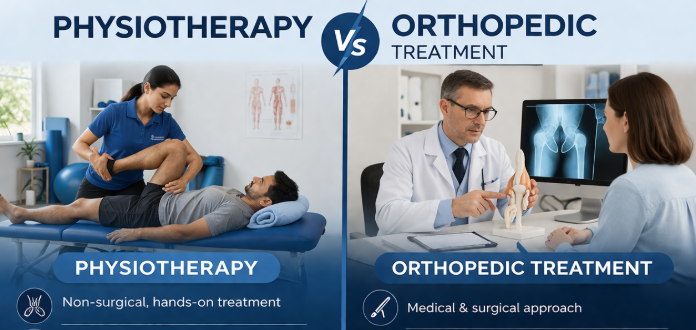
Orthopaedic treatment is a medical and surgical speciality, while physiotherapy is a non‑invasive, movement‑based rehabilitation therapy. Where an orthopaedic doctor corrects structural or tissue damage, a physiotherapist works on restoring your mobility, rebuilding strength, and preventing future injuries from happening again.
If you are recovering from surgery or managing a chronic condition, Pilates therapy at our Delhi clinic can be an excellent complement to both approaches — helping you rebuild deep core strength and improve overall movement quality.
Here is a clear comparison to help you understand the difference:
| Aspect | Orthopedic Treatment | Physiotherapy Treatment |
| Primary Focus | Medical diagnosis and treatment of musculoskeletal conditions, including surgical management when required | Rehabilitation, improving mobility, restoring function, and managing pain through movement-based therapies |
| Typical Methods | Medications, injections, casts, braces, imaging-guided procedures, and surgery | Exercise therapy, manual therapy, electrotherapy, posture correction, and patient education |
| Best For | Bone fractures, severe arthritis, ligament tears requiring repair, structural deformities, and advanced spine problems | Muscle strains, chronic back or neck pain, post-surgery rehabilitation, balance issues, and mild to moderate joint problems |
| Invasiveness | May involve invasive or semi-invasive procedures such as injections or surgery | Non-invasive treatments focused on physical rehabilitation and hands-on techniques |
| Treatment Duration | Usually, shorter-term treatment focuses on diagnosis and immediate medical management | Often involves medium to long-term rehabilitation programs to restore strength, mobility, and function |
Benefits of Orthopaedic Treatment
Many patients come to us unable to walk comfortably, dealing with persistent pain, or struggling to complete basic daily tasks. With the right orthopaedic care, these same patients often leave recovery with a completely transformed quality of life. That is because orthopaedic treatment does not just manage symptoms — it targets the root cause of your pain.
1. Long-Lasting Pain Relief- Unlike pain medication that only masks discomfort, orthopaedic treatment identifies and addresses the actual source of your problem – whether it is a damaged joint, a compressed nerve, or an inflamed tendon — giving you relief that lasts.
2. Improved Mobility and Flexibility- Conditions like arthritis, frozen shoulder, or knee injuries can severely restrict your ability to move. Orthopaedic intervention targets the structural cause, allowing you to regain full or near-full range of motion.
3. Avoids Unnecessary Surgery — A good orthopaedic specialist always tries non-surgical options first — physiotherapy, PRP injections, bracing — before recommending any procedure. Surgery is considered only when conservative approaches have been exhausted.
4. Supports Athletes and Active Individuals — Orthopaedic care is not just for older patients or those with chronic conditions. It is central to sports medicine, helping athletes recover from injuries quickly and safely. Our sports physiotherapy team in Delhi works hand-in-hand with orthopaedic care for complete, performance-focused recovery.
5. Boosts Mental Health and Confidence — Living with chronic pain takes a deep toll on mental well-being. When patients regain their movement and become pain-free, the improvement in mood, confidence, and overall outlook on life is just as significant as the physical recovery.
Benefits of Physiotherapy
Physiotherapy is not just an alternative to surgery — for many patients, it is the most effective first-line treatment available. A landmark 2020 study published in the New England Journal of Medicine found that for many patients with knee osteoarthritis, structured physiotherapy was as effective as arthroscopic surgery in reducing pain and improving function, with fewer risks and faster overall recovery.
1. Treats the Root Cause, Not Just the Symptom — Rather than masking pain with medication, physiotherapy identifies the underlying movement dysfunction, muscle imbalance, or postural problem causing your pain — and corrects it at the source.
2. Completely Non-Invasive — Physiotherapy requires no injections, no anaesthesia, and no recovery room. For patients who want to avoid surgery or who are not surgical candidates, physiotherapy offers a safe and effective path to recovery.
3. Prevents Injury Recurrence — One of physiotherapy’s greatest strengths is long-term prevention. By strengthening the muscles around an injured joint and correcting movement patterns, physiotherapy dramatically reduces the chance of the same injury happening again.
4. Safe for All Ages — From children recovering from sports injuries to elderly patients managing arthritis and osteoporosis, physiotherapy can be safely adapted to any age group or fitness level. Neuro rehabilitation, pre and post natal care, and Pilates therapy at AlignBody are all examples of how physiotherapy adapts to different life stages and needs.
5. Supports Mental Well-Being — Chronic pain is deeply linked to anxiety and depression. Regular physiotherapy sessions not only reduce physical pain but also restore confidence, independence, and quality of life — benefits that go far beyond the physical.
Conditions Treated by Physiotherapists vs Orthopedic Doctors
| Condition | Primarily treated by an orthopaedic doctor | Primarily treated by a physiotherapist |
| Fresh fracture | Yes, for diagnosis, stabilisation, and surgical treatment if required | No, physiotherapy usually begins after the bone has healed |
| Chronic low back pain | Sometimes, if serious underlying issues or surgery are required | Yes, through posture correction, strengthening, and mobility exercises |
| ACL tear | Yes, when surgical reconstruction is necessary | Yes, through pre-surgery conditioning and post-surgery rehabilitation |
| Early knee osteoarthritis | Sometimes, for diagnosis, medication, or injections | Yes, exercise therapy, strengthening, and lifestyle guidance |
| Joint replacement | Yes, performs the surgical procedure | Yes, provides pre-surgery conditioning and post-surgery rehabilitation |
People Also Ask-
1. When Should You Visit an Orthopaedic Doctor?
You should see an orthopaedic doctor when you suspect structural damage — a fracture, a torn ligament, or a severely damaged joint. It is also the right call when you are in severe pain, notice any visible deformity, or when conservative treatments like physiotherapy have not been giving you results. Orthopaedic evaluation is essential to rule out conditions that cannot be managed with rehabilitation alone.
2. When Should You See a Physiotherapist?
See a physiotherapist when pain, stiffness, or weakness is affecting your daily life but there is no immediate medical emergency. Physiotherapy is particularly effective for recovering from injuries, managing chronic pain, improving posture, and preventing conditions from recurring. For expert, evidence-based care, visit our physiotherapy clinic in South Delhi or our physiotherapy clinic in East Delhi — whichever is closer to you.
3. Can Physiotherapy Replace Orthopaedic Treatment?
In many mild to moderate cases, physiotherapy can significantly reduce or delay the need for surgery and medication. However, in serious structural conditions — advanced joint damage, complex fractures, or significant deformities — physiotherapy works best as a complement to orthopaedic care, not as a replacement. The two approaches, used together, almost always produce better outcomes than either alone.
Role of Physiotherapy After Orthopedic Surgery
Physiotherapy after orthopaedic surgery is not optional — it is an essential part of your recovery. Without structured rehabilitation, even a technically successful surgical procedure can result in stiffness, weakness, and a much longer return to normal life. Research consistently shows that early physiotherapy after surgery leads to faster functional recovery and fewer post-operative complications.
At AlignBody, your post-surgery physiotherapy programme will typically include:
- Pain and swelling control using modalities and gentle movement.
- Early mobilisation to prevent stiffness, clots, and muscle wasting.
- Progressive strengthening and gait training with or without aids.
Recovery Time: Physiotherapy vs Orthopedic Treatments
One of the most common questions we hear is: “How long will it take to get better?” The honest answer is — it depends. Recovery timelines vary based on the type and severity of your condition, the procedure performed, and how consistently you follow your rehabilitation programme.
As a general guide:
- Muscle strain with physiotherapy: 2–6 weeks, depending on grade.
- Mild ligament sprain: 4–8 weeks with rehab.
- ACL reconstruction plus physiotherapy: 6–9 months for sports return.
- Total knee replacement with structured rehab: most daily activities in 6–12 weeks, further gains up to 1 year