Core Strengthening Exercises for Back Pain Physiotherapy
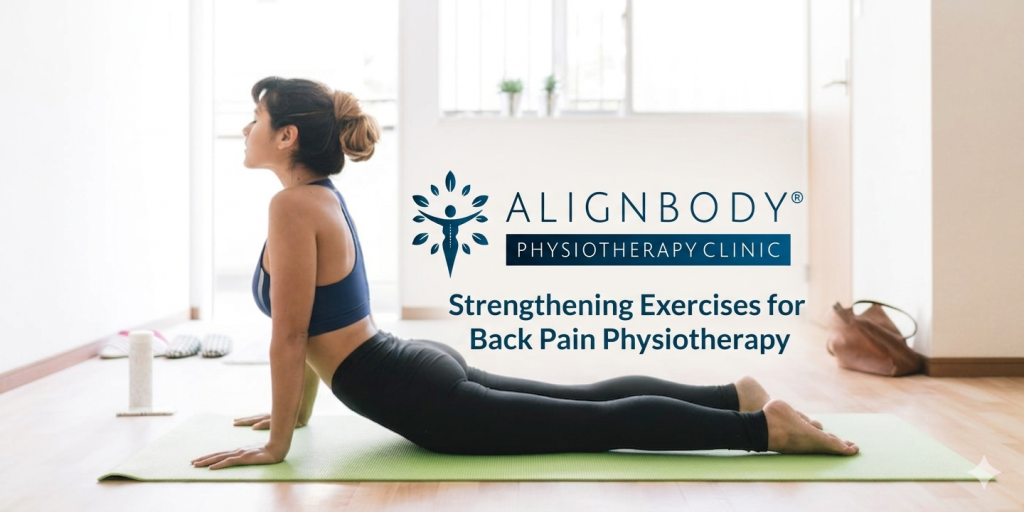
Core Strengthening Exercises for Back Pain: What Physiotherapists Actually Prescribe and Why?
“Just do some sit-ups for your back.”
If someone has told you this, I want you to stop — right now — before you do another crunch.
Sit-ups and crunches are not core exercises for back pain. In fact, they can actively make disc-related and sciatica pain significantly worse.
Here’s what nobody tells you: the ‘core’ muscles that protect your spine are not your six-pack. They’re a deeper group of muscles — and most people with chronic back pain have never properly activated them in their entire lives.
I’m Dr. Richa Gupta. At AlignBody’s physiotherapy clinics in Delhi, we assess core function in every single back pain patient — and the findings are consistently the same: the deep stabilisers are inhibited, weak, and poorly coordinated. And until that’s fixed, back pain keeps coming back.
This post gives you the complete guide — the right muscles to target, the right exercises to do (in the right order), and the common mistakes that make back pain worse. AlignBody provides services for physiotherapy at home in Delhi. Explore to get relief from your pain.
The Core Muscles That Actually Protect Your Spine
The spinal stabilisation system has four key components:
| Muscle | Role in Spinal Stability |
|---|---|
| Transverse Abdominis (TA) | The deepest abdominal muscle acts like a corset around the lumbar spine. The first muscle a healthy spine activates before any movement. |
| Multifidus | Small muscles running along each side of the spine. Critical for fine-tuning vertebral control and preventing shear forces between segments. |
| Pelvic Floor | Works in coordination with the TA and diaphragm to regulate intra-abdominal pressure — essential for spinal load management. |
| Diaphragm | Not just for breathing — it works as the ‘lid’ on the pressure cylinder that stabilises the spine during movement. |
The Physiotherapy Core Programme: 6 Essential Exercises
These exercises are prescribed in sequence — order matters. We always start with activation before loading, and stability before strength.
Level 1: Activation — Teaching the Right Muscles to Fire
Exercise 1: Diaphragmatic Breathing with TA Activation
Lie on your back, knees bent. Place one hand on your chest, one on your lower abdomen. Breathe in through your nose — your lower hand should rise, your chest hand should stay relatively still.
On the exhale, gently draw your lower abdomen in and up — as if you’re pulling your navel back toward your spine, not sucking in. Hold this gentle contraction for 5–10 seconds, breathing normally. Repeat 10 times.
Exercise 2: Heel Slides with Core Activation
Lying on your back, engage your deep core (as above). Slowly slide one heel away from you along the floor until your leg is straight. Slide it back. Keep your back flat — no arching. 3 sets × 10 reps each side. Discover our Pilates therapy clinic in East Delhi and start your core transformation today.
Level 2: Control — Building Stability Through Range
Exercise 3: Dead Bug
Lie on your back, arms pointing at the ceiling, knees and hips at 90°. Engage your deep core. Slowly lower one arm overhead while simultaneously extending the opposite leg toward the floor. Return to start. Alternate sides. 3 sets × 8–10 reps each side.
Exercise 4: Bird-Dog
On all fours, shoulders over wrists, hips over knees. Engage your core. Simultaneously extend one arm forward and the opposite leg back — maintain a level pelvis throughout. Hold 5 seconds. Return and repeat on the opposite side. 3 sets × 10 reps each side.
Level 3: Strength — Loading the Stabilised Spine
Exercise 5: Glute Bridge
Lie on your back, knees bent, feet flat and hip-width apart. Engage your core. Drive through your heels, squeeze your glutes, and lift your hips until your body forms a straight line from shoulders to knees. Hold 5 seconds at the top. Lower slowly. 3 sets × 15 reps.
Exercise 6: Modified Side Plank (Knee-Down)
Lie on your side, supporting yourself on your forearm and lower knee (straight leg version for advanced). Keep your body in a straight line from head to knee. Hold 20–30 seconds. Build toward 60 seconds. Repeat both sides. Don’t let chronic pain hold you back- visit AlignBody’s best chiropractic clinic in East Delhi for targeted, root-cause treatment.
How Long Until You See Results?
| Goal | Expected Timeline |
|---|---|
| Pain reduction | Often noticeable within 2–3 weeks of consistent daily practice |
| Core activation | Improved motor control typically develops over 4–6 weeks |
| Functional strength | Meaningful strength gains visible at 8–12 weeks |
| Long-term prevention | Maintained with 3–4 sessions weekly as a lifelong habit |
When Exercises Alone Aren’t Enough
Core exercises are powerful — but they’re most effective as part of a complete physiotherapy programme. If you have:
- A confirmed disc herniation or prolapse
- Active sciatica with leg pain or numbness
- Pain that worsens with any of these exercises
- A history of spinal surgery
…you need a physiotherapy assessment first. At AlignBody Delhi, we’ll determine exactly which exercises are appropriate for your specific diagnosis — and which ones could make things worse. For long-term relief, we recommend pairing physiotherapy with our Pilates therapy classes in Delhi– designed specifically for people with back and spine issues.
FAQ’s About Strengthening Exercises for Back Pain
Q: How often should I do core exercises for back pain?
A: Daily practice produces the best results — even 15–20 minutes. The activation exercises (Level 1) can be done every day. The strength exercises (Level 3) benefit from a day of rest between sessions.
Q: Should core exercises hurt?
A: No. A feeling of muscle fatigue or mild exertion is normal. Sharp pain, worsening leg symptoms, or increased back pain during any exercise means you should stop and seek professional advice.
Q: Can core exercises replace physiotherapy for back pain?
A: They’re complementary. Exercises address muscle weakness and coordination, but they don’t release tight tissues, mobilise stiff joints, or address the specific biomechanical patterns driving your pain. A physiotherapy programme does all of these.
The Bottom Line
The muscles that protect your spine are probably not working as well as they should be. That’s not your fault — it’s a predictable result of sedentary modern life.
But it is fixable. These six exercises, done correctly and consistently, can transform how your spine functions — and how your back feels every single day.
For a personalised core rehabilitation programme targeting your specific pain pattern and movement deficits, book a physiotherapy assessment at AlignBody in Delhi.
| Ready to Get Started?
Book your consultation at AlignBody — Delhi’s trusted physiotherapy clinic East Delhi: Jagriti Enclave, Vikas Marg | South Delhi: Vasant Vihar Phone: +91 9310 014 226 | alignbody.in/contacts/ |
| About the Author
Dr. Richa Gupta — Founder & Managing Director, AlignBody Physiotherapy Clinic, Delhi 14+ years of clinical experience. Certified in APBC practice (USA & Thailand), Diploma in Osteopathy (Ontario, Canada), Certified Mat Pilates Instructor (Ireland). Specialist in chronic pain, body alignment, dry needling, and manual therapy. AlignBody has helped 20,000+ patients across Delhi NCR live pain-free lives. |