Is Dry Needling Safe?
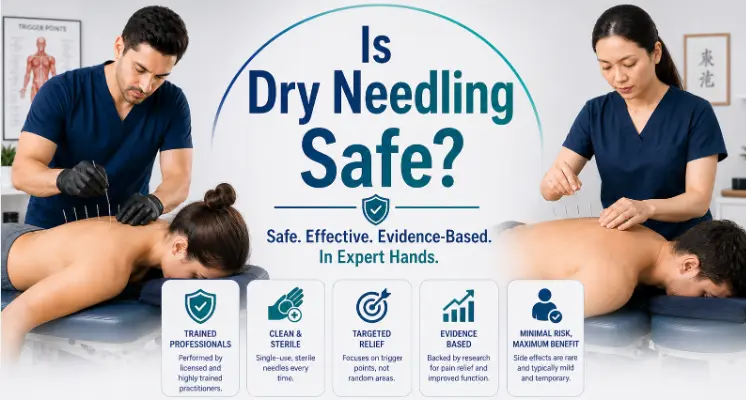
Yes, dry needling is safe when performed by a trained and certified physiotherapist using single-use sterile needles. Serious complications are extremely rare. Temporary muscle soreness for 24 to 48 hours is the most common side effect. Special precautions apply for pregnancy, diabetes, and children. At AlignBody, Delhi, every patient is screened for safety before any treatment begins.
Safety is the first thing people want to know before trying any needle-based treatment. That is completely reasonable. You are allowing someone to insert needles into your muscles, and you want to know what the risks actually are.
This guide gives you direct, clinical answers to every safety question patients commonly ask before their first dry needling session at AlignBody in Delhi. No sugarcoating, no unnecessary alarm. Just the facts.
Is Dry Needling Safe?
Yes. When performed by a physiotherapist with specific dry needling certification using single-use sterile needles, dry needling is a safe clinical procedure with a very low rate of serious adverse events.
The most comprehensive safety reviews in the literature consistently show that serious complications from dry needling are rare when practiced by trained clinicians. A 2011 review published in the Journal of Orthopaedic and Sports Physical Therapy found that minor adverse events (primarily post-needling soreness) occurred in a small proportion of treatments, but serious adverse events were extremely uncommon and almost always associated with inadequate training or failure to follow safety protocols.
What Makes Dry Needling Safe When Done Correctly
- Single-use, individually packaged sterile needles, discarded immediately after each session
- Thorough patient screening for contraindications before every session
- Practitioner training in regional anatomy to avoid nerves, blood vessels, and organs
- Appropriate needle depth and angle for each anatomical region
- Patient communication throughout the session so any unusual sensation is immediately addressed
- Post-treatment monitoring before the patient leaves the clinic
At AlignBody, Dr. Richa Gupta and our clinical team hold postgraduate certification in dry needling with specific training in safety protocols, regional anatomy, and emergency management. Every needle used is single-use sterile. No needle is ever reused.
Is Dry Needling Safe and Effective?
Yes on both counts, and the evidence for both is well established.
On effectiveness: multiple systematic reviews and randomised controlled trials confirm that dry needling reduces pain intensity, improves range of motion, and restores function in patients with myofascial trigger point pain, back pain, neck pain, shoulder pain, and sports injuries. The 2021 systematic review on upper quarter myofascial pain syndrome showed dry needling significantly superior to sham treatment for both pain and pressure pain threshold.
On safety: the evidence consistently shows a favourable safety profile when performed by trained practitioners. Minor adverse events are common and expected (post-treatment soreness). Serious adverse events are rare and preventable.
| Adverse Event | Frequency | Duration | Prevention |
|---|---|---|---|
| Local muscle soreness | Very common (up to 70% of sessions) | 24 to 48 hours | Expected and normal. Hydration and gentle movement help. |
| Minor bruising | Occasional (10 to 20%) | 3 to 7 days | More common in superficial areas and patients on anticoagulants |
| Light-headedness or vasovagal response | Uncommon (1 to 5%) | Minutes, resolves with rest | Eat before your session, do not attend on an empty stomach |
| Temporary symptom aggravation | Uncommon | 24 to 72 hours | Normal in chronic conditions. Reduces with subsequent sessions. |
| Infection | Extremely rare | Varies | Prevented by single-use sterile needles and clean technique |
| Nerve injury | Extremely rare | Varies | Prevented by thorough anatomy training and correct needle placement |
| Pneumothorax (collapsed lung) | Very rare, specific to chest/shoulder needling | Requires medical treatment | Correct needle angle and depth in thoracic region; experienced practitioner essential |
Is Dry Needling Safe in Pregnancy?
This is one of the most common safety questions we receive, and it requires an honest, nuanced answer rather than a simple yes or no.
Pregnancy is a relative contraindication for dry needling, not an absolute one. This means it is not automatically off the table, but it requires significant additional care, specific restrictions on where needles can be placed, and medical clearance before proceeding.
Specific Restrictions During Pregnancy
- The abdomen and lower back (especially after the first trimester)
- The sacrum and pelvic region
- The inner leg and medial thigh (Spleen 6 and related points that may stimulate uterine contractions)
- The shoulder and hand points traditionally associated with labour induction
- Any area overlying compromised skin or near varicose veins
- Upper back and thoracic spine for postural pain and shoulder blade tension
- Cervical and upper trapezius for neck pain common in pregnancy
- Calf muscles for leg cramps (with caution, avoiding contraindicated points)
- Gluteal muscles for pregnancy-related hip and buttock pain, away from the sacral region
At AlignBody, we do not perform dry needling on pregnant patients without written medical clearance from their obstetrician. If you are pregnant and experiencing musculoskeletal pain, book an assessment and we will advise which treatments are safe and appropriate at your stage of pregnancy. Home visit physiotherapy is often a practical option for pregnant patients who find travel uncomfortable.
Is Dry Needling Safe for Diabetics?
Well-controlled diabetes is not a contraindication for dry needling. Many of our patients at AlignBody with type 1 or type 2 diabetes receive dry needling safely and effectively.
However, diabetes introduces specific considerations that your physiotherapist must be aware of and manage carefully.
Key Considerations for Diabetic Patients
Peripheral neuropathy
Diabetic peripheral neuropathy reduces sensation in the hands and feet. This means a patient may not accurately feel or report pain during needling in these areas, which is an important safety signal. Practitioners must be more conservative in regions affected by neuropathy and rely more heavily on visual monitoring of the tissue response.
Compromised wound healing
Patients with poorly controlled diabetes or significant vascular complications may heal more slowly at needle sites. This increases the risk of minor skin irritation persisting beyond the usual 24 to 48 hours. Needle sites should be monitored and any sign of redness, warmth, or discharge reported to the clinic immediately.
Blood glucose management on treatment day
Attend your dry needling session with stable blood glucose. Do not come fasting or after excessive exertion. Hypoglycaemia during a needling session can produce symptoms that overlap with normal post-needling responses (light-headedness, sweating), making it difficult to distinguish. Bring a snack and your medication if needed.
Avoiding compromised skin areas
Needling should avoid any area with compromised skin integrity: open sores, active ulcers, infected tissue, or areas with significantly reduced circulation. Always inform your practitioner of any skin changes before each session.
Before starting dry needling at AlignBody, diabetic patients complete a health screening form that captures their diabetes type, current control level, medication, presence of neuropathy, and any vascular complications. We use this information to plan the safest approach for each individual.
Is Dry Needling Safe for Kids?
Dry needling in children is not standard practice and is approached with significantly more caution than adult treatment. The evidence base for paediatric dry needling is limited compared to adult populations.
Age Guidelines at AlignBody
| Age Group | Dry Needling Approach | Requirements |
|---|---|---|
| Under 12 | Not performed at AlignBody | Alternative physiotherapy approaches are used instead |
| 12 to 15 | Considered only in specific clinical circumstances | Full parental consent, medical clearance, and child assent required. Conservative technique only. |
| 16 to 17 | May be appropriate when clinically indicated | Parental consent required. Full explanation in age-appropriate language before proceeding. |
| 18 and over | Standard adult protocol applies | Patient consent only. Standard screening applies. |
For children presenting with musculoskeletal pain, trigger point massage, manual therapy, and corrective exercises are the preferred first-line approaches. These are effective, well tolerated, and carry no needle-related risks. If your child has muscle pain that is not responding to these approaches, book an assessment and we will advise whether dry needling is appropriate for their specific situation.
Is Dry Needling Harmful?
No, dry needling is not harmful when performed correctly. But this question deserves an honest and thorough answer rather than a blanket reassurance.
Dry needling can cause harm when:
- Performed by an undertrained practitioner who lacks the anatomical knowledge to avoid nerves, blood vessels, and organs at specific sites
- Needles are reused between patients, raising the risk of blood-borne infection transmission
- Contraindications are ignored, such as needling into infected tissue, near a known tumour, or in a pregnant patient without appropriate safety restrictions
- Needling too close to the lung apex in the chest or posterior shoulder region without correct technique, risking pneumothorax
- Needling an area the patient does not consent to or after failing to screen for relevant medical conditions
In India, as we noted in our broader dry needling guides, there is no national regulatory body for dry needling. This means that the range of practitioner training quality is wide. Always ask specifically about your practitioner’s dry needling certification before agreeing to treatment. A weekend workshop certificate is not equivalent to a postgraduate clinical programme.
At AlignBody, our team’s dry needling qualifications are documented and available on request. We only use individually packaged, single-use sterile needles. We screen every patient before every session.
Can Dry Needling Cause Problems?
It can cause temporary problems that are a normal part of the healing process. It can also cause more significant problems in specific situations. Here is the honest breakdown:
Normal Post-Treatment Responses (Not Problems)
- Muscle soreness for 24 to 48 hours at the treated area, similar to the soreness after a deep tissue massage or intense exercise. This is the tissue healing after the trigger point release.
- Temporary symptom increase in the first 24 hours before improvement. In chronic conditions, this is common and does not mean the treatment has failed.
- Minor bruising at needle sites, particularly in superficial areas or in patients on blood-thinning medication.
- Brief light-headedness during or immediately after the session, particularly in patients who have not eaten beforehand.
Genuine Problems That Should Be Reported
- Redness, warmth, or swelling at a needle site that persists beyond 72 hours or worsens (possible infection)
- Severe or worsening pain at the treatment site lasting more than 3 days
- Numbness or weakness that develops after treatment and does not resolve within 24 hours
- Shortness of breath or chest pain developing after needling near the upper back or shoulder (seek emergency care immediately)
- Signs of allergic reaction: rash, swelling, or difficulty breathing
If you experience any of the above after a session at AlignBody, contact us immediately. We take post-treatment concerns seriously and will assess you the same day if needed.
Is Dry Needling Worth It?
For the right patient with the right condition, dry needling is absolutely worth it. For the wrong patient or condition, it would be a waste of time and money. The honest answer requires knowing which category you fall into.
Dry Needling Is Strongly Worth It When:
- You have a musculoskeletal pain problem that a physiotherapist has confirmed involves active trigger points
- Massage, stretching, and exercise have not resolved the problem because the trigger point is too deep or too irritable to respond to surface techniques
- Your pain is significantly limiting your daily function, work, or sleep and you want the fastest legitimate path to relief
- You are in a sports rehabilitation programme and muscular trigger points are limiting your return to training
- You have been in pain for months or years and have run out of other options that work
Dry Needling Is Less Worth It When:
- Your pain has a structural cause (fracture, severe arthritis, active cancer) that dry needling cannot address
- Your condition is systemic (neuropathy from diabetes, fibromyalgia as a central sensitisation condition) where the muscular trigger point component is not the primary driver
- You have a needle phobia that would make the experience traumatic and the treatment ineffective
- You are accessing dry needling without a proper clinical assessment. Needling without knowing exactly which trigger points are involved is guesswork, not treatment
At AlignBody, no patient receives dry needling without a clinical assessment first. We identify the specific trigger points involved, confirm the condition is appropriate for needling, explain what to expect, and integrate the treatment within a broader plan. If dry needling is not the right tool for your situation, we will tell you that directly and recommend what is. This approach means that when we do proceed with dry needling, the outcomes are consistently good because the treatment is targeted and appropriate.
Who Should Avoid Dry Needling Entirely?
Some conditions represent absolute contraindications where dry needling should not be performed at all, regardless of the area being treated:
- Patients who are unwilling or unable to provide informed consent
- Active infection, fever, or systemic illness
- Known or suspected active cancer at or near the treatment site
- Haemophilia or severe bleeding disorders without medical clearance
- Needle phobia that cannot be managed with clinical communication and preparation
- Pacemaker (if electrical stimulation is added to dry needling, which we do not routinely use)
- Patients who have had a mastectomy should not receive needling distal to the site of lymph node removal
- Local skin infection, open wounds, or active dermatological conditions at the intended needling site
Dry Needling Safety at AlignBody, Delhi NCR
Here is exactly what our safety protocol looks like at AlignBody’s dry needling clinic:
- Pre-treatment screening: Every new patient completes a full health history form covering medications, medical conditions, pregnancy, bleeding disorders, diabetes, and any previous adverse reactions to needling.
- Verbal consent: We explain the procedure, expected sensations, common side effects, and rare risks before any session begins. You can ask questions at any point.
- Single-use sterile needles only: Every needle is individually packaged and sterile. It is opened in front of you and disposed of in a medical sharps container immediately after use. No needle is ever reused.
- Certified practitioners: All dry needling at AlignBody is performed by practitioners holding specific postgraduate certification, not a general physiotherapy degree or a short workshop certificate.
- Post-treatment monitoring: You are asked to remain in the clinic for a few minutes after your first session so we can confirm you are not experiencing any adverse response before you leave.
- Aftercare instructions: Every patient receives written aftercare guidance covering hydration, what to expect, and when to contact us if something does not feel right.
Have a Safety Question Before Booking?
Book a clinical assessment at AlignBody Delhi. We screen every patient before any treatment begins and will answer any safety questions specific to your health history before the first needle comes out.
Book Your Assessment
+91 9310 014 226