Why Lower Back Pain Hurt While Sitting at a Desk All Day

What Causes Lower Back Pain While Sitting?
Understanding why your lower back hurts when you sit for long periods requires a basic grasp of spinal anatomy and biomechanics. The lumbar spine- the five vertebrae in your lower back (L1–L5)- bears the greatest mechanical load in the human body. When you sit, particularly in a slouched or unsupported position, the pressure on your lumbar intervertebral discs increases significantly compared to standing.
Prolonged static posture is one of the most common causes of lower back pain at a desk job. When you remain in one position for extended periods, the deep stabilising muscles of the spine – including the multifidus, transverse abdominis, and erector spinae – become fatigued and inhibited. This leads to compensatory strain on passive structures such as spinal ligaments, facet joint capsules, and intervertebral discs. Stop living with back pain- our Physiotherapy Clinic in South Delhi can help you recover faster with personalised treatment.
| Cause | Mechanism | Affected Structure |
|---|---|---|
| Posterior pelvic tilt | Increases disc pressure, stretches posterior ligaments | Lumbar discs, ligaments |
| Hip flexor tightness | Anterior pelvic tilt, lumbar hyperlordosis | Facet joints, erector spinae |
| Weak core muscles | Reduced spinal stabilisation | Multifidus, transverse abdominis |
| Poor monitor height | Cervicothoracic strain cascading to the lumbar | All spinal segments |
| Non-neutral chair height | Pelvic misalignment | Sacroiliac joint, lumbar discs |
| Stress & tension | Paraspinal hypertonicity via sympathetic NS | Paraspinal muscles |
| Prolonged static posture | Muscle fatigue, ligament creep | Lumbar ligaments, facet capsules |
Is Sitting Too Long Bad for Your Lower Back?
The short answer is yes – and the evidence is overwhelming. Sitting has been labelled ‘the new smoking’ by many health researchers, and while that comparison is somewhat hyperbolic, the spinal consequences of prolonged sitting are well-documented and serious. Studies consistently show that individuals who sit for more than 8 hours per day without regular movement breaks have significantly higher rates of chronic low back pain, lumbar disc degeneration, and spinal muscle atrophy compared to those with more physically active lifestyles.
One of the most important mechanisms is disc nutrition. Intervertebral discs are avascular structures – they receive nutrients through diffusion, which is driven by spinal movement and load cycling. When you sit still for hours, this diffusion process slows dramatically, depriving the disc of oxygen and glucose while allowing the accumulation of metabolic waste products like lactic acid. For long-term relief, we recommend pairing physiotherapy with our Pilates therapy classes in Delhi– designed specifically for people with back and spine issues.
Research from the British Journal of Sports Medicine found that workers who replaced just 2 hours of daily sitting with standing and light walking experienced significant reductions in lower back pain, fatigue, and musculoskeletal discomfort over 12 weeks.
| Duration of Continuous Sitting | Spinal Effect | Recommended Action |
|---|---|---|
| 0–30 minutes | Minimal disc pressure increase | Normal – continue working |
| 30–60 minutes | Early muscle fatigue, mild disc compression | Micro-movement or posture reset |
| 60–90 minutes | Significant disc nutrient depletion begins | Stand up, walk 2–3 minutes |
| 90–120 minutes | Ligamentous creep, paraspinal inhibition | Movement break + stretching is essential |
| 2–4 hours continuous | Substantial disc stress, muscle atrophy risk | Urgent movement break required |
| 4+ hours daily (cumulative) | Chronic disc degeneration, structural changes | Ergonomic review + physiotherapy |
Common Symptoms of Desk-Related Back Pain
Recognising the specific symptoms of desk-related lower back pain is crucial for accurate self-assessment and appropriate treatment. Not all back pain is the same, and distinguishing between simple mechanical back pain – the most common type – and more serious pathological causes ensures you seek the right level of care at the right time.
| Symptom | Likely Cause | Severity |
|---|---|---|
| Dull lumbar ache worsening throughout the day | Postural/discogenic | Mild–Moderate |
| Stiffness after sitting eases with movement | Facet joint compression | Mild–Moderate |
| Buttock/hip referred pain (above knee) | Facet joint / SIJ dysfunction | Mild–Moderate |
| Pain radiating below the knee (sciatica) | Lumbar disc herniation/nerve root | Moderate–Severe |
| Pins & needles or numbness in the leg/foot | Nerve root compression | Moderate–Severe |
| Morning stiffness > 30 minutes | Inflammatory arthropathy | Requires investigation |
| Bladder/bowel dysfunction with back pain | Cauda equina syndrome | EMERGENCY – seek immediate care |
How to Sit Properly to Avoid Lower Back Pain
Proper sitting posture is arguably the single most impactful intervention you can make to prevent and manage lower back pain at your desk. However, ‘proper posture’ does not mean rigidly holding a perfect position-it means setting up your workstation ergonomically and varying your posture regularly throughout the day. As physiotherapists say: ‘Your best posture is your next posture.’
The foundation of ergonomic sitting is achieving a neutral lumbar spine- a position where the natural inward curve of the lower back (lordosis) is maintained without excessive flattening or exaggeration.
| Ergonomic Element | Common Mistake |
|---|---|
| Chair height | Too low – causes posterior pelvic tilt |
| Lumbar support | Positioned too high or absent |
| Monitor height | Too low – causes forward head posture |
| Monitor distance | Too close – increases eye/neck strain |
| Keyboard position | Too far – causes shoulder elevation |
| Hip-knee angle | 90° or less – increases disc pressure |
| Sitting depth | Perching – no lumbar support used |
| Feet position | Crossed or tucked under the chair |
Simple Exercises to Relieve Lower Back Pain at Your Desk
One of the most evidence-based interventions for lower back pain from prolonged sitting is targeted therapeutic exercise. At AlignBody, physiotherapists consider desk exercises for back pain an essential component of any management plan – not an optional add-on. Regular movement and specific exercises address the key dysfunctions that drive desk-related back pain: muscle inhibition, postural muscle fatigue, hip flexor tightness, and poor lumbopelvic stability.
The following exercises can be performed at or near your desk and require no equipment.
- Seated Pelvic Tilt (2–3 sets of 10 reps)
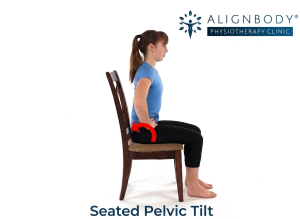
Sit upright at the edge of your chair with feet flat on the floor. Slowly arch your lower back by tilting your pelvis forward (anterior tilt), then gently flatten your lower back by tilting your pelvis backward (posterior tilt). Move through your comfortable range of motion.
- Standing Lumbar Extension (10 reps)
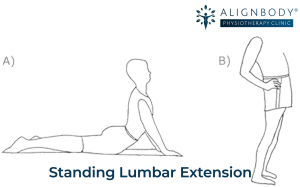
Stand up from your desk and place both hands on your lower back. Gently lean backwards into lumbar extension, holding 2 seconds at end range, then return to neutral.
- Hip Flexor Stretch
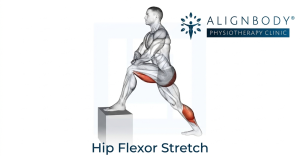
From a standing position, take a long step forward into a lunge. Lower your back knee toward the floor (use a cushion if needed), keeping your trunk upright. Gently push your hips forward until you feel a stretch in the front of the back hip.
- Seated Figure-4 Glute Stretch
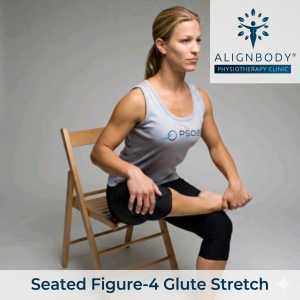
Sit upright in your chair and cross one ankle over the opposite knee. Gently press down on the bent knee and lean slightly forward with a tall, neutral spine. This stretches the piriformis and deep hip rotators – muscles that become tight with prolonged sitting and can contribute to both hip pain and sciatic-type symptoms. This is one of the most universally beneficial desk stretches for lower back and hip pain.
- Glute Bridges (3 sets of 15 reps, daily)
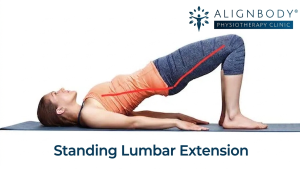
Lie on your back with knees bent and feet flat on the floor. Press through your heels to lift your hips toward the ceiling, squeezing your glutes at the top. Lower slowly. Glute bridges are perhaps the single most important exercise for desk workers with lower back pain.
FAQ’s About Lower Back Pain While Sitting
Q1. Why does my lower back hurt after sitting for just 20 minutes?
Short-duration sitting pain suggests significant lumbar disc sensitivity, possibly early disc degeneration or a posterolateral disc bulge that is provoked by the flexion loading of sitting. It can also indicate lumbar facet joint irritation, which is exacerbated by sustained compression.
Q2. What is the best sitting position for lower back pain?
The best position involves a neutral lumbar spine with the natural inward curve maintained (not flattened or exaggerated), hips at or slightly above knee level, feet flat on the floor, and full back contact with a chair that has adequate lumbar support. A slight recline of 100–110 degrees further reduces intradiscal pressure.
Q3. Is yoga good for lower back pain caused by sitting?
Yes – yoga can be highly beneficial for desk-related lower back pain when practised appropriately. Styles such as Hatha, Yin, and therapeutic yoga improve lumbar flexibility, strengthen core stabilisers, lengthen tight hip flexors and hamstrings, and reduce the psychosocial stress component of pain. However, not all yoga poses are suitable for all back pain presentations.
Q4. Can a bad mattress make lower back pain from desk work worse?
Yes, significantly. Sleep is the primary recovery period for spinal tissues, and a mattress that fails to support neutral spinal alignment can perpetuate the inflammatory and mechanical strain accumulated during the workday. Research supports medium-firm mattresses as optimal for most people with non-specific lower back pain.
Q5. Does drinking more water help with lower back disc pain?
Yes – hydration directly affects disc health. Intervertebral discs are approximately 80% water when healthy, and this hydration provides their shock-absorbing capacity. Throughout the day, spinal loading causes fluid to be expressed from discs; overnight recumbency allows rehydration.
Q6. Is heat or ice better for lower back pain from sitting?
For chronic or recurrent mechanical lower back pain from desk work, which involves muscle tension, stiffness, and reduced tissue circulation rather than acute tissue injury, heat is generally preferable. Heat increases local blood flow, reduces paraspinal muscle spasm, and improves tissue extensibility, making subsequent stretching and exercise more effective. Ice is more appropriate for acute injuries with tissue swelling (within the first 24–48 hours of a new injury).
Conclusion
Lower back pain while sitting at a desk all day is not an inevitable consequence of modern work life – it is a preventable and treatable condition when addressed with knowledge, consistency, and professional guidance. As a physiotherapist, I urge every desk worker to take spinal health seriously: invest in an ergonomic setup, set movement reminders, commit to a daily exercise routine that addresses the key musculoskeletal dysfunctions of sedentary work, and seek professional help early if pain persists or escalates.
The combination of evidence-based sitting posture correction, regular movement breaks, targeted therapeutic exercise, and lifestyle optimisation can transform your experience at the desk – from chronic pain and fatigue to productivity, comfort, and long-term spinal health. Your spine is the structural backbone of your life – give it the attention it deserves.