What Is Dry Needling Therapy?
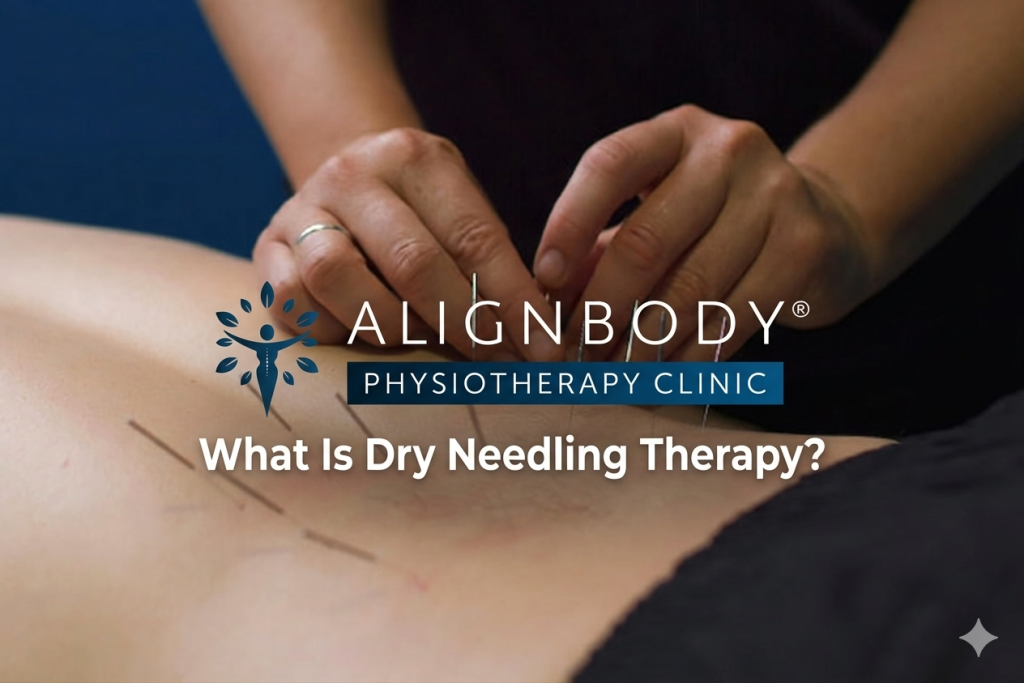
What Is Dry Needling Therapy? How It Works, What to Expect, and Who Actually Benefits
Every week at AlignBody, I get the same question.
“Dr. Richa — is dry needling the same as acupuncture?”
Short answer: No. Not even close.
Same tool — different philosophy, different targets, different science entirely.
Dry needling is one of the most effective treatments I use for patients with stubborn, chronic muscle pain — the kind that doesn’t fully respond to massage, manual therapy, or rest alone.
If you’ve been told you have ‘muscle knots’, tension headaches, persistent neck or shoulder pain, or sciatica that keeps returning, dry needling may be exactly what you’ve been missing.
Let me give you the complete, honest picture.
What Is Dry Needling? The Simple Explanation
Dry needling is a physiotherapy technique where a trained clinician inserts thin, sterile, single-use needles into specific points in the muscle tissue called myofascial trigger points — commonly known as muscle knots.
The word “dry” means the needle contains no medication, fluid, or injection. It’s the needle itself — and the precise neurophysiological response it triggers — that produces the therapeutic effect.
At AlignBody in Delhi, we use dry needling as part of a comprehensive physiotherapy programme. It’s rarely used in isolation — it’s most powerful when combined with manual therapy and corrective exercise. Don’t let chronic pain hold you back- visit AlignBody’s best chiropractic clinic in East Delhi for targeted, root-cause treatment.
What Are Trigger Points? (And Why Do They Cause So Much Pain?)
A trigger point is a hyperirritable spot within a taut band of skeletal muscle. At the microscopic level, it’s a cluster of muscle fibres stuck in a state of sustained contraction — unable to fully release even when you consciously try to relax.
Trigger points cause two distinct types of pain:
- Local pain — tenderness right at the spot itself
- Referred pain — discomfort that radiates to a different part of the body
Trigger points develop from: muscle overuse, repetitive strain, poor posture (desk workers in Delhi, this means you), sports injuries, trauma, prolonged immobilisation, and emotional stress. Discover our Pilates therapy clinic in East Delhi and start your core transformation today.
The Science: How Dry Needling Actually Works
When the needle is inserted precisely into a trigger point, several things happen simultaneously:
- Local twitch response — a brief, involuntary contraction of the muscle fibres. This is the most therapeutic moment. It signals that the needle has located the dysfunctional motor endplate.
- Biochemical reset — the needle disrupts the abnormal electrical activity sustaining the trigger point, allowing muscle fibres to return to their normal resting state.
- Increased blood flow — the micro-trauma created by the needle triggers a healing response, flooding the chronically ischaemic (blood-starved) tissue with oxygenated blood.
- Pain signal interruption — the needle stimulates the release of natural endorphins and other pain-modulating substances, breaking the pain-spasm-pain cycle.
Dry Needling vs Acupuncture: The Definitive Comparison
| Dry Needling | Acupuncture | |
|---|---|---|
| Philosophy | Western medicine/neuroscience | Traditional Chinese Medicine |
| Target | Myofascial trigger points | Acupuncture meridians (energy channels) |
| Goal | Release muscle knots, reduce pain | Restore qi (energy) flow |
| Performed by | Trained physiotherapists | Licensed acupuncturists |
| Evidence | Supported by modern neuroscience | Based on traditional philosophy |
| Placement | Within muscle tissue | Along 12 energy meridians |
Both have legitimate clinical applications. But when a physiotherapist recommends dry needling, it’s for a specific musculoskeletal reason — not an energetic one. AlignBody provides services for physiotherapy at home in Delhi. Explore to get relief from your pain.
What Does a Dry Needling Session Feel Like?
I’m going to be completely honest here — because I know the word “needles” makes many patients immediately anxious.
1. The insertion: A brief, sharp sensation lasting less than a second as the needle enters the skin. Most patients rate it 2–3/10 on the discomfort scale.
2. The twitch response: When the needle reaches the trigger point, you’ll likely feel a brief muscle cramp or squeeze. It can feel intense for 1–2 seconds. This is the most therapeutic part of the whole procedure.
3. After the twitch: A deep, heavy aching sensation in the area. Many patients describe it as a “good hurt” — similar to when someone presses firmly on a very tight muscle.
4. Post-session: Mild muscle soreness for 24–48 hours is completely normal — similar to post-workout muscle soreness. It’s a sign your tissues are responding and healing.
Who Benefits Most from Dry Needling?
At AlignBody’s Delhi clinics, dry needling is particularly effective for:
- Sciatica and lower back pain — releasing deep lumbar and piriformis trigger points (see our sciatica guide for more details)
- Chronic neck pain and cervical stiffness — especially in IT professionals and desk workers
- Tension headaches and migraines — driven by suboccipital and upper trapezius trigger points
- Frozen shoulder — breaking up adhesions and restoring shoulder mobility
- Sports injuries — hamstring strains, rotator cuff issues, tennis elbow, runner’s knee
- Plantar fasciitis — calf and foot trigger points that drive heel pain
- Jaw pain (TMJ disorders) — masseter and pterygoid trigger points
How Many Dry Needling Sessions Will You Need?
| Condition Type | Estimated Sessions |
|---|---|
| Acute injury (under 6 weeks) | 2–4 sessions |
| Subacute/recurring pain | 4–6 sessions |
| Chronic, long-standing pain | 6–10 sessions within a full programme |
| Maintenance/performance | 1–2 sessions monthly |
Most patients notice significant improvement from the first or second session. The full therapeutic effect builds progressively over the course of treatment.
Is Dry Needling Safe?
When performed by a trained physiotherapist, dry needling has an excellent safety profile.
At AlignBody, we use:
- 100% single-use, sterile, hospital-grade needles (never reused)
- Strict clinical hygiene protocols
- Precise anatomical knowledge ensures safe needle placement away from nerves, vessels, and organs
Dry needling is not recommended if you:
- Are pregnant (especially first trimester)
- Have a bleeding disorder or take blood thinners
- Have an active skin infection at the treatment site
- Have a severe needle phobia that prevents relaxation
FAQ’s About Dry Needling Therapy
Q1: Is dry needling the same as an injection?
A: No. Dry needling uses a solid filiform needle with no fluid or medication. Nothing is injected into your body. The only substance involved is the needle itself.
Q2: Does dry needling hurt?
A: There is temporary discomfort — particularly the brief twitch response when the needle reaches a trigger point. Most patients rate it manageable and report that the relief it provides is well worth it.
Q3: How is dry needling different from deep tissue massage?
A: Both can release trigger points, but dry needling reaches much deeper into the muscle tissue with far greater precision, and triggers a neurophysiological response that massage alone cannot replicate.
Q4: Can I exercise after dry needling?
A: Light activity is fine. Avoid intense exercise for 24 hours to allow your muscles to fully respond to the treatment. Gentle walking is actually encouraged.
The Bottom Line
If you have stubborn muscle pain — the kind that keeps coming back no matter what you try — dry needling may be the missing piece in your recovery.
At AlignBody, dry needling is always part of a comprehensive physiotherapy programme designed around your specific pain pattern, not a generic protocol. That’s the difference between temporary relief and lasting recovery.
| Ready to Get Started?
Book your consultation at AlignBody — Delhi’s trusted physiotherapy clinic East Delhi: Jagriti Enclave, Vikas Marg | South Delhi: Vasant Vihar Phone: +91 9310 014 226 | alignbody.in/contacts/ |
| About the Author
Dr. Richa Gupta — Founder & Managing Director, AlignBody Physiotherapy Clinic, Delhi 14+ years of clinical experience. Certified in APBC practice (USA & Thailand), Diploma in Osteopathy (Ontario, Canada), Certified Mat Pilates Instructor (Ireland). Specialist in chronic pain, body alignment, dry needling, and manual therapy. AlignBody has helped 20,000+ patients across Delhi NCR live pain-free lives. |