What Is Dry Needling Treatment?
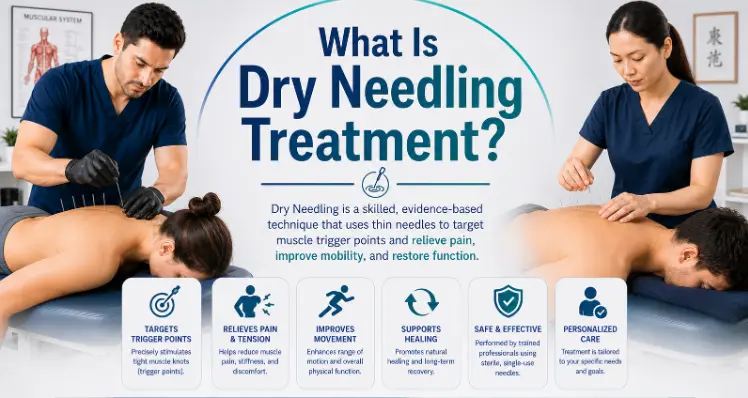
Dry needling treatment is a modern physiotherapy technique where thin sterile needles are inserted into tight, painful muscle knots called trigger points. The needle stimulates the trigger point to release, restoring muscle function and reducing pain without any medication. At AlignBody, Delhi, certified practitioners perform dry needling for back pain, neck pain, shoulder pain, sciatica, and sports injuries.
You have probably heard of dry needling. Maybe your physiotherapist recommended it. Maybe a colleague swears by it for their shoulder pain. Or maybe you just spotted it on a clinic’s service list and had no idea what it meant.
The name does not help. It sounds vague. It sounds a bit uncomfortable. And for most people in India, it is still genuinely unfamiliar.
This guide explains everything clearly. What it is, how it works, what it treats, whether it hurts, how it differs from acupuncture, and whether it is right for you.
What Is Dry Needling Therapy?
Dry needling therapy is a clinical treatment where a physiotherapist inserts a very thin, solid filament needle directly into a trigger point inside a muscle.
A trigger point is a tight, hyperirritable spot within a muscle. You likely know it as a knot. It is a small area where the muscle fibres have contracted and become unable to relax fully. These knots are often tender to touch, and pressing on them can cause pain that radiates to other parts of the body.
The needle has no medication in it. Nothing is injected. That is why it is called dry needling. The needle itself is the therapeutic tool. Its insertion into the trigger point causes a localised healing response that breaks the muscle’s contraction and restores normal function.
Dry needling is a Western medicine technique grounded in anatomy, neuroscience, and evidence-based physiotherapy. It is not acupuncture, and it is not related to traditional Chinese medicine. We will address that distinction in detail below.
At AlignBody’s dry needling clinic in East Delhi, we use two approaches: trigger point dry needling for localised muscle pain, and neuro-myoskeletal dry needling for conditions involving both the muscular and nervous system.
What Is Dry Needling and How Does It Work?
Here is the mechanism, explained plainly.
When a muscle becomes overloaded, through repetitive movement, sustained posture, injury, or stress, groups of muscle fibres go into a sustained contraction. The blood supply to these contracted fibres is reduced. Without adequate blood flow, the tissue becomes acidic and oxygen-starved. The muscle stays in a state of metabolic crisis, unable to release on its own.
The physiotherapist locates this trigger point through palpation, feeling for the taut band of fibres and identifying the most tender central point. The dry needle is then inserted precisely into that spot.
What happens next is called a local twitch response: a brief, involuntary contraction of the trigger point fibres followed by immediate relaxation. Most patients feel this as a quick deep ache or cramping sensation that lasts only a second or two. The twitch itself is a positive sign that the needle has hit the right spot.
What Happens Physiologically After the Twitch
- Blood flow returns to the starved muscle fibres, flushing out the accumulated metabolic waste products causing the pain
- Muscle tension drops as the contracted fibres finally release their sustained contraction
- Pain signals reduce as the needle stimulates nerve fibres that block pain transmission through the gate control mechanism
- Endorphins release naturally in response to the needle stimulus, providing additional pain relief
- Range of motion improves immediately as the muscle returns to its normal resting length
The whole process is fast. A typical dry needling session lasts 20 to 40 minutes. The needles may be left in place for 10 to 20 minutes after insertion, or they may be inserted and immediately removed depending on the technique used and the patient’s sensitivity.
What Does Dry Needling Do?
In practical terms, here is what dry needling achieves for patients:
- Releases tight muscle knots (trigger points) that have not responded to massage, stretching, or other manual therapy
- Reduces localised muscle pain and the referred pain patterns that trigger points create
- Restores the muscle’s full range of motion by resolving the sustained contraction
- Reduces protective muscle spasm that develops around an injured joint or disc
- Improves the effectiveness of subsequent exercise and rehabilitation by removing the muscular barrier to full movement
- Reduces headache frequency when the source is trigger points in the neck, upper trapezius, or suboccipital muscles
- Accelerates sports injury recovery by addressing the muscular component of the injury directly
Dry needling alone can produce immediate pain relief, but that relief is not permanent without addressing the underlying causes of the trigger points. At AlignBody, dry needling is always combined with corrective exercise, postural assessment, and manual therapy. The needle breaks the pain cycle. The rehabilitation programme stops it from coming back.
What Conditions Does Dry Needling Treat?
Dry needling is appropriate for any condition involving myofascial trigger point pain. Here is a comprehensive breakdown of what our team treats at AlignBody:
| Condition | How Dry Needling Helps | Combined With |
|---|---|---|
| Lower back pain | Releases trigger points in the lumbar erectors, quadratus lumborum, and gluteal muscles | Spinal mobilisation and core strengthening |
| Neck pain and cervical stiffness | Releases the trapezius, levator scapulae, and suboccipital muscles driving neck pain and stiffness | Cervical mobilisation and postural correction |
| Shoulder pain and frozen shoulder | Releases rotator cuff trigger points and the pectoralis minor, a major contributor to frozen shoulder and impingement | Shoulder mobilisation and progressive loading |
| Sciatica | Releases piriformis and deep gluteal trigger points compressing the sciatic nerve | Spinal adjustment and nerve gliding exercises |
| Tension headaches and migraines | Targets trigger points in the suboccipitals, trapezius, and temporalis muscles driving referred head pain | Cervical manipulation and postural retraining |
| Sports injuries | Addresses muscle strains and the satellite trigger points that develop around the primary injury site | Sports-specific rehabilitation via sports physiotherapy |
| Knee pain | Releases VMO, IT band, and quadriceps trigger points contributing to patellofemoral pain | Biomechanical assessment and strengthening |
| Plantar fasciitis | Targets trigger points in the intrinsic foot muscles and the gastrocnemius-soleus complex | Foot strengthening and offloading strategies |
| Disc herniation | Reduces secondary muscle spasm around the herniated disc level, improving comfort during rehabilitation | Spinal decompression and physiotherapy |
| Chronic muscle tension | Treats entrenched trigger points that have not responded to massage or stretching over months or years | Myofascial release therapy and corrective exercise |
What Are the Benefits of Dry Needling?
Dry needling offers several clear advantages over other soft tissue treatments:
- Reaches deep muscle trigger points that hands cannot access effectively
- Produces immediate pain reduction in most patients
- Restores full range of motion faster than passive stretching
- Reduces the protective muscle guarding that limits rehabilitation progress
- Effective for both acute and chronic trigger point pain
- No medication required: no side effects, no prescriptions
- Sessions are short (20 to 40 minutes)
- Results are often felt within the first 1 to 3 sessions
- Works well alongside chiropractic, physiotherapy, and manual therapy
- Suitable for most adults regardless of age or fitness level
Is Dry Needling the Same as Acupuncture?
No. This is the most common misconception about dry needling, and it is worth addressing clearly.
Both dry needling and acupuncture use very thin needles. That is where the similarity ends.
| Factor | Dry Needling | Acupuncture |
|---|---|---|
| Origin | Western medicine (1979, USA) | Traditional Chinese medicine (thousands of years old) |
| Basis | Anatomy, neuroscience, and musculoskeletal physiology | Energy flow through meridians and traditional Chinese medicine theory |
| Target | Specific myofascial trigger points in muscles, identified through clinical palpation | Acupuncture points along energy meridians, mapped by TCM tradition |
| Goal | Release muscle trigger points, reduce pain, restore movement | Restore the flow of qi (energy), treat systemic conditions |
| Practitioner | Certified physiotherapist or chiropractor with specific dry needling training | Licensed acupuncturist trained in TCM |
| Evidence base | Supported by clinical research in musculoskeletal pain management | Evidence varies by condition; strong for some, limited for others |
| Needles used | Solid filament needles, same type as acupuncture needles | Solid filament needles |
At AlignBody, our practitioners are physiotherapists trained specifically in dry needling as a musculoskeletal technique. We do not practice acupuncture. If you are looking for acupuncture, we would direct you to a licensed acupuncturist. If you have a muscular or joint pain problem, dry needling with our team is likely to be the more appropriate choice.
Is Dry Needling Safe?
Yes, when performed by a trained and certified practitioner, dry needling is a safe treatment with a very low rate of serious adverse events.
Common and Expected Side Effects
- Muscle soreness: A bruised, aching sensation in the treated area lasting 24 to 48 hours. This is the most common response and is a sign the trigger point was successfully activated.
- Slight bruising: Occasional and minor, particularly in areas with thin skin or in patients on blood-thinning medications.
- Temporary pain increase: Some patients experience a brief increase in pain before it improves. This typically resolves within 24 hours.
- Mild fatigue or light-headedness: Usually brief and resolves within an hour of the session.
- Patients with a needle phobia or inability to consent to the procedure
- Active infection, skin breakdown, or open wounds at the treatment site
- Pregnancy (treatment near the abdomen and lumbar spine is contraindicated)
- Severe bleeding disorders or patients on anticoagulant therapy (with medical clearance required)
- Active cancer in or near the treatment area
- Children under 16 (relative contraindication, assessed case by case)
At AlignBody, every patient is screened for contraindications before their first session. We never proceed without a full clinical assessment.
Does Dry Needling Hurt?
This is what almost every patient wants to know before their first appointment. The honest answer is: it depends on the trigger point, but it is far less uncomfortable than most people expect.
Needle insertion
The needles are extremely thin, much thinner than an injection needle. Most patients do not feel the needle entering the skin at all. There may be a slight prick sensation as it passes through, but it is minimal.
Reaching the trigger point
When the needle reaches an active trigger point, you will usually feel a brief, deep aching or cramping sensation. This is the local twitch response. It lasts one to three seconds and then subsides. Patients often describe it as an intense but brief muscle cramp that immediately relaxes.
While the needle is in place
After the initial twitch, most patients feel very little. Some feel a dull ache in the area. The needle is often barely noticeable once the trigger point has released.
After the session
Expect muscle soreness in the treated area for 24 to 48 hours. Staying well hydrated and applying a warm pack to the area helps. Light movement is encouraged. Avoid intense exercise on the same day.
The level of discomfort varies with how irritable the trigger point is and how sensitive the patient is. At AlignBody, our practitioners calibrate needle depth and technique to each patient’s tolerance. You are always in control and can ask us to stop at any point.
What Happens in Your First Dry Needling Session?
Here is exactly what to expect from start to finish at AlignBody:
Clinical assessment (10 to 15 min)
Your physiotherapist takes a full history of your pain, reviews your posture and movement patterns, and identifies the trigger points most likely driving your symptoms. They explain what they have found and what the treatment will involve before any needles come out.
Contraindication screening
A brief safety check covering medications, medical history, and any reasons dry needling may not be appropriate for you at this time.
Treatment (15 to 25 min)
Single-use sterile needles are inserted into the identified trigger points. Your practitioner monitors your response and adjusts the technique based on how each trigger point responds. Needles may be left in for 10 to 20 minutes or removed immediately depending on the approach used.
Post-treatment assessment
Your physiotherapist reassesses your range of motion and pain levels immediately after treatment. Most patients notice a measurable difference in mobility straight away.
Aftercare guidance and exercise prescription
You receive specific aftercare advice covering hydration, gentle movement, and what to avoid for 24 hours, plus any initial corrective exercises to begin between sessions.
How Many Dry Needling Sessions Do I Need?
The number of sessions depends on how long you have had the trigger points, how many there are, and how your body responds to treatment.
| Condition | Typical Sessions | Progress Timeline |
|---|---|---|
| Acute muscle pain or strain | 1 to 3 sessions | Significant improvement often after session 1 |
| Subacute pain (4 to 8 weeks) | 3 to 6 sessions | Steady improvement over 3 to 5 weeks |
| Chronic trigger point pain (3+ months) | 6 to 10 sessions | Gradual improvement; multiple trigger points need sequential treatment |
| Neck pain and headaches | 3 to 6 sessions | Headache frequency often reduces within first 2 to 3 sessions |
| Shoulder pain and frozen shoulder | 4 to 8 sessions | Range of motion improves measurably within first 3 sessions |
| Lower back pain | 3 to 8 sessions | Depends on whether disc or joint involvement accompanies the trigger points |
| Sports injury recovery | 3 to 6 sessions | Faster recovery when combined with sport-specific rehabilitation |
Most patients notice meaningful improvement within the first 1 to 3 sessions. If you are not seeing any change after 4 sessions, the treatment approach needs to be reviewed. At AlignBody, we reassess your response after every session and adjust accordingly.
Dry Needling at AlignBody, Delhi NCR
AlignBody offers two levels of dry needling:
- Trigger point dry needling: Direct treatment of myofascial trigger points for localised muscle pain, sports injuries, and postural conditions.
- Neuro-myoskeletal dry needling: A more advanced approach targeting both the muscular and nervous system components, used for conditions like chronic pain, nerve-related symptoms, and complex musculoskeletal presentations.
Dr. Richa Gupta, our lead clinician, holds specialist postgraduate certifications in both approaches. Dry needling is always integrated with our broader clinical assessment rather than used as a standalone procedure.
We use only single-use sterile needles. No needle is ever reused. All practitioners follow strict clinical hygiene protocols at both our East Delhi (Jagriti Enclave) and South Delhi (Vasant Vihar) clinics. Home visit dry needling is also available across Delhi NCR.
Chronic Muscle Pain That Is Not Getting Better?
Dry needling works on the trigger points driving your pain at their source. Book a clinical assessment at AlignBody Delhi and we will tell you whether dry needling is right for your condition before any treatment begins.
Book a Consultation
+91 9310 014 226