Disc Bulge Exercises: What to Do and What to Strictly Avoid
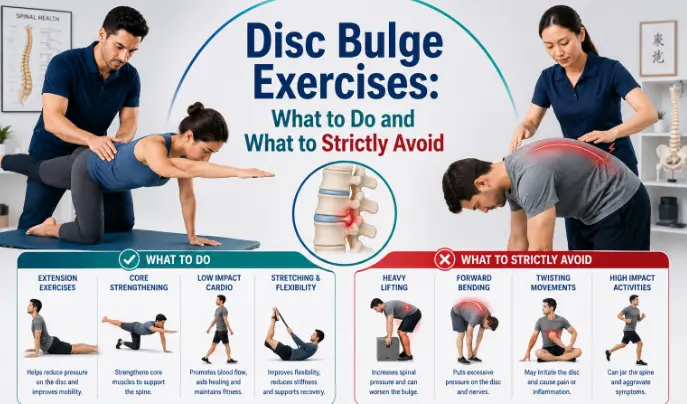
The safest exercises for a disc bulge are walking, gentle knee-to-chest stretches, pelvic tilts and the McKenzie extension press-up. You must avoid heavy lifting, forward bending under load, sit-ups and high-impact activities during an active flare. A physiotherapy assessment tells you exactly which exercises apply to your specific disc level and direction of bulge before you start any programme at home.
If you have been told you have a disc bulge, the first question most people ask is whether they should rest completely or keep moving. The short answer is that rest is rarely the right choice and movement done correctly is almost always better. But not all movement is equal and doing the wrong exercises at the wrong stage of healing can genuinely make a disc bulge worse.
This guide explains the anatomy of a disc bulge, which exercises help and why, which exercises you should never do when you have this condition and what a proper physiotherapy-led exercise programme looks like at AlignBody in Delhi. If you are still unclear about what is causing your back symptoms in the first place, our article on why lower back pain hurts covers the most common root causes.
What Is a Disc Bulge and Why Does Exercise Matter?
The discs between your vertebrae are made of a tough outer ring called the annulus fibrosus and a soft gel-like centre called the nucleus pulposus. When the outer ring weakens or develops small tears, the inner material can push outward into the spinal canal. This is a disc bulge. Many patients are unsure how this differs from a slipped or herniated disc – read our detailed comparison of slip disc vs herniated disc to understand where a disc bulge fits.
At certain points in the day, particularly when you sit for long periods or bend forward repeatedly, the pressure inside the disc increases significantly. The wrong exercises load the disc in exactly the direction that makes the bulge worse. The right exercises reduce intradiscal pressure, strengthen the muscles that support the spine and gradually help the disc material retract.
Exercise is not optional in disc bulge recovery. It is the main treatment. Passive treatments like heat or medication manage the symptoms. Exercise is what actually changes the underlying problem over time. For a broader understanding of how physiotherapy treatment for back pain works beyond exercises alone, see our dedicated guide.
Exercises That Are Safe for Disc Bulge
The exercises below are generally well tolerated and supported by physiotherapy evidence for disc bulge. However, each person’s disc bulge is different in terms of level, direction and severity. Always confirm with your physiotherapist before starting any programme.
1. Walking
Short, regular walks are one of the best things you can do for a disc bulge. Walking encourages fluid movement through the disc, activates the stabilising muscles of the spine and promotes healing without overloading the damaged tissue. Start with 10 to 15 minutes and build gradually.
2. Knee-to-Chest Stretch
Lie flat on your back. Bring one knee gently toward your chest and hold for 20 to 30 seconds. Repeat with the other side. This gently decompresses the lower lumbar segments and reduces muscle spasm around the disc. Most patients with L4-L5 or L5-S1 disc bulges find relief from this exercise.
3. Pelvic Tilts
Lie on your back with knees bent and feet flat. Gently flatten your lower back against the floor by tightening your abdominal muscles. Hold for 5 seconds and release. This activates the deep core muscles that protect the spine without loading the disc in a harmful direction.
4. McKenzie Extension Press-Up
This is one of the most evidence-based exercises for posterior disc bulges. Lie face down with your hands under your shoulders. Slowly push your upper body up while keeping your pelvis on the floor. Hold for a few seconds and lower down. If your symptoms reduce or centralise toward the back rather than radiating down the leg, this exercise is likely helping.
The McKenzie method requires a proper assessment by a trained physiotherapist to confirm you are pressing in the right direction for your specific disc bulge. Not all disc bulges respond the same way to extension.
5. Cat-Cow Stretch
This gentle spinal mobility exercise is safe for most disc bulge patients in the subacute phase. On all fours, arch your back gently toward the ceiling (cat) then let it sag gently downward (cow). Move slowly and stay within a comfortable range. This keeps the spinal segments mobile without placing compressive load on the disc.
6. Bird Dog
From an all-fours position, extend one arm forward and the opposite leg backward simultaneously. Hold for 5 seconds and alternate sides. This activates the multifidus and deep core muscles that directly support the lumbar spine. It is one of the most recommended exercises in clinical physiotherapy for disc-related back pain.
7. Partial Curl-Up
This is different from a full sit-up. Lie on your back with one knee bent and the other leg straight. Place your hands under the small of your back to maintain its natural curve. Lift only your head and shoulders slightly off the floor. This activates the abdominals without the dangerous flexion load of a full sit-up.
For a complete core rehabilitation plan that builds on these exercises, explore our guide on core strengthening exercises for back pain.
Exercises to Avoid with a Disc Bulge
These exercises increase intradiscal pressure, load the spine in flexion under force or place the disc in a position where the bulge can worsen. Avoid them during active symptoms and until your physiotherapist confirms the disc is stable.
| Exercise to Avoid | Why It Is Harmful | Safer Alternative |
|---|---|---|
| Full sit-ups and crunches | Extreme spinal flexion under load compresses the anterior disc and forces the bulge posteriorly | Partial curl-up or dead bug |
| Deadlifts and heavy barbell lifting | Compressive axial load combined with flexion is the highest-risk movement for disc injury | Bodyweight bird dog or resistance band exercises in neutral spine |
| Touching toes with straight legs | Full forward flexion with a straight spine maximises intradiscal pressure in the lumbar region | Knee-to-chest stretch or seated hamstring stretch with supported back |
| Leg press with heavy weight | The combined hip flexion and spinal loading reproduces the pressure pattern that causes disc injury | Glute bridge or clamshell for hip strengthening without spinal compression |
| Running on hard surfaces | Impact loading during a flare increases disc pressure with each stride | Swimming or walking on softer surfaces |
| Twisting with load (golf swing, rotational machines) | Combined axial rotation and compression is the movement pattern most associated with disc annular tears | Core stability in neutral spine first before any rotational training |
| High-impact jumping or plyometrics | Repeated compressive impact during an active disc bulge delays healing | Low-impact cycling or aquatic physiotherapy |
Exercises for Specific Disc Levels
L4-L5 Disc Bulge Exercises
L4-L5 is the most commonly affected level in the lumbar spine. Disc bulge here often affects the L5 nerve root causing pain or numbness radiating to the outer shin and top of the foot. The safest exercises at this level are pelvic tilts, bird dog, McKenzie press-up and walking. Avoid forward bending and sit-ups completely until your physiotherapist clears you.
L5-S1 Disc Bulge Exercises
L5-S1 bulges often affect the S1 nerve root causing pain into the calf and outer heel. The same principles apply. Extension-based exercises (McKenzie method) are usually beneficial. Any exercise that involves sustained forward bending or loaded rotation should be avoided in the early stages. This nerve root pain is closely related to sciatica pain treatment – in severe cases where radiation is significant, a combined approach may be needed.
Cervical Disc Bulge Exercises
For neck disc bulges at C5-C6 or C6-C7, the exercise approach is different from lumbar bulges. Chin tucks, gentle neck rotations in a pain-free range and scapular retractions are generally safe. Overhead pressing, heavy shoulder exercises and any activity that increases arm or hand symptoms should be stopped and reassessed by a physiotherapist. Patients with cervical disc bulges often also present with cervical spondylosis – understanding this overlap helps in managing symptoms more effectively. If your cervical disc bulge is accompanied by stiffness, our article on neck pain and cervical stiffness explains what to expect and how physiotherapy helps.
How Many Times a Day Should You Exercise for Disc Bulge?
In the acute phase (first two to four weeks), gentle exercises two to three times daily for short sessions of 10 to 15 minutes each is typically appropriate. As symptoms reduce and stability improves, sessions can become more structured and progressive.
The key principle is that exercise should not increase your radiating pain. Localised back discomfort that reduces after exercise is acceptable and expected. Symptoms that travel further down the leg or into the arm during exercise mean you are loading the disc in the wrong direction and you need reassessment.
When Should You Stop Exercising and See a Physiotherapist?
Stop exercising and book an urgent physiotherapy assessment if:
- Leg or arm pain increases significantly during or after exercise
- You develop numbness or weakness in the legs or feet
- You lose bladder or bowel control (this requires emergency medical assessment immediately)
- Pain is severe and constant rather than activity-related
- You have been doing exercises for two weeks with no improvement at all
The Role of Physiotherapy in Disc Bulge Exercise Programmes
The exercises listed in this guide are a starting framework. What makes a disc bulge exercise programme effective is that it is specific to your disc level, the direction of your bulge, the severity of your nerve involvement and your current strength and mobility baseline.
At AlignBody in Delhi, we assess disc bulge patients thoroughly before prescribing any exercise programme. We use the McKenzie assessment methodology to identify the directional preference of your disc which tells us exactly which movements will help and which will harm. We combine this with manual therapy to reduce pain and neural mobilisation if nerve root involvement is present.
A home exercise programme without a proper assessment is guesswork. A properly assessed and progressively loaded programme is what actually resolves disc bulge over time in most cases without surgery.
Can Exercise Heal a Disc Bulge Permanently?
Many disc bulges do resolve with the right exercise programme and time. Research shows that disc bulges can reduce in size and the nuclear material can retract as the annulus heals. A 2019 study in the Journal of Orthopaedic and Sports Physical Therapy found that the majority of patients with lumbar disc bulges treated with physiotherapy-guided exercise avoided surgery and showed significant functional improvement at six months.
The timeline depends on the severity of the bulge, the disc level, your age and how consistently you follow your exercise programme. Mild to moderate disc bulges often show significant improvement within six to twelve weeks of structured physiotherapy.
Disc Bulge Exercise Programme at AlignBody, Delhi
If you have a disc bulge and are not sure which exercises are right for your specific level and direction of bulge, book a clinical assessment at AlignBody. We see patients at our physiotherapy clinic in East Delhi (Jagriti Enclave) and our physiotherapy clinic in South Delhi (Vasant Vihar). Home visit physiotherapy is available for patients who find travel difficult during an acute flare.
Your assessment will include a directional preference analysis using the McKenzie method, neural tension testing if leg symptoms are present and a specific exercise prescription that is safe for your disc from day one.
Book a Disc Bulge Assessment at AlignBodyEast Delhi: Jagriti Enclave | South Delhi: Vasant Vihar | Home Visit Available
Call: +91 9310 014 226