Safe Disc Bulge Home Exercises: A Physiotherapist’s Guide
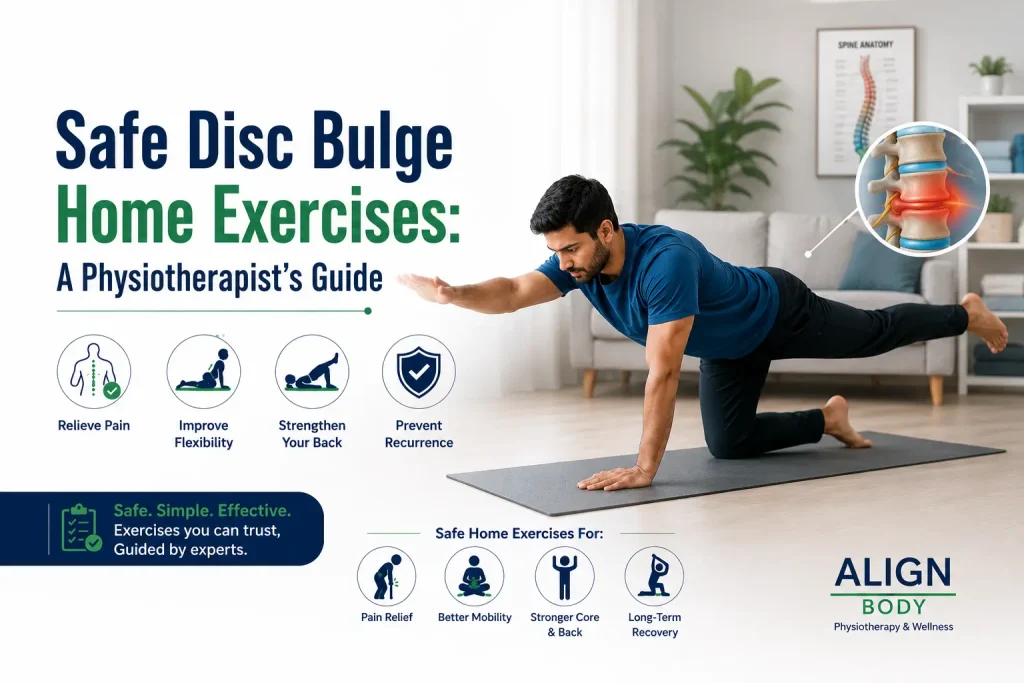
Safe home exercises for disc bulge include the McKenzie press-up, knee-to-chest stretch, pelvic tilt, bird dog and walking. These can be started as soon as your pain is manageable and should be done two to three times daily. Always have a clinical assessment first to confirm which direction of movement is right for your specific disc level before starting any home exercise programme.
Home exercises are the backbone of disc bulge recovery. Clinic sessions with your physiotherapist provide the manual therapy, assessment and progression. But the real work happens at home, done consistently every day between sessions.
The challenge is knowing which home exercises are safe and appropriate for your specific situation. The wrong exercises can worsen disc symptoms. The right ones, done correctly, accelerate recovery significantly.
Rule One: Assessment Before Exercises
Before starting any home exercise programme for a disc bulge, you need a proper clinical assessment. This is not about being cautious for the sake of it. It is because different disc bulges respond to different movements. An L4-L5 posterior bulge usually responds well to extension exercises. An anterolateral disc bulge may need a different approach entirely.
Without an assessment, you are guessing. A McKenzie physiotherapy assessment takes about one hour and tells you exactly which home exercises to do and which to avoid. Learn more about what physiotherapy can do for disc bulge. This is the single most important thing you can do before starting.
Safe Home Exercises for Most Disc Bulges
The following exercises are appropriate for most posterior lumbar disc bulges once you have had a clinical assessment confirming extension as your directional preference. They are to be done gently and within a pain-free or low-pain range.
1. McKenzie Extension Press-Up (Prone on Elbows)
Start by lying face down with your elbows under your shoulders. Hold this position for 30 to 60 seconds. As comfort allows, progress to pressing up onto your hands while keeping your hips on the floor. This is the foundational exercise for posterior lumbar disc bulges.
Do this 10 times, holding the top position for 1 to 2 seconds. Perform two to three sets throughout the day. The key sign that it is helping: any radiating pain in your leg should reduce or centralise back toward the lower back during or after the exercise.
2. Knee-to-Chest Stretch
Lie on your back with knees bent. Gently bring one knee toward your chest and hold for 20 to 30 seconds. This gently decompresses the lower lumbar segments and relieves muscle spasm. Repeat with the other leg and then with both knees together.
If this increases your leg pain, stop and inform your physiotherapist. For most posterior disc bulges this stretch is comfortable and helpful.
3. Pelvic Tilt
Lie on your back with knees bent and feet flat. Gently tighten your abdominal muscles and flatten your lower back against the floor. Hold for 5 seconds and release. Repeat 10 to 15 times.
This activates the deep core muscles that stabilise the lumbar spine without loading the disc. It is one of the safest and most universally appropriate exercises for any disc problem.
4. Bird Dog
Start on all fours with hands under shoulders and knees under hips. Slowly extend one arm forward and the opposite leg backward until both are parallel to the floor. Hold for 3 to 5 seconds and return slowly. Alternate sides.
Keep your spine completely neutral throughout. Do not allow the lower back to arch or rotate. This exercise activates the multifidus and transversus abdominis muscles that directly support the lumbar disc.
5. Walking
Regular short walks are genuinely therapeutic for disc bulge. They load the spine through natural movement patterns, activate the core and reduce stiffness without harmful compressive loading. Start with ten to fifteen minutes and build gradually. Walk on flat surfaces and avoid hills or stairs if they increase your symptoms initially.
6. Side-Lying Knee Opening (Clam)
Lie on your side with hips bent to about 45 degrees and knees stacked. Keep your feet together and slowly rotate your top knee upward like a clamshell opening. Hold for 2 seconds and lower. Repeat 15 times on each side.
This activates the gluteal muscles that support the lumbar spine. Hip weakness is very common in patients with disc problems and contributes to the mechanical stress at the disc level.
How Often Should You Do Home Exercises for Disc Bulge?
In the acute phase (first two to four weeks), short exercise sessions done two to three times daily are more effective than one longer session. Ten to fifteen minutes each session is enough. As you improve, the programme becomes more progressive and sessions become longer but less frequent.
Consistency is more important than duration. Doing five minutes of the right exercises three times daily is better than doing thirty minutes once every few days.
Exercises to Avoid at Home with a Disc Bulge
For a detailed breakdown of safe and harmful movements, see our full guide on disc bulge exercises: what to do and what to strictly avoid.
- Full sit-ups and crunches: these maximise intradiscal pressure in flexion
- Toe touches with straight legs: forward flexion under load worsens most posterior disc bulges
- Heavy lifting of any kind
- Running or any high-impact exercise during active symptoms
- Any exercise that increases your radiating pain into the leg or arm
When Your Home Exercises Are Not Working
If you have been doing home exercises consistently for two weeks and your symptoms are not improving, or if your lower back pain is worsening, you need reassessment. The exercises may need to be modified or the direction may need to change. Do not continue with an exercise programme that is not producing results or that is making things worse. Explore your options for non-surgical slip disc treatment in Delhi.
Book a Disc Bulge Assessment at AlignBody, DelhiGet a specific home exercise programme from your first session. East Delhi: Jagriti Enclave | South Delhi: Vasant Vihar | +91 9310 014 226