Shockwave Therapy vs Physiotherapy
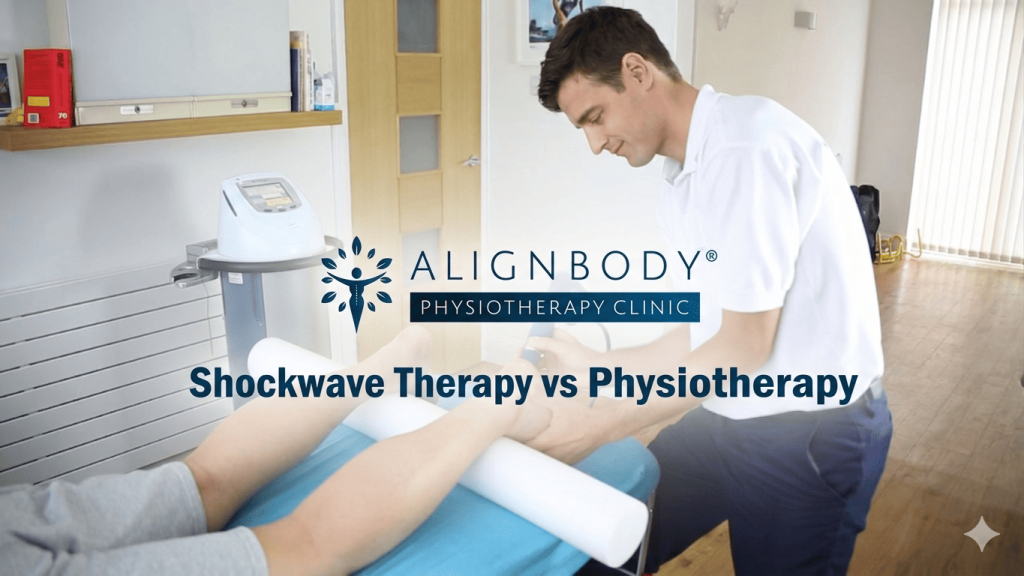
Shockwave Therapy vs Physiotherapy — Which One Is Right for You? A Delhi Physiotherapist’s Honest Answer
This question lands in my inbox almost every week.
A patient has been to physiotherapy for 3 months. Their Achilles tendon still hurts. Someone tells them about shockwave therapy, and they want to know: “Is it better than what I’ve already been doing? Should I switch? Should I have started with it?”
Here’s the honest answer — the one that doesn’t try to sell you one over the other.
They are not competitors. They are different tools that operate through distinct mechanisms, address different aspects of musculoskeletal pain, and produce different types of outcomes. The question isn’t which one is better. The question is which one your condition needs — and whether it needs both.
I’m Dr. Richa Gupta, founder of AlignBody Physiotherapy Clinic in Delhi. We use both shockwave therapy and physiotherapy at our clinics across East Delhi and South Delhi — and I want to explain clearly how each one works, where the evidence actually stands, and how to make the right decision for your specific situation.
How They Work — The Fundamental Difference
Before comparing outcomes, you need to understand the biological mechanism behind each. Because this is where the comparison actually begins.
What Physiotherapy Does
Physiotherapy is rehabilitation. It restores function, corrects movement patterns, strengthens muscles, and retrains the neuromuscular system. It works by:
- Increasing strength in muscles that are underloading the injured structure
- Improving flexibility in tissues that restrict movement
- Restoring joint mobility through manual therapy and mobilisation techniques
- Retraining movement patterns so the body stops loading the painful structure incorrectly
- Educating the patient on ergonomics, activity modification, and self-management
Physiotherapy works brilliantly for acute injuries, post-surgical rehabilitation, muscle imbalances, postural disorders, and early-stage tendon conditions. It requires active patient participation and produces results over weeks to months of progressive loading. Struggling with leg pain or numbness? Discover effective sciatica pain treatment in Delhi.
What Shockwave Therapy Does
Shockwave therapy is tissue regeneration. It uses high-energy acoustic waves to stimulate a biological healing response at the cellular level in tissue that has stopped healing on its own. It works by:
- Triggering neovascularisation — new blood vessel formation, restoring oxygen supply to degenerate tissue
- Activating fibroblasts — the cells that produce collagen, restarting the tissue repair process
- Breaking down calcium deposits and fibrous scar tissue adhesions
- Reducing Substance P — a neuropeptide directly involved in pain signal transmission
- Creating controlled microtrauma that ‘tricks’ the body into treating a chronic injury as a fresh acute one
Shockwave therapy works for chronic, degenerative conditions — tendinopathies, calcific deposits, and tissue that has failed to heal despite weeks or months of conventional treatment. It requires no active participation from the patient and produces results over 6 to 12 weeks as the biological repair process completes. Take the first step towards relief—know more about arthritis treatment today.
Head-to-Head: Shockwave Therapy vs Physiotherapy
| Shockwave Therapy (ESWT) | Physiotherapy |
|---|---|
| Non-invasive, no needles, no surgery | Non-invasive, no needles, no surgery |
| Works through acoustic energy applied externally | Works through movement, loading, manual techniques |
| Passive — patient lies still during treatment | Active — patient exercises, participates in rehabilitation |
| 3 to 6 sessions typically sufficient | 8 to 20+ sessions often required for full rehabilitation |
| Each session: 5 to 15 minutes active treatment | Each session: 45 to 60 minutes typically |
| Targets degenerate, non-healing tissue directly | Targets muscle imbalance, movement dysfunction, strength |
| Most effective for: chronic tendinopathy, calcific deposits, plantar fasciitis | Most effective for: acute injuries, post-surgical rehab, postural disorders, muscle weakness |
| Results continue 6 to 12 weeks after last session | Results maintained with continued home exercise programme |
| Does not rebuild strength or correct movement patterns | Does not trigger cellular tissue regeneration |
| Not appropriate for: acute injuries, pregnancy, blood thinners, cancer in area | Not sufficient alone for: chronic tendinopathy unresponsive to exercise |
What the Research Actually Shows — Condition by Condition
This is where I want to be precise — because the research does not show a single winner across all conditions. It shows that each approach has specific strengths, and the evidence changes depending on what you’re treating. Our sports physiotherapy team manages paediatric sports injuries regularly and can advise on the safest approach.
1. Plantar Fasciitis and Heel Pain
This is the condition with the strongest evidence for shockwave therapy over conventional physiotherapy alone. A 2020 PMC study and multiple meta-analyses consistently show ESWT outperforming physiotherapy (including TENS, ultrasound, and exercise) for chronic plantar fasciitis, particularly where symptoms have persisted beyond 3 to 6 months.
A key 2024 meta-analysis comparing ESWT against six conservative treatments found it significantly outperformed placebo and equalled or exceeded steroid injections in medium-to-long term outcomes, with none of the tissue-thinning risks associated with repeated steroid use.
2. Achilles Tendinopathy
For mid-portion Achilles tendinopathy, the gold-standard treatment is eccentric loading — a specific physiotherapy exercise programme. ESWT is a powerful adjunct when the tendon is not responding to loading alone. Multiple RCTs show that the combination of ESWT plus eccentric exercise consistently outperforms either alone.
For insertional Achilles tendinopathy (pain right at the heel-bone junction), shockwave therapy has strong evidence and is often more effective than eccentric loading alone, because the insertional zone has poor blood supply and limited healing capacity without external stimulus.
3. Calcific Shoulder Tendinitis
This is a condition where shockwave therapy clearly outperforms physiotherapy. A 2023 narrative review synthesising 18 studies (1,600+ patients) confirmed that shockwave therapy produced significantly greater pain and function improvement than TENS, exercise, and conventional physiotherapy at 3 and 6 months. The mechanism is direct — shockwave energy breaks down calcium deposits in the rotator cuff tendon, reducing the mechanical irritation that causes pain.
Physiotherapy alone cannot dissolve calcium deposits. This is a fundamental biological limitation, not a technique failure.
4. Proximal Hamstring Tendinopathy
A landmark 2025 RCT from La Trobe University (Rich et al.) compared individualised physiotherapy versus shockwave therapy in 100 patients with proximal hamstring tendinopathy over 52 weeks. The finding: no significant difference between the two. Both produced comparable improvements in pain and function.
What this means clinically: for proximal hamstring tendinopathy, shockwave therapy is as effective as physiotherapy, but not clearly superior. The practical implication is that patient preference, access, and cost become relevant factors when both options produce similar outcomes.
5. Chronic Low Back Pain
A well-designed PMC study randomising 91 patients with chronic lower back pain found that ESWT was superior to conventional physiotherapy (TENS, hot pack, ultrasound) on pain, disability, spinal mobility, and quality of life — both at 1 week and 12 weeks post-treatment.
Important nuance: the comparison was ESWT versus passive physiotherapy modalities (heat, TENS, ultrasound) — not against active exercise-based physiotherapy. Exercise therapy remained part of both groups. The finding is that adding ESWT produces better outcomes than passive modalities alone for chronic LBP.
6. Lateral Epicondylosis (Tennis Elbow)
A 2025 RCT with 24-month follow-up (Lhee et al.) comparing physiotherapy, ESWT, prolotherapy, and PRP for chronic lateral epicondylosis found that at 24 months, physiotherapy and ESWT produced similar outcomes (DASH score reduction of approximately 18 points for both). PRP and prolotherapy outperformed both at this time point.
For practical purposes, both physiotherapy and ESWT are effective for tennis elbow. ESWT may offer faster early relief; physiotherapy addresses the underlying tendon load tolerance more comprehensively.
When to Choose Shockwave Therapy
Based on both the research evidence and 14 years of clinical practice in Delhi, shockwave therapy is the right first-choice or add-on intervention when:
- The condition has been present for more than 3 months and has not adequately responded to physiotherapy, rest, and stretching
- There is calcification — either in the shoulder (calcific tendinitis) or as a heel spur — that is driving the pain
- The tissue is chronically degenerate rather than acutely inflamed — physiotherapy cannot reverse tissue degeneration without a biological stimulus
- Multiple steroid injections have been given, with only temporary relief and diminishing returns
- The patient needs faster results — ESWT typically shows measurable improvement within 3 to 6 sessions versus weeks to months of physio alone
- Surgery is being considered — ESWT should always be trialled before invasive intervention for eligible tendon conditions
When to Choose Physiotherapy
Physiotherapy is the right starting point — and often the complete solution — when:
- The injury is acute — recent sprain, strain, or post-surgical rehabilitation. Shockwave therapy is contraindicated in acute injuries.
- The problem is a muscle imbalance or movement dysfunction — postural correction, sports rehabilitation, and movement retraining require physiotherapy’s exercise-based approach
- The condition has not yet been given adequate time with physiotherapy — ESWT is an advanced intervention for cases that have genuinely not responded, not a shortcut to skip rehab
- The patient has shockwave contraindications — pregnancy, blood thinners, recent steroid injection, cancer in the treatment area
- The goal is functional strength — no amount of shockwave therapy builds muscle strength or corrects faulty movement patterns
When Combining Both Gives the Best Results
| The clinical truth: For most chronic tendon conditions, the best outcomes come from shockwave therapy and physiotherapy working together. ESWT initiates tissue healing. Physiotherapy then loads the healing tissue progressively, builds surrounding muscle strength, and corrects the movement patterns that caused the overload in the first place. Without rehab after ESWT, tissue heals in isolation — and the same mechanical stresses recur. |
Here’s how the combination works in practice at AlignBody:
- Phase 1 — ESWT (Sessions 1 to 3 or 1 to 5): Acoustic waves are applied to the damaged tissue to initiate the healing cascade. Activity modification — reduce the load on the painful structure during this phase.
- Phase 2 — Early rehabilitation (Weeks 3 to 6): Begin gentle loading and flexibility work as the tissue healing response progresses. Manual therapy for surrounding joint restrictions and muscle tightness.
- Phase 3 — Progressive strengthening (Weeks 6 to 12): Full rehabilitation programme addressing muscle strength, movement patterns, and functional load capacity. A home exercise programme was established for long-term maintenance.
- Phase 4 — Return to activity (Weeks 10 to 16): Sport-specific or activity-specific loading. Ergonomic guidance and recurrence prevention strategies.
At our shockwave therapy clinic in East Delhi and physiotherapy clinic in South Delhi, this combined model is the standard for all chronic tendon conditions. Patients who go through both phases consistently achieve better outcomes and lower recurrence rates than those who receive either intervention in isolation.
A Practical Decision Guide — Which One Do You Need?
| Condition | ESWT? | Physio? | Clinical Recommendation |
|---|---|---|---|
| Recent injury (under 6 weeks) | No | Yes | Physio first — ESWT contraindicated acutely |
| Chronic tendon pain (3+ months) | Yes | Yes | ESWT to heal, physio to rehabilitate |
| Plantar fasciitis — not resolving | Yes | Yes | ESWT superior for chronic presentation |
| Achilles tendinopathy | Yes | Yes | Combine: ESWT + eccentric loading programme |
| Calcific shoulder tendinitis | Yes | Yes | ESWT first — calcification cannot be dissolved by physio |
| Postural correction | No | Yes | Physio — no tissue degeneration to treat |
| Post-surgical rehabilitation | No | Yes | Physio — ESWT generally avoided post-surgery |
| Back pain (chronic, not resolving) | Yes | Yes | ESWT + active physio — superior to passive modalities |
| Muscle weakness or imbalance | No | Yes | Physio — shockwave does not build strength |
| Tennis elbow (chronic) | Yes | Yes | Both equally effective; combine for best results |
| Hamstring tendinopathy | Yes | Yes | Both equally effective — patient preference guides choice |
Cost and Practicality — What to Consider
In Delhi, both treatments are accessible — but they differ in structure and time commitment:
Shockwave therapy at AlignBody involves 3 to 6 sessions of approximately 15 to 20 minutes each, spaced 5 to 10 days apart. The treatment itself is brief. Most patients complete their ESWT course within 3 to 5 weeks.
Physiotherapy involves longer sessions — typically 45 to 60 minutes — over a more extended period. For full rehabilitation of a chronic tendon condition, 10 to 20 sessions over 2 to 4 months is typical.
When combined, the total treatment period is actually often shorter than physiotherapy alone — because ESWT accelerates the tissue healing that physio would otherwise have to work around. A tendon that resists exercise-based rehabilitation for months may heal and become fully loadable within 6 to 8 weeks with ESWT added to the programme.
If you’re in Delhi NCR and considering either or both options, our physiotherapy clinic at Jagriti Enclave, East Delhi offers full assessments that include a clinical decision on whether ESWT is appropriate, what the protocol should be, and how to structure your rehabilitation. Home visit physiotherapy is also available for patients who cannot attend the clinic.
FAQ’s About Shockwave Therapy vs Physiotherapy
Q: Is shockwave therapy better than physiotherapy?
A: For specific conditions — particularly chronic plantar fasciitis, calcific shoulder tendinitis, and heel spurs — shockwave therapy produces superior outcomes to physiotherapy alone. For other conditions,, such as proximal hamstring tendinopathy and tennis elbow, the outcomes are comparable. For acute injuries, postural correction, and muscle rehabilitation, physiotherapy is more appropriate. For most chronic tendon conditions, the combination of both achieves the best clinical results.
Q: Can you do shockwave therapy and physiotherapy at the same time?
A: Yes — and this is the recommended approach for most chronic tendon conditions. ESWT initiates the tissue healing process; physiotherapy builds on that healing with progressive loading and strength work. The two modalities are complementary, not contradictory. At AlignBody, we often deliver both within the same treatment programme, sequenced appropriately.
Q: When should I choose shockwave therapy over physiotherapy?
A: When the condition is chronic (3+ months), when tissue degeneration rather than acute inflammation is driving the pain, when physiotherapy has already been tried without adequate response, when calcification is present, or when multiple steroid injections have produced diminishing returns. Shockwave therapy is not a shortcut — it is an advanced intervention for conditions that have genuinely not responded to conservative management.
Q: How many shockwave sessions are equivalent to physiotherapy?
A: This comparison doesn’t directly translate — they work differently. A typical ESWT course is 3 to 6 sessions. A full physiotherapy rehabilitation programme for a chronic tendon condition typically requires 10 to 20 sessions. However, ESWT accelerates the tissue healing that physiotherapy depends on, often shortening the overall rehabilitation timeline significantly when both are used together.
Q: Does shockwave therapy replace the need for physiotherapy exercises?
A: No. Shockwave therapy heals the tissue. Physiotherapy exercises rebuild the strength and correct the movement patterns that caused the tissue to overload in the first place. Without addressing those underlying factors, even successfully healed tissue is at high risk of re-injury. ESWT and exercise rehabilitation are sequential steps in the same process — not alternatives.
Q: Which is better for a sports injury — shockwave or physiotherapy?
A: It depends on how chronic the injury is. For a recent sports injury (under 6 weeks), physiotherapy and appropriate rest are the correct first-line approach — ESWT is generally contraindicated in acute injuries. For a chronic, recurring sports injury involving a tendon or fascia, ESWT combined with sports physiotherapy produces the best outcomes. At AlignBody, our sports physiotherapy team assesses both dimensions and structures the treatment accordingly.
Q: Is shockwave therapy available in Delhi?
A: Yes — AlignBody offers shockwave therapy at both our East Delhi (Jagriti Enclave) and South Delhi (Vasant Vihar) clinics. We use it as part of integrated treatment programmes combining ESWT with physiotherapy, dry needling, and manual therapy. A clinical assessment is required before ESWT to confirm diagnosis, suitability, and the appropriate treatment protocol.
The Bottom Line
Shockwave therapy is not better than physiotherapy. And physiotherapy is not better than shockwave therapy.
They are different tools — built for different biological problems. Physiotherapy rehabilitates the musculoskeletal system through movement. Shockwave therapy regenerates tissue at a cellular level. The conditions that respond best to each are well-understood, and the evidence is clear on where the combination of both consistently outperforms either alone.
The question you should be asking is not “which is better?” — it’s “which does my condition need right now, and what comes next?”
That’s a question that deserves a proper clinical assessment — not a comparison article. If you’re in Delhi NCR and dealing with a tendon, heel, or chronic pain problem that hasn’t responded to treatment, come and see us. We’ll assess exactly what’s happening in the tissue and tell you directly whether you need ESWT, physio, or both — and in what order.
| Book a Consultation at AlignBody — Delhi NCR
Shockwave therapy + physiotherapy, under one roof East Delhi: Jagriti Enclave | South Delhi: Vasant Vihar +91 9310 014 226 | alignbody.in/contacts/ |
| Written by
Dr. Richa Gupta — Founder & MD, AlignBody Physiotherapy Clinic, Delhi NCR 14+ years of clinical experience treating musculoskeletal conditions with both physiotherapy and shockwave therapy. Certified APBC practitioner (USA & Thailand), Diploma in Osteopathy (Ontario, Canada). Founder of AlignBody — Delhi’s trusted physiotherapy clinic across East Delhi and South Delhi. 20,000+ patients treated. Medically reviewed and accurate as of April 2025. |