What Is IASTM Therapy?
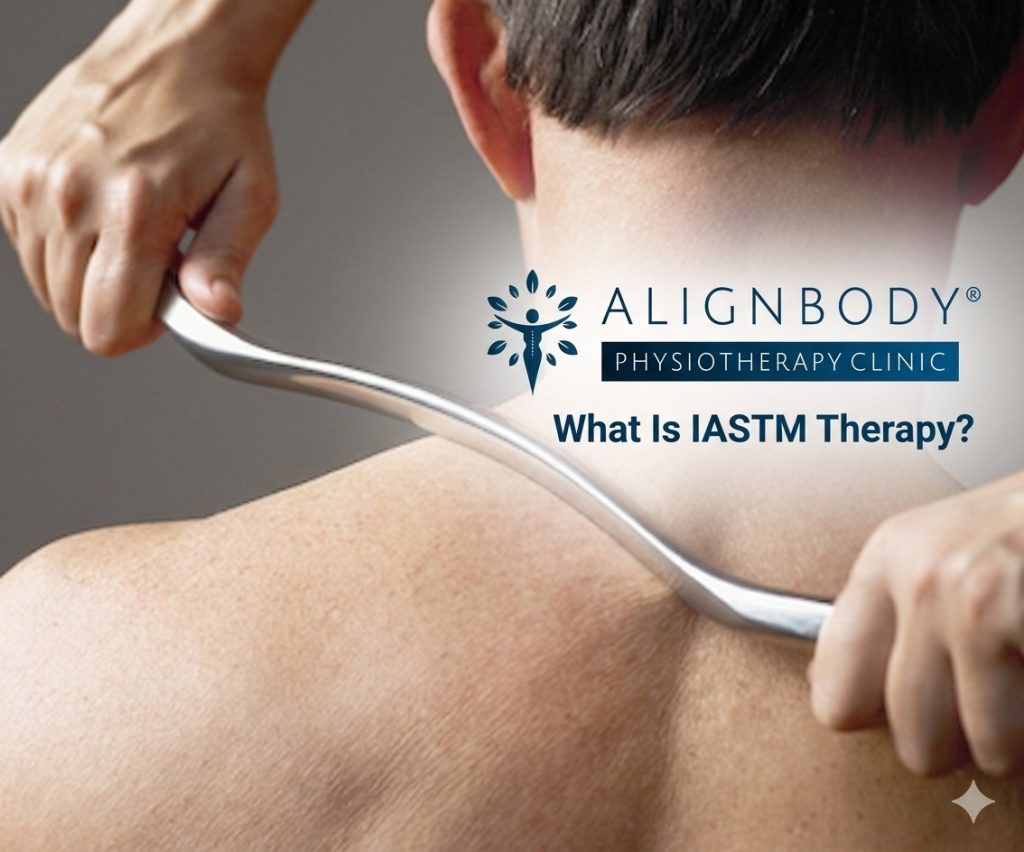
IASTM Therapy: The Instrument-Assisted Technique That Finally Gets to the Root of Stubborn Soft Tissue Pain
You’ve tried massage. You’ve tried rest. You’ve tried heat and ice.
But that stubborn tightness in your neck, that chronic shoulder restriction, that persistent calf tightness that just won’t release — it keeps coming back.
The reason? Fascial adhesions and scar tissue. And the reason your usual treatments aren’t working? Because they don’t reach deep enough.
IASTM does. That’s why it’s one of the most requested treatments at AlignBody’s physiotherapy clinics in Delhi — and why it’s become a staple in elite sports medicine worldwide. Back pain keeping you down? Discover the core strengthening exercises for back pain our Delhi physiotherapists prescribe.
What Is IASTM? The Simple Explanation
IASTM uses specialised instruments — usually made from stainless steel, with bevelled edges of varying shapes — to detect and treat areas of restricted tissue in the body.
The instruments allow a trained physiotherapist to apply controlled, precise pressure to the skin and underlying fascia that would be difficult or impossible to achieve with hands alone. The edge of the instrument acts as an extension of the therapist’s fingertips — only more sensitive and more specific.
IASTM is known by several brand names: Graston Technique, ASTYM, HawkGrips, and others. At AlignBody Delhi, we use a comprehensive IASTM protocol tailored to each patient’s specific tissue restriction pattern. Take the first step towards relief—know more about arthritis treatment today.
What Is Fascia — and Why Does It Matter?
Fascia is the connective tissue network that runs throughout your entire body — wrapping around muscles, organs, bones, and nerves like a three-dimensional web.
Healthy fascia is flexible, hydrated, and slides freely. Restricted fascia is thickened, dehydrated, and stuck. It can pull on structures around it, alter movement patterns, compress nerves, and cause pain that seems to have no identifiable source. Struggling with muscle pain? Discover how dry needling therapy can provide fast relief.
Fascia becomes restricted through:
- Repetitive strain and overuse (the desk worker’s constant companion)
- Acute injuries — sprains, muscle tears, post-surgical scarring
- Immobilisation — being in a cast, prolonged bed rest
- Inflammation and chronic pain states
- Poor posture sustained over months and years
The Science: How IASTM Produces Its Effects
When the IASTM instrument is applied to restricted tissue, several evidence-backed mechanisms occur:
- Mechanical disruption of adhesions — The instrument physically breaks up fascial cross-links and scar tissue that have formed between tissue layers
- Increased fibroblast activity — The controlled micro-trauma stimulates fibroblasts to remodel collagen into a healthier, more functional orientation
- Neurological reset — IASTM stimulates mechanoreceptors in the tissue, altering pain signals and improving sensorimotor awareness
- Inflammatory response — Triggers a localised acute inflammatory response that initiates a fresh healing cascade in previously stagnant chronic tissue
- Increased tissue perfusion — Improved blood flow to chronically ischaemic (blood-starved) fascial tissue. AlignBody provides services for physiotherapy at home in Delhi. Explore to get relief from your pain.
What Conditions Does IASTM Treat?
At AlignBody’s Delhi clinics, IASTM is particularly effective for:
| Condition | How IASTM Helps |
|---|---|
| Neck and shoulder pain | Cervical fascial restrictions, upper trap tightness, levator scapulae adhesions |
| Plantar fasciitis | Fascial restrictions in the sole and calf complex |
| IT band syndrome | Lateral thigh and knee fascial tightness in runners and cyclists |
| Tennis/golfer’s elbow | Chronic tendinopathy and fascial adhesions at the lateral/medial epicondyle |
| Achilles tendinopathy | Scar tissue and adhesions in the Achilles tendon and surrounding sheath |
| Post-surgical scarring | Breaking up scar tissue after knee replacement, rotator cuff, or other procedures |
| Shin splints | Anterior compartment fascial restrictions causing tibial stress pain |
What Does an IASTM Session Actually Feel Like?
I want to set expectations correctly — because “scraping therapy” sounds alarming when you’ve never experienced it.
The sensation: As the instrument glides over your skin, you’ll feel a firm, sometimes intense pressure. Over areas of restriction or adhesion, it feels distinctly different — a grittiness, granular sensation, or “catching” feeling under the instrument. This is the therapist physically detecting the adhesion. Struggling with leg pain or numbness? Discover effective sciatica pain treatment in Delhi.
Pain level: IASTM should feel like a therapeutic discomfort — intense but tolerable. A 5–6 out of 10 at most. If it’s genuinely painful, the therapist adjusts pressure immediately.
After treatment: The treated area will appear pink or red (this is normal — it’s increased circulation, not bruising). Some patients have mild soreness for 24–48 hours, similar to a deep tissue massage.
Duration: An IASTM component within a physiotherapy session typically takes 5–10 minutes per area treated. It’s rarely used in isolation — it’s combined with manual therapy and exercise for maximum effect. Physiotherapy and orthopaedic treatment aren’t the same — and knowing the difference helps you heal faster.
IASTM vs Deep Tissue Massage: Key Differences
| Factor | IASTM | Deep Tissue Massage |
|---|---|---|
| Tool | Stainless steel instrument with a precise bevelled edge | Therapist’s hands and forearms |
| Depth | Reaches deeper fascial layers with more precision | Limited by hand strength and anatomy |
| Tissue detection | Instrument transmits tactile feedback — therapist feels restrictions | Less specific detection |
| Scar tissue | Mechanically disrupts scar tissue and adhesions | Limited effect on true scar tissue |
| Collagen remodelling | Directly stimulates fibroblast activity | Indirect effect |
| Session duration | 5–10 minutes per area (intensive) | 20–60 minutes per area |
How Many Sessions Do You Need?
Most patients notice a significant improvement in tissue mobility within 3–6 sessions. Chronic conditions with significant scar tissue may require 8–12 sessions.
IASTM is almost always combined with therapeutic exercise, because releasing the restriction without strengthening the surrounding structures risks recurrence. Choosing between Yoga and Pilates. find out which workout is right for your lifestyle and health needs.
FAQ’s About IASTM Therapy
Q: Does IASTM therapy leave bruises?
A: Mild petechiae (small red dots from increased circulation) and temporary redness are common and expected. True bruising is uncommon with proper technique and indicates excessive pressure. The pink/red colour typically fades within 24–48 hours.
Q: Is IASTM the same as gua sha?
A: They share superficial similarities but serve different purposes. Gua sha is a Traditional Chinese Medicine practice applied to skin. IASTM is a Western physiotherapy technique targeting deeper fascial and musculoskeletal tissues with clinical instruments and specific protocols.
Q: Can IASTM help with post-surgical scar tissue?
A: Yes — it is one of the most effective tools we have for breaking up post-surgical adhesions and improving mobility after procedures like knee replacement, rotator cuff repair, or carpal tunnel surgery.
Q: Is IASTM painful?
A: It involves therapeutic discomfort — particularly over areas of genuine restriction. An experienced physiotherapist calibrates pressure continuously based on your feedback. The discomfort is temporary and is followed by improved mobility and reduced pain.
The Bottom Line
If you have stubborn neck pain, chronic soft tissue restriction, or post-injury tightness that doesn’t respond to conventional treatment, IASTM may be the missing piece.
At AlignBody Delhi, it’s not a standalone treatment — it’s one precise tool in a comprehensive physiotherapy programme designed around your specific restrictions.
| Ready to Start Your Recovery?
Book your consultation at AlignBody — Delhi’s trusted physiotherapy clinic East Delhi: Jagriti Enclave | South Delhi: Vasant Vihar +91 9310 014 226 | alignbody.in/contacts/ |
| About the Author
Dr. Richa Gupta — Founder & MD, AlignBody Physiotherapy Clinic, Delhi 14+ years clinical experience. Certified APBC (USA & Thailand), Diploma Osteopathy (Ontario), Mat Pilates Instructor (Ireland). Specialist in chronic pain, body alignment, dry needling & manual therapy. AlignBody has helped 20,000+ patients across Delhi NCR live pain-free lives. |