Slip Disc vs Herniated Disc
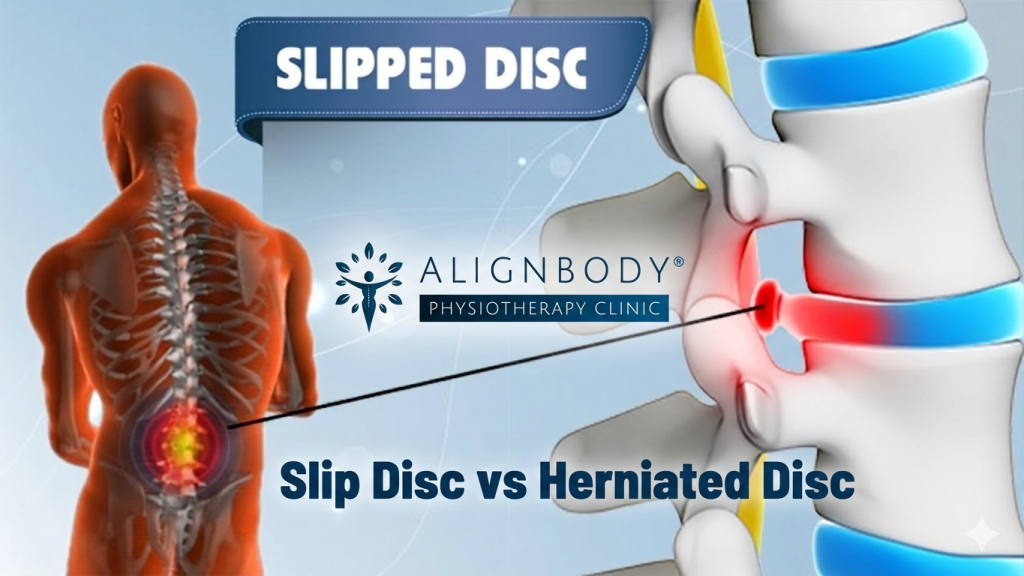
Slip Disc vs Herniated Disc: The Real Difference and How Physiotherapy Treats Both
“Doctor, I have a slip disc.”
I hear this multiple times every single week at my clinic in Delhi.
And almost every time, there’s confusion — about what it actually means, how serious it is, and whether surgery is inevitable.
Here’s the reality: the term ‘slip disc’ is widely used but medically imprecise. It’s a catch-all phrase that most people use to describe any disc-related spinal problem — but the actual diagnosis, severity, and treatment can vary enormously.
And here’s the most important thing I want you to take from this post: the vast majority of disc conditions — including those causing significant pain and sciatica — can be effectively treated with physiotherapy, without surgery. Don’t let chronic pain hold you back- visit AlignBody’s best chiropractic clinic in East Delhi for targeted, root-cause treatment.
What Is a Spinal Disc?
Before we get into the different types of disc problems, you need to understand what a spinal disc actually is.
Between each vertebra in your spine sits a intervertebral disc — a structure with two distinct components:
- Annulus fibrosus: The tough, fibrous outer ring. Think of it like the tyre wall.
- Nucleus pulposus: The gel-like, shock-absorbing centre. Like the air inside the tyre.
These discs act as shock absorbers and spacers between your vertebrae. They allow movement, distribute load, and protect the spinal cord and nerves.
When something goes wrong with a disc, it’s almost always a problem with the structural integrity of one or both of these components. Discover our Pilates therapy clinic in East Delhi and start your core transformation today.
The Different Types of Disc Problems — Explained Clearly
| Type | What Happens | Typical Symptoms |
|---|---|---|
| Disc Bulge | Mild outward pressure of disc material — still contained within annulus. Common with age. | Aching, stiffness, some referred pain. No nerve root involvement typically. |
| Disc Herniation | Inner nucleus pushes through a tear in the outer annulus. Can press on nerve roots. | Sharp, radiating pain (sciatica), numbness, tingling, possible weakness. |
| Disc Prolapse | More severe herniation — nucleus material significantly protrudes outside the disc space. | Often significant nerve symptoms, can cause muscle weakness in leg/foot. |
| Disc Extrusion | Nucleus material breaks through and separates from the main disc body. | Often causes severe acute pain and neurological symptoms. |
| Disc Sequestration | A fragment of nucleus pulposus breaks free and enters the spinal canal. | Most severe — can cause serious nerve compression requiring urgent evaluation. |
Does a ‘Slip Disc’ Mean You Need Surgery?
Almost certainly not.
This is the most common misconception I address at AlignBody — and the fear of surgery is often what delays people from seeking help.
The research is clear: 80–90% of patients with disc herniation and sciatica improve significantly with conservative physiotherapy treatment — without surgery.
Even more remarkable: studies using MRI imaging show that herniated disc material can actually reabsorb over time — particularly with appropriate physiotherapy, movement, and lifestyle modification. The body has a remarkable capacity to heal disc pathology when given the right conditions. AlignBody provides services for physiotherapy at home in Delhi. Explore to get relief from your pain.
Surgery is typically considered only when:
- Progressive neurological deficit (worsening weakness or numbness)
- Cauda equina syndrome (bladder/bowel dysfunction — always urgent)
- Severe pain that has not responded to 6–12 weeks of comprehensive conservative treatment
How Physiotherapy Treats Disc Problems
At AlignBody — with physiotherapy clinics in East Delhi and South Delhi — our disc rehabilitation programme typically includes:
Phase 1: Pain Relief and Protection (Weeks 1–3)
The priority is reducing nerve irritation and acute muscle spasm.
- Specific directional exercises (McKenzie technique or extension-bias movements for most disc herniations)
- Manual therapy to restore lumbar mobility gently
- Neural mobilisation (nerve flossing) to reduce sciatic nerve sensitivity
- Dry needling for acute muscle guarding and trigger points — see our detailed dry needling guide for how this works
- Postural advice and activity modification to avoid positions that increase disc pressure
Phase 2: Stability and Rehabilitation (Weeks 4–8)
Once acute pain is controlled, we focus on rebuilding the support structure around the spine.
- Deep core activation — transverse abdominis and multifidus strengthening (the topic of our Thursday deep-dive this week)
- Progressive loading of the spine in controlled, disc-friendly positions
- Hip and gluteal strengthening to reduce mechanical stress on the lumbar discs
- Postural correction and movement re-education
Phase 3: Function and Prevention (Weeks 8–12+)
The goal here is to return you to full activity — and ensure you don’t come back.
- Sport or occupation-specific rehabilitation
- Ergonomic and lifestyle guidance
- A long-term home exercise programme to maintain disc health.
Also Read: Understanding Paralysis: Causes, Types, & Symptoms
What You Should Avoid With a Disc Problem
- Prolonged sitting dramatically increases intradiscal pressure. Use a lumbar roll and take breaks every 45 minutes
- Bending forward under load — the highest-risk movement for disc injury
- High-impact activity — running, jumping, heavy lifting until cleared by your physiotherapist
- Complete bed rest — slows recovery and weakens supporting muscles
- Crunches and sit-ups — create flexion forces that compress herniated disc material toward the nerve
Frequently Asked Questions
Q: How long does it take to recover from a slip disc with physiotherapy?
A: Acute disc herniation with sciatica typically improves significantly within 6–12 weeks of appropriate physiotherapy. Full recovery and return to all activities may take 3–6 months. Chronic disc disease can be effectively managed long-term with a maintenance exercise programme.
Q: Can I exercise with a slipped disc?
A: Yes — with guidance. Certain exercises are highly beneficial (extension movements, neural mobilisation, core stabilisation). Others are contraindicated. A physiotherapy assessment is essential before starting any exercise programme for disc problems.
Q: Will my disc herniation show up on an X-ray?
A: No. X-rays show bone — not soft tissue. An MRI scan is required to visualise disc herniations, prolapses, and nerve compression. However, physiotherapy treatment can begin based on clinical assessment even without imaging.
Q: Does a large herniation on MRI mean more pain?
A: Not necessarily. There is a well-documented disconnect between MRI findings and clinical symptoms. Many patients with significant herniations on imaging have minimal pain, while others with smaller herniations experience severe symptoms. The clinical presentation and functional impact matter far more than the MRI appearance alone.
The Bottom Line
A ‘slip disc’ is not a death sentence for your spine.
In the vast majority of cases, it is a treatable, manageable condition — one that responds well to evidence-based physiotherapy, appropriate exercise, and the right lifestyle modifications.
The worst thing you can do is wait, worry, and do nothing. The second worst is to rush into surgery without first giving conservative treatment a proper chance.
At AlignBody in Delhi, we treat disc conditions every single day — successfully, without surgery, and with lasting results.
| Ready to Get Started?
Book your consultation at AlignBody — Delhi’s trusted physiotherapy clinic East Delhi: Jagriti Enclave, Vikas Marg | South Delhi: Vasant Vihar Phone: +91 9310 014 226 | alignbody.in/contacts/ |