Can Physiotherapy Fix Bad Posture?
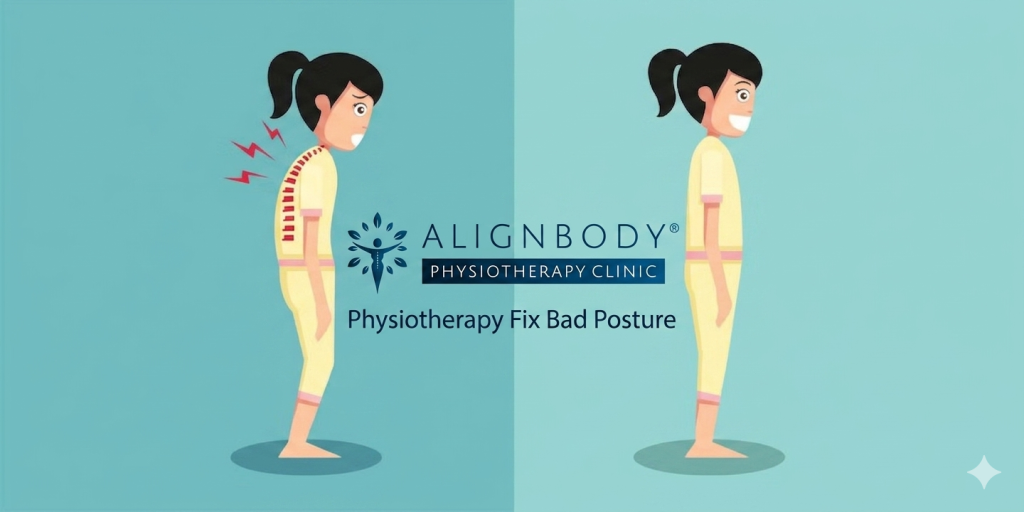
Can Physiotherapy Fix Bad Posture? A Delhi Physiotherapist Answers — Honestly
Yes, But I want to give you the longer, more useful answer — because ‘yes’ by itself doesn’t tell you what physiotherapy actually does, how long it takes, what happens in a session, or when self-directed exercises aren’t enough and you need clinical help.
I’m Dr. Richa Gupta, founder of AlignBody Physiotherapy Clinic in Delhi — with clinics in Jagriti Enclave, East Delhi and Vasant Vihar, South Delhi. I’ve treated postural problems for over 14 years. This is the answer I give every patient who asks me this question in the consultation room.
First — What Is ‘Bad Posture’ Actually Doing to Your Body?
Most people think of bad posture as an aesthetic problem — the hunched back, the rounded shoulders, the forward-jutting head. But what it’s actually doing is a structural and biomechanical problem with real physical consequences.
When your posture is out of alignment, your body compensates. Muscles that aren’t supposed to be primary load-bearers start doing the heavy lifting. Joints get loaded asymmetrically. Discs compress unevenly. Nerves get pulled tight. Over months and years, these compensations accumulate into pain – neck pain, tension headaches, shoulder ache, and lower back problems – that may seem unrelated at first. However, specialists in posture correction physiotherapy Delhi often find that these chronic issues are closely linked to long-term postural imbalance and can be effectively managed through targeted physiotherapy treatment.
In my experience at AlignBody, at least 60% of the chronic pain presentations I see in Delhi have a significant postural component that nobody has addressed because the patient — and sometimes previous treating doctors — focused only on where it hurt, not why it hurt.
That’s why physiotherapy does its work. Back pain keeping you down? Discover the core strengthening exercises for back painthat our Delhi physiotherapists prescribe.
What Physiotherapy Actually Does for Bad Posture
Physiotherapy treats bad posture by working on three interconnected systems that most other interventions — braces, YouTube exercises, generic gym work — don’t address simultaneously:
1. It Identifies the Specific Pattern That’s Failing You
Not all bad posture is the same. A person with forward head posture has different muscle imbalances to someone with anterior pelvic tilt or thoracic kyphosis. Getting the exercises wrong — or doing the right exercises in the wrong sequence — either produces no result or makes things worse.
The first thing a physiotherapist does is a proper assessment. At AlignBody, this involves looking at your posture statically and in movement, testing individual muscle strength and length, assessing joint mobility, and mapping out which muscles are overactive and which are inhibited. Only then do we build a programme. Struggling with leg pain or numbness? Discover effective sciatica pain treatment in Delhi.
2. It Releases What Is Tight — Before Attempting to Strengthen What Is Weak
This is the step that almost every generic posture programme skips — and it’s the reason so many people do weeks of strengthening exercises and see no change.
If your pectorals are pulling your shoulders forward, no amount of upper back strengthening will permanently pull them back. The pectorals are stronger than the exercises. Every time you stop concentrating, the tight muscles win.
Physiotherapy breaks this cycle by first releasing the tight structures — through manual therapy, myofascial release, dry needling, and IASTM — before beginning strength work. It’s a sequence most fitness content never mentions. Take the first step towards relief—know more about arthritis treatment today.
At AlignBody, we combine several modalities for this: myofascial release for deep fascial restrictions, IASTM therapy for scar tissue and chronic adhesions, and dry needling for persistent trigger points that stretching alone cannot release.
3. It Rebuilds the Muscles That Should Have Been Doing the Work
Once the tight structures are released, the weak ones can actually engage. The deep cervical flexors hold your head in neutral. The lower trapezius keeps your shoulder blades in position. The glutes that prevent anterior pelvic tilt. The deep spinal stabilisers take the load off the lumbar spine.
These muscles don’t respond to generic exercises the way strong, healthy muscles do. They need specific loading, in specific ranges of motion, with proper motor control cues. That’s what a physiotherapist provides — not a handout of exercises, but guided, progressive rehabilitation with correction of form and real-time feedback. Physiotherapy and orthopaedic treatment aren’t the same — and knowing the difference helps you heal faster.
Can You Go to Physiotherapy Just for Bad Posture? (Yes — And Here’s When You Should)
You absolutely can — and should — see a physiotherapist specifically for postural concerns, even if you don’t have significant pain yet.
Most people wait until the pain is bad enough to interfere with work or sleep before they seek help. By that point, the postural dysfunction has usually been established for months or years, which makes correction slower and more involved than if it had been addressed earlier.
Think of it like dental care. You don’t wait for a tooth to be destroyed before seeing a dentist. Physiotherapy works the same way — preventive and early intervention produces faster, cheaper, and more sustainable results than waiting for a chronic pain state. Choosing between Yoga and Pilates. find out which workout is right for your lifestyle and health needs.
Here are the signs that your posture needs professional attention — not just a YouTube video:
- Persistent neck tension or headaches that return within days of massage or stretching
- Shoulder or upper back aching by mid-afternoon on desk days, regardless of how you sit
- Lower back stiffness first thing in the morning that takes more than 20 minutes to ease
- Numbness or tingling in your arms or hands — possible nerve involvement from cervical postural compression
- Visible asymmetry — one shoulder higher, head consistently tilted, hip hiking — that you or others notice
- You’ve had a baby in the last 12 months — post-natal postural changes almost always need guided rehabilitation
- You’ve been doing posture exercises for 6+ weeks with no measurable improvement
If any of these describe you, self-directed exercise is unlikely to be sufficient. You need an assessment to understand the specific pattern driving your problem before you can address it effectively. Stroke recovery can feel overwhelming—here’s how physiotherapy helps patients rebuild strength, coordination, and confidence.
What Happens in a Physiotherapy Session for Posture?
This is one of the most common questions I get from patients who’ve never been to a physiotherapist before. Here’s exactly what happens at AlignBody:
| 1 | Detailed Postural Assessment
We observe your standing and sitting posture, test how you move, assess individual muscle strength and length, check joint mobility in the spine and hips, and identify the specific muscle imbalances driving your pattern. This typically takes 20–30 minutes in the first session. |
| 2 | Manual Therapy and Tissue Release
Based on the assessment, we use hands-on techniques — joint mobilisation, myofascial release, and IASTM — to release the tight structures that are pulling your posture out of alignment. For stubborn chronic restrictions, dry needling may be used in the same session. |
| 3 | Targeted Exercise Prescription
We prescribe a specific set of exercises tailored to your pattern — not a generic posture programme. Each exercise is demonstrated, performed under our supervision in the clinic, and corrected in real time. You leave knowing exactly what to do, how to do it, and why. |
| 4 | Ergonomic and Lifestyle Guidance
We assess your workstation setup, sleeping position, movement habits, and daily load patterns. Often the most powerful change a patient makes is an ergonomic adjustment to their desk or phone use — something that prevents 8 hours of daily re-loading of the postural problem. |
| 5 | Progressive Review and Programme Advancement
Each session, we reassess what’s changed. The programme evolves as you improve — we don’t give you the same exercises forever. The goal is to build you toward self-management with a home programme you can maintain independently. |
How Long Does Physiotherapy Take to Fix Posture?
This is the question everyone wants a specific number for. I’ll give you the most honest answer a physiotherapist can give: it depends on how long the imbalance has been there, and how consistently you do the work between sessions.
Here’s a realistic breakdown based on what I see clinically in Delhi:
| Severity | Sessions Needed | Typical Timeline | Expected Outcome |
|---|---|---|---|
| Mild postural discomfort (under 6 months) | 4–8 sessions | 3–5 weeks | Pain and tension reduce significantly. Noticeable postural change. |
| Moderate postural dysfunction (6 months to 2 years) | 8–12 sessions | 6–10 weeks | Clear structural improvement. Home programme established. |
| Chronic, long-standing patterns (2+ years) | 12–20 sessions | 3–5 months | Significant correction with ongoing home maintenance required. |
| Post-natal postural changes | 8–15 sessions | 6–12 weeks | Pelvic floor and core coordination plus postural correction. |
| Kyphosis or significant scoliosis | Ongoing management | Variable | Symptom management, not structural reversal in severe cases. |
Can Physiotherapy Cure Bad Posture Permanently?
This is a question worth answering carefully, because ‘cure’ implies something permanent and complete — and that’s a nuanced picture.
Can physiotherapy produce lasting postural correction? Yes. The muscle imbalances that drive bad posture are reversible. The deep cervical flexors can be reactivated. The pectorals can be lengthened. The glutes can be rebuilt. When this happens — and when the ergonomic factors reinforcing the pattern are also addressed — the correction is genuinely long-lasting.
Can posture re-deteriorate after physiotherapy? Also yes. If someone returns to the same habits, workstation, and lifestyle that created the problem, the muscles gradually return to their previous imbalanced state. This is not a failure of physiotherapy — it’s a failure of maintenance. And it’s why the home exercise programme we give patients is not optional; it’s part of the treatment.
Think of it like dental hygiene. A dentist can clean your teeth. But if you stop brushing after the appointment, the problem returns. The same logic applies to posture. Physiotherapy changes the structure, and maintenance keeps it changed. If your neck pain keeps coming back, it could be more than just strain—discover everything about cervical spondylosis here.
What Physiotherapy Cannot Do
I want to be honest about this because I think it builds more trust than overselling.
- Reverse severe structural scoliosis. Physiotherapy can significantly reduce pain, improve muscle balance, and slow progression — but it cannot straighten a spine with significant structural curvature.
- Produce instant results. Anyone promising to fix years of postural dysfunction in one or two sessions is overpromising. The timeline in the table above is realistic — not pessimistic.
- Replace ergonomic changes. If you spend 10 hours a day in a poor workstation setup and come for an hour of physiotherapy, you are doing 10 hours of damage and 1 hour of repair. The maths doesn’t work. Ergonomics and physiotherapy must go together.
- Overcome a sedentary lifestyle without other intervention. Physiotherapy gives you the tools and the neurological reprogramming. Daily movement — walking, stretching, mobility work — sustains the gains.
Physiotherapy vs Other Approaches- Honest Comparison
| Approach | Can It Fix Bad Posture? |
|---|---|
| Posture corrector brace | No — provides passive support only. Muscles weaken further with dependency. Posture returns immediately when brace is removed. |
| Generic YouTube exercises | Partially — but without knowing your specific pattern, you may work the wrong muscles, in the wrong sequence. Slow progress or no progress is common. |
| Yoga and Pilates | Yes — both improve mobility and body awareness and complement physiotherapy well. Clinical Pilates integrated with physiotherapy principles works well. Pilates alone often lacks the specificity needed for clinical postural correction. |
| Chiropractic adjustments | Partially — adjustments can relieve joint-related pain and restore mobility. But without addressing the muscle imbalances maintaining the poor posture, the adjustment often needs repeating. Best combined with corrective exercise. |
| Physiotherapy | Yes — the most comprehensive approach. Assesses the specific pattern, releases tight structures, strengthens weak ones, retrains movement habits, and provides a self-management programme for lasting correction. |
How to Get Started with Physiotherapy for Posture in Delhi
If you’re in Delhi NCR, AlignBody has two clinics — Jagriti Enclave, East Delhi and Vasant Vihar, South Delhi — where we see postural correction patients every day of the week.
Your first appointment will be a comprehensive postural assessment. Bring any imaging (X-rays, MRI) if you have it, and wear comfortable clothing that allows us to observe your spine and shoulders easily. The assessment takes 30 to 45 minutes, and by the end of it, you’ll have a clear picture of exactly what your postural pattern is and what needs to be done about it.
We also offer home visit physiotherapy across Delhi NCR — so if you have significant mobility limitations or find it difficult to travel, we can come to you.
For patients who want to understand their back pain in relation to posture, our physiotherapy and back pain guide is worth reading before your first appointment. And if you’re already doing posture exercises, our lower back pain resource explains the postural drivers of lumbar pain in detail.
FAQ’s About Bad Posture
Q: Can physiotherapy fix bad posture?
A: Yes. Physiotherapy is the most evidence-based approach to correcting postural dysfunction. It identifies the specific muscle imbalances causing your posture problem, releases tight structures through manual therapy and dry needling, and rebuilds the weak muscles through targeted exercise. Most patients see measurable improvement within 3 to 6 weeks of consistent treatment.
Q: Can you go to physiotherapy just for bad posture, without having pain?
A: Absolutely. You don’t need to be in significant pain to benefit from physiotherapy for posture. In fact, addressing postural dysfunction before it becomes painful is far more effective and efficient than waiting for a chronic pain state to develop. Many patients in Delhi come to AlignBody proactively — desk workers, new parents, athletes — for exactly this reason.
Q: How many physiotherapy sessions do I need to fix my posture?
A: Mild postural problems typically respond within 4 to 8 sessions. Moderate dysfunction — the kind that’s been developing for a year or more — usually requires 8 to 12 sessions. Long-standing, chronic patterns may need 15 to 20 sessions alongside a sustained home exercise programme. The single biggest factor influencing your timeline is how consistently you do your home exercises between sessions.
Q: What does a physiotherapist do for bad posture?
A: A physiotherapist begins with a detailed postural assessment to identify your specific pattern — which muscles are tight, which are weak, which joints are restricted. They then use manual therapy, myofascial release, IASTM, and dry needling to release tight structures, followed by targeted exercises to rebuild the weak ones. Ergonomic advice and a home maintenance programme round out the treatment.
Q: Can physiotherapy cure bad posture permanently?
A: Physiotherapy can produce lasting correction — but ‘permanent’ depends on what you do after treatment. If you maintain your home exercise programme and address the ergonomic factors that caused the problem, the correction is long-lasting. If you return to the exact same habits without any maintenance, the imbalances gradually return. Think of it like dental care — the treatment works, but maintenance keeps it working.
Q: Is physiotherapy better than a posture corrector brace for fixing posture?
A: Yes, significantly. A brace provides passive external support. The moment you remove it, your muscles have the same imbalances as before — because the brace was doing their job for them. Over time, dependency on a brace can actually weaken the postural muscles further. Physiotherapy corrects the underlying muscle imbalances directly, producing structural change that doesn’t disappear when you remove anything.
Q: Does physiotherapy hurt when treating posture problems?
A: Physiotherapy for posture should not be painful. Some techniques — like deep tissue myofascial release or dry needling for trigger points — involve therapeutic discomfort that patients typically describe as ‘a good pain’. But the exercises and assessment should feel manageable. If something hurts acutely, always tell your physiotherapist immediately — pain is a signal, not something to push through.
Q: Can physiotherapy help with tech neck and forward head posture?
A: Yes — forward head posture and tech neck are among the most common and successfully treated presentations in physiotherapy. Treatment combines chin tuck exercises to reactivate the deep cervical flexors, manual therapy to the upper cervical and thoracic spine, and ergonomic guidance on screen positioning. Most patients in Delhi notice a significant reduction in neck tension within 3 to 4 weeks.
The Bottom Line
Let me give you the direct, no-hedging answer one more time.
Yes, physiotherapy can fix bad posture. It is, in fact, the most effective intervention available for postural correction — more effective than braces, more specific than generic exercise programmes, and more lasting than yoga or massage alone when used as a standalone approach.
What it requires from you is two things: consistency with your home exercises, and patience with the timeline. Posture doesn’t deteriorate overnight, and it doesn’t correct overnight either. But with the right programme — built around your specific muscle imbalances, your lifestyle, and your goals — it changes. Measurably. Lastingly.
If you’re in Delhi and ready to find out exactly what your postural pattern is and what it needs, book a consultation at AlignBody. We’ll tell you precisely what’s happening in your body, and exactly what we’re going to do about it.
| Book Your Posture Assessment at AlignBody, Delhi
Drug-free, evidence-based physiotherapy — East Delhi & South Delhi East Delhi: Jagriti Enclave | South Delhi: Vasant Vihar +91 9310 014 226 | alignbody.in/contacts/ |
| Written by
Dr. Richa Gupta — Founder & MD, AlignBody Physiotherapy Clinic, Delhi NCR 14+ years of clinical experience in postural rehabilitation, chronic pain, manual therapy and dry needling. Certified APBC practitioner (USA & Thailand), Diploma in Osteopathy (Ontario, Canada), certified Mat Pilates Instructor (Ireland). Founder of AlignBody — Delhi’s trusted physiotherapy clinic across East Delhi (Jagriti Enclave) and South Delhi (Vasant Vihar). 20,000+ patients treated across Delhi NCR. Medically reviewed and accurate as of April 2025. |