Anterior Pelvic Tilt: Fix the Hidden Cause of Lower Back Pain
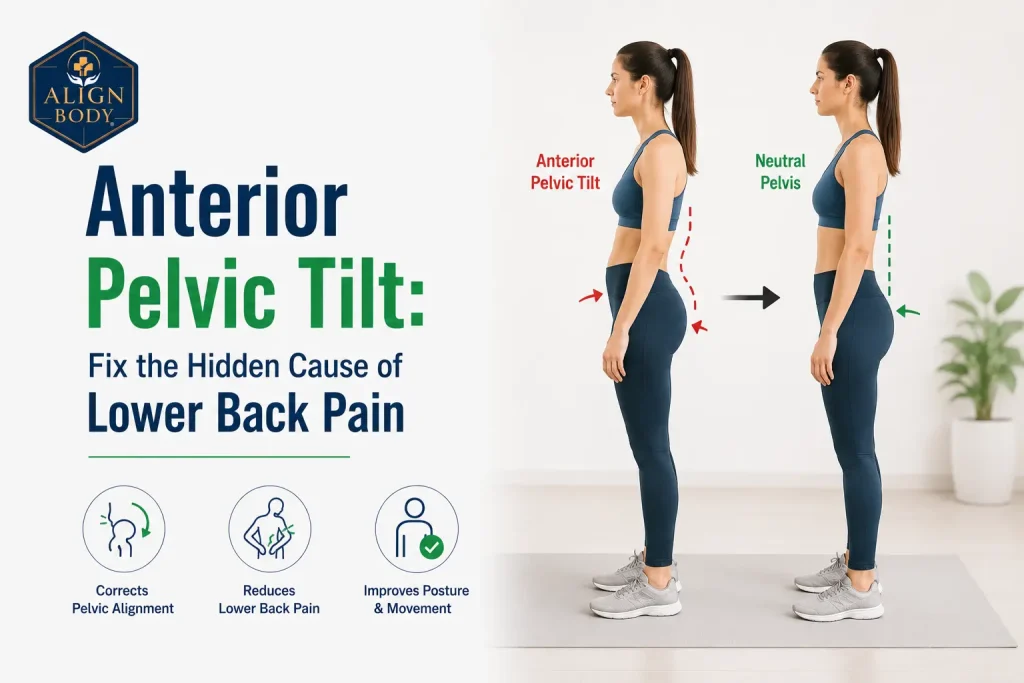
Anterior pelvic tilt is when the front of your pelvis drops and the back rises, creating an excessive arch in the lower back. It is caused by tight hip flexors, weak glutes and a weak core from prolonged sitting. You can correct it with a targeted programme of hip flexor stretching and glute and core strengthening. Mild cases improve in 6 to 8 weeks with daily exercise.
Most patients who come to me with chronic lower back pain have already tried painkillers, heat packs and rest. Some have tried general physiotherapy. A significant number of them have anterior pelvic tilt and nobody has ever pointed it out to them.
It is one of the most common postural faults in Delhi and one of the most consistently missed. Sitting at a desk for 8 to 10 hours a day, driving through Delhi traffic for another 1 to 2 hours, and then spending the evening on a sofa creates exactly the muscle imbalance pattern that produces it.
I am Dr. Richa Gupta, founder of AlignBody Physiotherapy Clinic in Delhi. This post explains what anterior pelvic tilt is, how to test yourself at home, why it causes lower back pain and exactly which exercises correct it.
What Is Anterior Pelvic Tilt?
Your pelvis is not fixed in one position. It rotates forward and backward throughout the day depending on your posture and the muscles pulling on it. Anterior pelvic tilt (APT) is when the pelvis rotates too far forward so the front (the ASIS, or anterior superior iliac spine) drops downward and the back (the PSIS, or posterior superior iliac spine) rises upward.
This forward rotation of the pelvis increases the arch in your lower back (lumbar lordosis). From the side, a person with significant APT looks like they are permanently sticking their bottom out, with a pronounced curve in the lower back even when they are trying to stand straight.
A small degree of anterior pelvic tilt is normal. The average normal range is 7 to 15 degrees in women and 4 to 7 degrees in men. Problems start when the tilt is significantly beyond this range and the muscles that should be correcting it are too weak or too tight to do so.
How to Test Yourself for Anterior Pelvic Tilt at Home
You do not need clinical equipment to get a reasonable indication of whether you have APT.
The wall test
Stand with your back against a flat wall. Your heels, upper back and head should all touch the wall. Now slide your hand between the wall and your lower back.
- If you can slide one flat hand in with light resistance: your lumbar curve is within a normal range
- If you can slide your whole forearm in easily, or if there is a gap you could fit a fist through, you likely have a significant anterior pelvic tilt
- If there is almost no space between your lower back and the wall: you may have a posterior pelvic tilt (flat back)
The mirror test
Stand sideways in front of a full-length mirror in a relaxed, natural standing position. Look at your lower back and pelvis. If your lower back has a pronounced inward curve and your abdomen protrudes forward even when you are not breathing in, this is a visual indicator of anterior pelvic tilt.
These self-tests are indicative, not diagnostic. A physiotherapist can measure pelvic tilt accurately using a simple inclinometer or manual assessment. If you are unsure, book an assessment at AlignBody for a formal evaluation.
What Causes Anterior Pelvic Tilt?
APT is almost always caused by a specific pattern of muscle imbalance first described by rehabilitation specialist Vladimir Janda as the Lower Crossed Syndrome. Two groups of muscles become chronically tight and overactive while two opposing groups become chronically weak and inhibited.
| Tight and Overactive | Weak and Inhibited |
|---|---|
| Hip flexors (iliopsoas and rectus femoris) | Gluteus maximus (main glute muscle) |
| Lumbar erector spinae (lower back extensors) | Deep abdominals (transverse abdominis) |
| Tensor fascia latae (outer hip) | Hamstrings |
The hip flexors are the primary driver. When you sit for extended periods the iliopsoas and rectus femoris spend hours in a shortened position. Over time they become adaptively stiff and pull the pelvis forward even when you stand up. The glutes, which should counterbalance this pull, become inhibited from chronic underuse in a seated position. This imbalance pattern is one of the most common contributors to lower back pain.
Common triggers in Delhi
Prolonged sitting at a desk or workstation is the primary cause. Delhi’s commuting culture adds to this: 1 to 2 hours per day in a car or auto puts the hip flexors in sustained flexion far beyond office hours. Add evening sitting and screen time and many people’s hip flexors spend fewer than 3 to 4 hours per day in anything close to a lengthened position.
Other triggers include high heels (which mechanically force the pelvis into anterior tilt), pregnancy and the postpartum period (see our guide on pre and post natal physiotherapy), and certain sports like cycling and distance running without adequate hip flexor recovery.
How Anterior Pelvic Tilt Causes Lower Back Pain
The excessive lumbar lordosis that comes with APT loads the lumbar spine in ways it is not designed to sustain over long periods.
The lumbar facet joints (the small joints at the back of each vertebra) take more compression when the spine is in hyperextension. Over months and years this can produce facet joint irritation and pain, particularly at L4-L5 and L5-S1. The tight hip flexors also pull directly on the lumbar spine’s transverse processes, creating a constant low-level traction force on the lower back structures. This is why the lower back feels tight and achy by the end of a working day.
Beyond lower back pain, untreated APT often contributes to sciatic nerve irritation, hip impingement and even knee pain, because the biomechanical chain that runs from the pelvis affects every joint above and below it. Many patients are surprised to find their knee pain reduces when we address their pelvic tilt rather than focusing on the knee directly.
APT also commonly accompanies forward head posture. Both are components of what Janda described as the upper and lower crossed syndromes. Many patients who present to us have both occurring simultaneously.
The Anterior Pelvic Tilt Correction Programme
The correction programme has three phases. They build on each other. Skipping straight to phase 3 exercises before you have addressed the tightness in phase 1 is the most common reason people do not see results from APT programmes they find online.
Phase 1: Release the tight muscles (daily)
These stretches must be done before the strengthening exercises. You cannot effectively activate an inhibited glute if the opposing hip flexor is in spasm.
Kneeling hip flexor stretch (90/90 position): Kneel on one knee with the other foot in front (90-degree angle at both knees). Gently tuck your pelvis under (posterior pelvic tilt) before you lean forward. You should feel the stretch in the front of the hip of the kneeling leg. Hold for 45 seconds, 3 repetitions each side.
The posterior pelvic tuck is critical. Without it you are simply leaning forward with your lumbar spine hyperextended and the stretch reaches the lumbar spine rather than the iliopsoas. Most people do this stretch incorrectly.
Rectus femoris stretch: Stand holding a wall for balance. Bend your knee behind you and hold your ankle. Now tuck your pelvis under (squeeze your glute on that side) before you pull the ankle toward your buttock. Hold for 30 seconds, 3 repetitions each side.
Thomas stretch (table edge hip flexor stretch): Lie on your back at the edge of a table or bed. Hold one knee to your chest and let the other leg hang off the edge. The hanging leg should drop toward the floor under gravity. If your lower back arches significantly or the hanging thigh stays above horizontal, your hip flexors on that side are tight. Hold 30 to 45 seconds each side.
Phase 2: Activate the inhibited muscles (daily)
Glute bridge: Lie on your back with knees bent and feet flat on the floor. Squeeze your glutes first, then lift your hips off the floor. The movement should come from glute contraction, not from pushing through your lower back. Hold at the top for 2 seconds. 3 sets of 15 repetitions. If you feel this primarily in your hamstrings rather than your glutes, your glutes are inhibited and need more isolated activation work first.
Clamshell: Lie on your side with hips stacked, knees bent to 90 degrees and feet together. Rotate your top knee upward like a clamshell opening without letting your pelvis rock backward. This activates gluteus medius which is also typically inhibited with APT. 2 sets of 15 each side.
Dead bug: Lie on your back with arms pointing to the ceiling and knees bent to 90 degrees (legs in the air). Press your lower back firmly into the floor. Maintain this contact throughout. Slowly lower one arm overhead while extending the opposite leg toward the floor, without allowing your lower back to lift. Return and repeat on the other side. 3 sets of 10 each side. This is one of the most effective exercises for transverse abdominis activation without loading the hip flexors. Read more in our guide on core strengthening exercises for back pain.
Abdominal hollowing in 4-point kneeling: On all fours, let your abdomen completely relax downward, then draw your navel up toward your spine without moving your lower back or holding your breath. Hold for 5 seconds. 3 sets of 10 repetitions. This activates the transverse abdominis in isolation before loading it in functional positions.
Phase 3: Integrate into functional movement (3 to 4 times per week)
Hip thrust: Sit with your upper back against a bench, knees bent, feet flat on the floor. Drive your hips upward by squeezing your glutes, forming a straight line from shoulders to knees. This is a loaded progression of the glute bridge and builds the glute strength needed to counteract hip flexor tightness during walking and running. 3 sets of 12 repetitions.
Goblet squat: Hold a weight at chest height. As you squat, actively maintain a neutral pelvic position rather than allowing your lower back to hyperextend at the bottom. 3 sets of 12 repetitions. The weight counterbalances the body and makes it easier to maintain neutral spine through the movement.
Conscious walking: During your daily walk, practice engaging your glutes lightly with every push-off step. Think about pushing the floor backward rather than leaning forward. This re-educates the gluteus maximus firing pattern during the functional movement it most needs to work in.
Clinical Pilates is also highly effective for APT correction because it systematically addresses the deep core activation and pelvic alignment that these exercises target. Read more about our clinical Pilates programme at AlignBody East Delhi.
What Not to Do With Anterior Pelvic Tilt
| Avoid This | Why |
|---|---|
| Sit-ups and crunches | These primarily activate the hip flexors (rectus femoris and iliopsoas), which are already overactive. They worsen the muscle imbalance rather than correcting it |
| Lumbar hyperextension exercises (cobra pose, back extension machine) | Further increase lumbar lordosis and load the facet joints that are already compressed by APT |
| Relying on posture corrector braces alone | Braces passively hold posture without strengthening the muscles that need to hold it actively. Muscles weaken further under passive support |
| Only stretching hip flexors without strengthening glutes | The most common mistake. Hip flexor stretching alone is not sustained if the glutes are too weak to maintain the corrected pelvic position |
| Stopping exercises once the pain goes | Pain relief typically precedes structural correction by 4 to 6 weeks. Stopping early leaves the underlying imbalance uncorrected and the problem returns |
How Long Does Anterior Pelvic Tilt Take to Correct?
This is one of the most common questions we get at AlignBody’s posture correction clinic. The answer depends entirely on how severe the tilt is and how consistently the programme is followed.
| Severity | Correction Timeline | Approach |
|---|---|---|
| Mild APT (recent onset, mostly sitting-related) | 6 to 8 weeks with daily exercise | Self-managed programme with initial physiotherapy guidance |
| Moderate APT (1 to 3 years, with lower back pain) | 3 to 4 months with consistent exercise | Physiotherapy assessment, manual therapy and supervised exercise |
| Severe APT (long-standing, with associated hip or disc pain) | 4 to 6 months with physiotherapy | Full clinical programme including manual therapy, dry needling and progressive exercise rehabilitation |
Read our detailed guide on how long posture correction takes and what factors speed up or slow down the process. See also: can physiotherapy fix bad posture and our best posture correction exercises guide.
When to See a Physiotherapist for Anterior Pelvic Tilt
You can start the exercises above at home. But you should see a physiotherapist if any of the following apply:
- Your lower back pain is severe (above 6 out of 10) or has been present for more than 6 weeks
- You have pain, numbness or tingling radiating into the buttock or down the leg
- You have tried the exercises for 4 weeks without any improvement
- You are unsure whether your lower back pain is coming from pelvic tilt or from a disc or joint problem
- You are postpartum or pregnant and experiencing pelvic pain alongside the lower back symptoms
At AlignBody we assess pelvic alignment as part of every lower back pain assessment. If anterior pelvic tilt is contributing to your pain, we build it into the treatment programme from day one rather than addressing it as an afterthought. We are available at our East Delhi (Jagriti Enclave) and South Delhi (Vasant Vihar) clinics.
For more on how physiotherapy helps with back pain, see: physiotherapy treatment for back pain relief.
Frequently Asked Questions
Can anterior pelvic tilt be permanent?
No. Anterior pelvic tilt is a postural fault driven by muscle imbalance and it is correctable at any age. Even patients who have had significant APT for 10 or 15 years see meaningful correction with consistent physiotherapy and exercise. The muscles that need to change are not structurally damaged. They are adaptively shortened or inhibited and respond well to the right training stimulus. Structural bony changes at the hip joint can reduce the degree of correction achievable, but functional improvement in pain and posture is achievable in almost all cases.
Is anterior pelvic tilt the same as a lordosis?
They are closely related but not the same. Anterior pelvic tilt is the position of the pelvis. Lumbar lordosis is the curve of the lower back that results from it. APT causes increased lumbar lordosis. You can have lumbar lordosis without significant pelvic tilt in some structural presentations, but in most clinical cases, excessive lumbar lordosis and anterior pelvic tilt occur together and are treated together.
Can sitting all day cause anterior pelvic tilt?
Yes, and this is the primary cause for most patients we see in Delhi. When you sit, your hip flexors spend hours in a shortened position. Over months and years they become adaptively stiff and start pulling the pelvis into anterior rotation even when you are standing. The glutes simultaneously become inhibited from sustained inactivity. This combination. tight hip flexors and weak glutes. is the Lower Crossed Syndrome and it produces APT in a very predictable way. Taking a 5-minute walk every 45 to 60 minutes of sitting significantly reduces the rate at which this imbalance develops.
Does anterior pelvic tilt make your stomach stick out?
Yes. When the pelvis tilts forward it changes the angle of the abdominal cavity, pushing the lower abdomen forward and making it appear to protrude even in people with low body fat. Many patients are surprised to find that correcting their pelvic tilt reduces their apparent belly size without any change in diet or weight. This is because the stomach was not protruding due to fat. it was being pushed forward by the pelvic position.
Can anterior pelvic tilt cause hip pain?
Yes. APT changes the biomechanics of the hip joint, increasing anterior impingement stress and altering the tracking of the femoral head in the acetabulum. Tight hip flexors combined with weak glutes also increases lateral hip loading, which can produce greater trochanteric pain. Many patients with hip pain that has been labelled as bursitis or impingement improve significantly when the underlying pelvic tilt is corrected rather than only treating the hip symptom directly.
Should I see a chiropractor or a physiotherapist for anterior pelvic tilt?
A physiotherapist is the most appropriate primary clinician for APT because the condition is fundamentally a muscle imbalance problem requiring exercise rehabilitation, not primarily a joint manipulation problem. Manual therapy from a physiotherapist or chiropractor can help reduce the associated lower back tightness and improve range of motion, but without the targeted strengthening programme the improvement will not be sustained. At AlignBody we combine manual therapy with a progressive exercise programme to address both the structural and the functional components of APT together.
Anterior pelvic tilt is not a life sentence. It is a muscle imbalance that developed over years of sitting and it responds well to a targeted, consistent correction programme.
The key is to do both halves of the programme. release the tight hip flexors and strengthen the inhibited glutes and core. Doing one without the other is the most common reason patients spend months on exercises and see little change.
If you are in Delhi NCR and want a clinical assessment to confirm whether APT is contributing to your lower back pain, book a posture assessment at AlignBody. Our posture correction programme gives you a complete picture of what is causing your pain and a structured plan to fix it.
When you stand up from your chair right now and look at your reflection, does your lower back curve inward and your stomach push forward? That is the test. The answer tells you whether this post applies to you.
Anterior pelvic tilt assessment, posture correction programme and lower back pain treatment.
East Delhi: Jagriti Enclave | South Delhi: Vasant Vihar | +91 9310 014 226