5 Posture Correction Exercises After Pregnancy That Actually Work
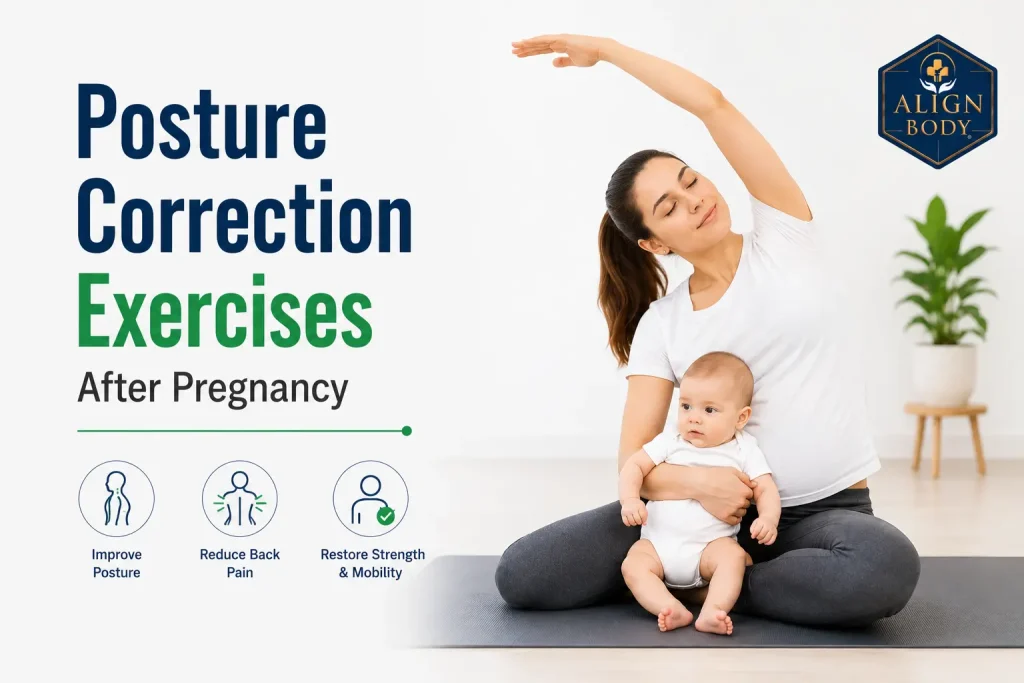
Pregnancy shifts your centre of gravity forward, tilting the pelvis, arching the lower back and rounding the upper back. These changes do not automatically reverse after delivery. Gentle posture correction can begin within days of a vaginal delivery with breathing and pelvic floor work, progressing to targeted strengthening from 6 weeks after clearance. Most mothers see meaningful improvement in 3 to 4 months with consistent daily exercise.
Your body spent nine months adapting to pregnancy. It will not undo those adaptations in nine days.
That is the sentence I say most often to new mothers who come to our clinic frustrated that their back aches, their shoulders slump and their posture “does not feel like theirs” months after delivery. The postural changes of pregnancy are real, they are measurable and they persist unless actively corrected. The good news is that they respond very well to the right exercise programme started at the right time.
I am Dr. Richa Gupta, founder of AlignBody Physiotherapy Clinic in Delhi. Our pre and post natal programme has helped hundreds of mothers rebuild their posture, strength and confidence after delivery. This guide explains exactly what happens to your posture during pregnancy, when it is safe to start correcting it and which exercises to do at each stage.
How Pregnancy Changes Your Posture
The postural changes of pregnancy are not random. They follow a predictable mechanical sequence driven by the growing weight at the front of your body and the hormones that loosen your ligaments to prepare for delivery.
The lower body changes
As the baby grows, your centre of gravity shifts forward. To stay balanced, your pelvis tilts anteriorly (forward) and your lumbar spine increases its arch. The abdominal muscles stretch and lengthen across the growing uterus, losing their ability to counterbalance the pull. By the third trimester, most women stand with a significantly increased lumbar curve, an anteriorly tilted pelvis and locked-back knees.
The hormone relaxin loosens the ligaments of the pelvis to allow delivery. This is necessary and normal, but it also means the pelvic joints (the sacroiliac joints and pubic symphysis) lose some of their passive stability at exactly the time the muscles that actively stabilise them are stretched and weakened.
The upper body changes
The growing breasts and the forward-shifted weight pull the upper back into increased rounding (thoracic kyphosis). The shoulders roll forward and the head moves forward of the shoulders to counterbalance. This pattern is nearly universal by late pregnancy.
Then feeding begins. Whether breastfeeding or bottle feeding, mothers spend 4 to 8 hours a day in a sustained flexed position looking down at the baby. This reinforces and deepens the rounded upper back and forward head posture that pregnancy started. Add night feeds in awkward positions and carrying a progressively heavier baby on one hip and the upper body pattern becomes firmly established.
The abdominal wall
The rectus abdominis (the six-pack muscle) stretches around the growing uterus. In most pregnancies, the two halves of this muscle separate along the midline as the connective tissue between them (the linea alba) stretches. This is called diastasis recti. Some degree of separation occurs in almost all pregnancies and it typically recovers substantially in the first 8 weeks after delivery. In about a third of mothers, a significant separation persists beyond 8 weeks and needs specific rehabilitation.
A persistent diastasis matters for posture because the deep abdominal wall is your spine’s front anchor. Without it functioning properly, the lower back and pelvis cannot be held in a corrected position no matter how many stretches you do.
When Is It Safe to Start Posture Exercises After Delivery?
This is the question that matters most. The answer depends on your delivery type and your individual recovery. The stages below are general guidance. Your doctor’s clearance at your postnatal check takes priority over any general timeline.
| Stage | Vaginal Delivery | C-Section | What Is Appropriate |
|---|---|---|---|
| Days 1 to 14 | Yes, gently | Breathing only | Diaphragmatic breathing, gentle pelvic floor activation, posture awareness during feeding. No loaded exercise |
| Weeks 2 to 6 | Yes | Gentle, after incision comfort | Pelvic tilts, gentle walking, seated posture resets, shoulder blade squeezes. Still no impact or heavy lifting |
| Week 6 onwards (after clearance) | Progress | Progress gradually | Structured strengthening: deep core activation, glute work, upper back strengthening. The main programme begins here |
| Months 3 to 6 | Full programme | Full programme | Progressive loading, functional strength, return to exercise classes or running if pelvic floor is ready |
Important: The 6-week clearance from your obstetrician clears you for general activity. It does not mean your core and pelvic floor have recovered their function. Those two things are different. A postnatal physiotherapy assessment checks the things the standard 6-week check does not: diastasis recti width and depth, pelvic floor strength and coordination and the muscle activation patterns that posture correction depends on.
The Postpartum Posture Correction Programme
The programme runs in three phases. Each builds on the previous one. The order matters more here than in almost any other posture programme because the deep systems (breathing, pelvic floor, deep abdominals) must work before the outer strength work can be effective and safe.
Phase 1: Restore the foundation (weeks 1 to 6)
Diaphragmatic breathing with pelvic floor connection: Lie on your back or side with knees bent. Breathe in and let your ribcage expand sideways and your belly rise gently. As you breathe out, gently lift your pelvic floor (the feeling of stopping urine flow) and let your lower abdomen draw in softly. 10 slow breaths, 3 to 4 times daily. This re-establishes the coordination between your diaphragm, pelvic floor and deep abdominals that pregnancy disrupted. Every other exercise in this programme depends on this pattern working.
Posture reset during feeding: Before each feed, take 10 seconds to set your position. Sit with your lower back supported, bring the baby up to your breast or chest height with pillows rather than curling down to the baby and drop your shoulders away from your ears. This single habit, repeated 8 to 12 times a day, does more for your upper back than any exercise done once daily.
Gentle pelvic tilts: Lying with knees bent, gently rock your pelvis to flatten your lower back into the floor, then release. 10 repetitions, twice daily. This begins re-educating the deep abdominals and mobilising the stiff lower back.
Phase 2: Rebuild the deep system (weeks 6 to 12, after clearance)
Heel slides with core activation: Lying with knees bent, exhale, engage your deep core gently (as in the breathing exercise) and slide one heel along the floor until the leg is straight, then return. The challenge is keeping your lower back stable and your abdomen flat while the leg moves. 10 each side, 2 sets daily. If your abdomen domes or bulges along the midline during this exercise, the load is too much for your current diastasis recovery. Regress to smaller movements.
Glute bridge: Lying with knees bent, squeeze your glutes and lift your hips. Pregnancy inhibits the glutes just as prolonged sitting does. Weak glutes leave the anterior pelvic tilt of pregnancy uncorrected. Hold 2 seconds at the top. 3 sets of 12, daily. Read more about core rebuilding in our guide on core strengthening exercises for back pain.
Wall angel: Stand with your back against a wall, arms in a goalpost position against the wall. Slide your arms up and down while keeping your lower back gently in contact with the wall. This strengthens the mid-back muscles that reverse the feeding hunch while training the core to hold a neutral spine. 10 slow repetitions, 2 sets daily.
Side-lying thoracic rotation: Lie on your side with knees bent at 90 degrees, arms outstretched together in front of you. Open the top arm across your body toward the floor behind you, letting your upper back rotate while your knees stay stacked. This restores the upper back rotation that months of feeding posture stiffens. 8 each side, once daily.
Phase 3: Strengthen for motherhood (months 3 to 6)
The physical demands of motherhood are significant and they grow with the baby. Lifting a 6 to 10 kg baby out of a cot dozens of times daily, carrying a car seat, pushing a pram and the endless floor-to-standing transitions all require genuine strength delivered in good alignment.
Squat to lift: Practice squatting with a neutral spine to pick things up rather than bending from the back. Progress from bodyweight squats to holding light weights. 3 sets of 10, alternate days. This is the movement pattern that protects your back every time you lift your baby.
Suitcase carry: Hold a weight in one hand and walk 20 steps maintaining level shoulders and upright posture, then swap sides. This trains the lateral core to resist the one-sided loading of carrying a baby on your hip. 3 rounds each side, alternate days.
Row variations: Using a resistance band anchored at chest height, pull the band toward you squeezing your shoulder blades together. The upper back strength built here is what makes your corrected posture sustainable rather than something you have to consciously hold. 3 sets of 12, alternate days.
For the full picture of general posture exercises beyond the postpartum-specific ones, see our guide: best posture correction exercises.
Exercises to Avoid in the Early Months
| Avoid Until Cleared | Why |
|---|---|
| Sit-ups, crunches and planks (before diastasis assessment) | These load the abdominal wall directly. On an unrecovered diastasis they increase doming and can worsen the separation |
| Running and jumping (before 3 months and pelvic floor readiness) | Impact loading on a recovering pelvic floor increases the risk of leaking and prolapse symptoms. Walk first, run later |
| Heavy overhead lifting | Overhead loads increase intra-abdominal pressure against a recovering core and pelvic floor |
| Deep backbends and aggressive stretching | Relaxin keeps ligaments loose for up to 5 months after delivery (longer if breastfeeding). Aggressive stretching in this window can strain unstable joints |
| Waist trainers and heavy compression binders as a fix | Gentle support garments can help comfort in the early weeks but they do not rebuild muscle function. Relying on them delays true recovery |
How Long Does Postpartum Posture Correction Take?
With consistent daily exercise, most mothers see meaningful improvement in posture and reduction in back and neck ache within 3 to 4 months of starting the structured programme. Full restoration of strength, alignment and confidence typically takes 6 to 9 months from delivery.
That timeline lengthens if a significant diastasis persists, if pelvic floor dysfunction is present or if the programme keeps getting interrupted (which, with a new baby, is entirely understandable). It shortens with earlier assessment and a properly structured plan. Read our general guide on how long posture correction takes for the factors that speed up and slow down progress, and see can physiotherapy fix bad posture for what physiotherapy specifically adds.
When to See a Physiotherapist
Every new mother benefits from at least one postnatal physiotherapy assessment. But you should definitely book one if any of these apply:
- A visible gap, doming or bulging along the midline of your abdomen when you sit up from lying
- Leaking urine when you cough, sneeze, laugh or exercise
- A feeling of heaviness or dragging in the pelvis
- Lower back, pelvic or neck pain that is not settling by 6 to 8 weeks (see our guide on why lower back pain persists)
- Pain at the C-section scar or restricted movement around it
- You want to return to running, sport or fitness classes and are unsure whether your body is ready
At AlignBody’s pre and post natal clinic we assess diastasis recti, pelvic floor function, posture and movement patterns in a single session and build your programme from what we find. We see mothers at our East Delhi (Jagriti Enclave) clinic and our South Delhi (Vasant Vihar) clinic. For the complete picture of what postnatal physiotherapy includes beyond posture, read our full guide: pre and post natal physiotherapy in Delhi.
Frequently Asked Questions
When can I start posture exercises after a C-section?
Breathing exercises and posture awareness can begin within days of a C-section. Gentle movement like short walks and seated posture resets can begin as incision comfort allows, usually within 2 to 3 weeks. Structured strengthening should wait until after your 6-week clearance and should progress more gradually than after a vaginal delivery because the abdominal wall was surgically opened and needs longer to rebuild its load tolerance. Scar mobility work from around 6 weeks also helps prevent the scar tissue from restricting trunk movement and posture.
Can I fix my posture while breastfeeding?
Yes. You should not wait until feeding ends to start. The two most effective things are the feeding posture reset (bringing baby up to you with pillows rather than curling down) and the daily wall angel and thoracic rotation exercises that counteract the sustained flexed position. Relaxin levels remain elevated while breastfeeding, so avoid aggressive stretching, but all the strengthening exercises in this programme are safe and beneficial during breastfeeding.
How do I know if I have diastasis recti?
Lie on your back with knees bent. Lift your head and shoulders slightly off the floor and feel along the midline of your abdomen above and below your navel with your fingertips. A gap wider than 2 to 2.5 finger-widths or a visible doming along the midline when you sit up suggests a diastasis that would benefit from assessment. Depth and tension matter as much as width, which is why a physiotherapy assessment gives a more useful answer than the finger test alone.
Why does my upper back hurt more than my lower back after delivery?
Feeding posture. Pregnancy loads the lower back but the postpartum months load the upper back and neck through hours of daily sustained flexion during feeds, night waking in awkward positions and constantly looking down at the baby. The thoracic spine stiffens, the mid-back muscles weaken and lengthen and the result is the deep ache between the shoulder blades that most new mothers know well. The wall angel, thoracic rotation and row exercises in this programme target exactly this pattern.
Is it too late to fix my posture if my baby is over a year old?
No. The postural adaptations of pregnancy respond to exercise at any point, whether your baby is 3 months or 3 years old. The muscle imbalances persist until they are actively corrected, which means they remain correctable. Mothers starting the programme later often progress faster through the early phases because the initial tissue healing is complete. The assessment still matters because a persistent diastasis or pelvic floor issue can be present years after delivery without being obvious.
Can posture correction help with the mummy tummy?
Often, significantly. The protruding lower abdomen that persists after delivery has three possible contributors: remaining diastasis recti, weak deep abdominal activation and the anterior pelvic tilt that pushes the abdominal contents forward. Posture correction addresses the second and third directly and supports recovery of the first. Many mothers find their abdominal profile improves noticeably as their pelvic alignment and deep core function are restored, independent of any weight change.
Pregnancy changed your posture through nine months of gradual adaptation. Correcting it is also gradual, but it is very achievable with the right exercises done in the right order at the right time.
Start with the breathing and the feeding posture reset today. Build to the structured programme after your clearance. Get assessed if anything on the warning list applies to you.
If you are in Delhi NCR and want a proper postnatal assessment covering posture, diastasis and pelvic floor in one session, book at AlignBody. Our posture correction programme and pre/post natal service work together to rebuild your alignment and strength from the foundation up.
How many hours a day do you spend in feeding posture right now? That number explains more about your upper back ache than almost anything else.
Posture correction, diastasis recti assessment and pelvic floor rehabilitation for new mothers.
East Delhi: Jagriti Enclave | South Delhi: Vasant Vihar | +91 9310 014 226