Does Dry Needling Hurt ? An Honest Patient Experience Guide
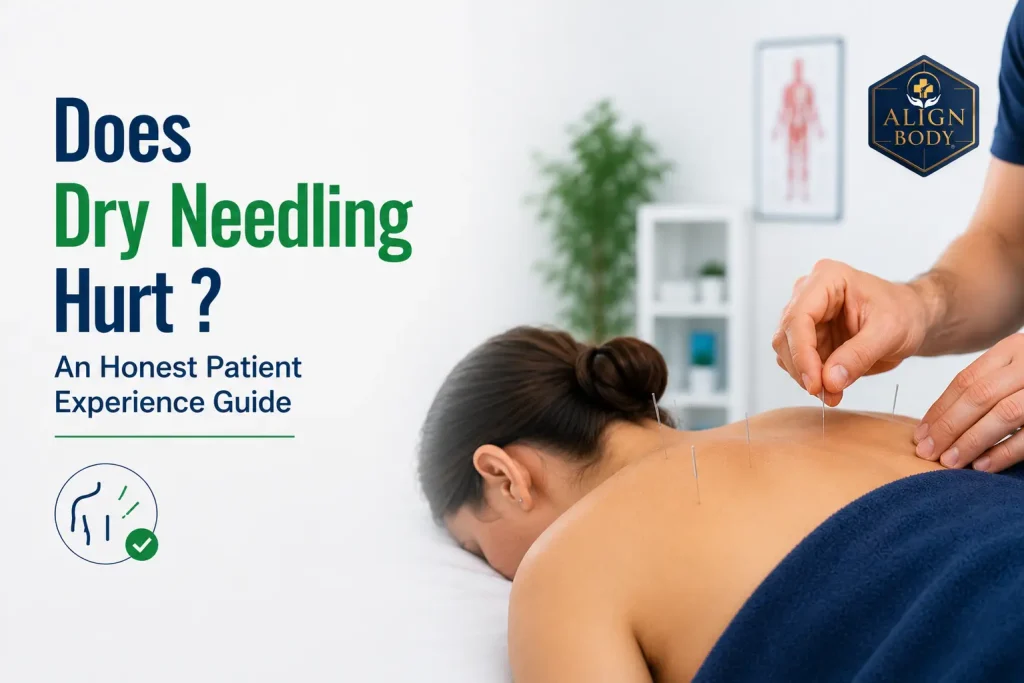
Dry needling is not painless but most patients do not find it painful in the conventional sense. Needle insertion feels like a small prick or nothing at all. The notable sensation is the local twitch response (a brief involuntary muscle contraction when the needle reaches the trigger point, described as a deep ache or cramp lasting 2 to 5 seconds) before releasing. Post-session soreness for 24 to 48 hours is normal and a sign the treatment is working.
Fear of needles is understandable.
It is one of the most common reasons patients delay a treatment that would genuinely help them. They imagine a syringe, a blood draw, something invasive. That mental picture is wrong and it is worth correcting before it stops someone from getting the pain relief they need.
Dry needling uses a completely different type of needle to anything used in a blood draw or injection. The mechanism is different, the sensation is different and the experience is different. Most patients who expect the worst tell me afterwards that it was nothing like they imagined.
I am Dr. Richa Gupta, founder of AlignBody Physiotherapy Clinic in Delhi. I have performed thousands of dry needling sessions across our clinics in East Delhi and South Delhi. This post tells you exactly what to expect from the moment the needle goes in to how you feel the next morning.
The Needle Itself: What You Are Actually Dealing With
A dry needle (filiform needle) is not a hollow needle like a syringe. It has no cutting edge and no opening at the tip. It is a solid, extremely fine needle, typically 0.25 to 0.30 mm in diameter.
To put that in context, a standard blood-draw needle is roughly 0.64 to 0.91 mm in diameter. The dry needle is significantly thinner.
Because the needle is solid and thin, it displaces tissue rather than cutting through it. The number of pain receptors in the skin that it activates during insertion is minimal. That is why many patients report feeling very little at the point of entry.
The experience that follows the insertion is a different story. That is where the real explanation begins.
The Two Sensations You Will Feel
Sensation 1: Needle insertion
This is the prick as the needle passes through the skin. For most people it is a 1 or 2 out of 10. Some patients feel nothing at all. Some feel a tiny sharp prick that lasts under a second.
Areas with thinner skin or higher nerve density are more sensitive. The face, hands and feet tend to be more noticeable than the back, glutes or upper trapezius. Your physiotherapist will always start with lower-intensity stimulus and adjust based on your response.
Sensation 2: The local twitch response
This is the sensation most patients are surprised by.
When the needle reaches a myofascial trigger point (a hypersensitive, contracted knot within the muscle), the muscle involuntarily contracts and then releases. This is called the local twitch response (LTR) and it is the therapeutic event the entire treatment is aiming to produce.
The LTR feels like a sudden deep ache, cramp or electrical sensation in the muscle. It typically lasts 2 to 5 seconds. Here is how patients most commonly describe it:
| How Patients Describe It | How Common | What It Means |
|---|---|---|
| “A deep aching cramp” | Most common | The classic LTR sensation in larger muscles |
| “An electric buzz or zing” | Common in limb muscles | Felt when needle is near a nerve branch |
| “A muscle jumping or twitching” | Visible and palpable | The physical contraction of the LTR |
| “A heavy, full feeling” | Common in the upper back | Sometimes called “de qi” from acupuncture terminology |
| “Pressure, not sharp pain” | Frequent in thick muscles | The needle is felt but not perceived as sharp |
The LTR is not a sign that something is wrong. It is confirmation that the needle has found the trigger point. The brief discomfort is followed, in most cases, by an immediate release of tension in the surrounding tissue. Patients often notice the muscle feels noticeably looser within seconds of the twitch.
What Affects How Much It Hurts
The same dry needling technique can feel very different from one person to the next. Several factors influence this.
Trigger point sensitivity
A highly active, recently aggravated trigger point produces a stronger LTR than a chronic, partially resolved one. Patients with acute muscle spasm often report more intense twitches in the first session. As the trigger point deactivates across sessions, the LTR typically becomes milder.
Body region
Muscles with a higher density of trigger points and nerve supply tend to produce stronger sensations. The upper trapezius, infraspinatus and piriformis are typically more intense. The thoracic paraspinals and gluteus maximus tend to be milder. Your physiotherapist selects starting points based on this knowledge and works up to more sensitive areas gradually.
Anxiety and muscle guarding
Patients who tense up in anticipation of the needle make the experience significantly more uncomfortable. Tensed muscle tissue resists the needle and amplifies the sensation. Slow breathing and a relaxed posture genuinely reduce the perceived discomfort. This is not a placebo. It is basic neurophysiology.
How many sessions you have had
First sessions are almost always more intense than subsequent ones. The trigger points are typically more active before treatment has begun, producing stronger LTRs. Your nervous system also learns to anticipate and modulate the sensation over time. Most patients report that sessions 2 and 3 feel noticeably easier than session 1.
What Happens in the 24 to 48 Hours After
Post-needling soreness is the most consistent aftereffect and the one patients most often want to know about.
The sensation is very similar to delayed onset muscle soreness (DOMS) after exercise. The treated area feels heavy, tender to touch and occasionally bruised. This is not damage. It is the normal inflammatory response to the microtrauma that stimulates tissue healing.
What is normal in the first 48 hours:
Soreness and tenderness at the treatment site (very common, occurs in 19 to 36% of patients per 2025 research)
Mild bruising or redness where the needle was inserted
Feeling of fatigue or heaviness in the treated muscle
Occasional brief aching or tightness that feels like a muscle cramp
Mild fatigue in the few hours immediately after an extensive session
What is not normal: Soreness that intensifies significantly after 72 hours, spreading redness suggesting infection, persistent numbness or weakness in the treated limb or sharp shooting pain that does not settle within a day. These require you to contact your physiotherapist.
Managing Post-Needling Soreness
Most post-needling soreness resolves on its own within 24 to 48 hours. If it is uncomfortable, these steps help:
- Gentle movement: Light walking and gentle range of motion movements improve blood flow and clear the local inflammatory response faster than rest alone.
- Heat after 24 hours: A warm compress applied to the area 24 hours post-session reduces muscle soreness. Avoid heat in the first few hours as it may increase local bruising.
- Hydration: Drink more water than usual on the day of and the day after treatment. Adequate hydration supports the cellular healing response and reduces the duration of soreness.
- Avoid NSAIDs (ibuprofen, diclofenac): These suppress the inflammatory response that dry needling is designed to trigger. Taking them within 48 hours of a session reduces treatment effectiveness.
- Paracetamol is fine: If discomfort is significant, paracetamol provides pain relief without suppressing the healing response.
How Dry Needling Compares to Other Treatments
| Treatment | Typical Pain Level | Character of Sensation |
|---|---|---|
| Blood draw or injection | Sharp, brief, 3 to 4 out of 10 | Hollow needle, larger diameter, breaks skin differently |
| Deep tissue massage | Sustained pressure, 4 to 7 out of 10 | Broader area, no needle, sustained discomfort during treatment |
| Dry needling insertion | Tiny prick, 1 to 2 out of 10 | Solid filiform needle, minimal skin receptor activation |
| Dry needling twitch response | Deep ache or cramp, 3 to 6 out of 10 for 2 to 5 seconds | LTR: brief, involuntary, resolves immediately |
| Post-session soreness | Dull ache, 2 to 4 out of 10 | Peaks at 12 to 24 hours, resolves by 48 hours in most cases |
When Dry Needling Should Not Be Used
Dry needling is not appropriate for everyone. See our detailed guide on dry needling safety and contraindications for the full list. Key situations to disclose to your physiotherapist before treatment:
- Active infection, open wound or skin condition at the treatment site
- Blood thinning medication (anticoagulants). Bruising risk increases.
- Severe needle phobia that cannot be managed with relaxation techniques
- Pregnancy in the first trimester. Certain points are avoided.
- Recent surgery or implant near the intended treatment area
Frequently Asked Questions
Does dry needling hurt more than acupuncture?
The needles are identical in type and size. The difference is the intent and technique. Acupuncture targets meridian points with minimal stimulation. Dry needling targets myofascial trigger points and deliberately elicits the local twitch response, which produces a more intense brief sensation. Patients who have had both typically describe dry needling as more intense but shorter-lasting. Read more in our guide on the difference between dry needling and acupuncture.
What does the twitch response feel like?
A deep ache or involuntary cramp lasting 2 to 5 seconds. Some patients describe it as a brief electric sensation or a sudden heaviness in the muscle. It is involuntary. Your muscle contracts on its own in response to the needle stimulating the trigger point. The twitch is the therapeutic mechanism. The release that follows it is the reason the muscle feels looser afterwards.
Is dry needling more painful in some body parts than others?
Yes. Areas with higher nerve density and more active trigger points produce stronger sensations. The upper trapezius, piriformis and infraspinatus tend to be more intense. The gluteus maximus, thoracic paraspinals and hamstrings tend to be milder. Your physiotherapist will always tell you which area they are treating and start with less sensitive points before progressing.
How long does post-needling soreness last?
Most patients experience soreness that peaks around 12 to 24 hours after treatment and resolves within 48 hours. A 2025 study in the International Journal of Sports Physical Therapy (Tolbert et al.) found that while 19 to 36% of patients reported localised adverse events including soreness and bruising, the large majority considered these acceptable given the clinical benefits they experienced.
Will I feel better immediately after dry needling or does it take time?
Both are possible. Some patients feel an immediate reduction in muscle tightness and improved range of motion within minutes as the trigger point releases. Others experience a delayed improvement where the soreness fades over 24 to 48 hours and the full benefit becomes apparent on day 2 or 3. For chronic, longstanding trigger points, improvement typically builds progressively across 3 to 5 sessions.
Can I exercise after dry needling?
Light activity and walking on the same day is fine and actually helps clear the post-needling inflammatory response. Avoid heavy resistance training or activities that load the treated muscle significantly for 24 hours. Returning to full training after 24 to 48 hours is appropriate for most patients. Your physiotherapist at AlignBody will advise specifically based on which muscles were treated.
Most patients who have been avoiding dry needling out of fear come back after their first session and say the same thing.
It was not what they expected. The insertion was barely noticeable. The twitch felt strange but not terrible. The soreness the next day was no worse than after a tough gym session.
The concern that stops people is reasonable. The reality, in the hands of a trained clinician, is manageable. If you are in Delhi NCR and want to try dry needling for chronic muscle pain, stiffness or a condition that has not responded to other treatment, book a session at AlignBody. We will explain exactly what will happen before we begin.
Read our related guides: dry needling vs acupuncture and dry needling side effects: what to expect.
What is the one thing about dry needling that concerns you most before your first session?
Trigger point dry needling for pain, stiffness and muscle dysfunction. Evidence-based physiotherapy.
East Delhi: Jagriti Enclave | South Delhi: Vasant Vihar | +91 9310 014 226