Neuro Myoskeletal Dry Needling: How It Differs from Standard Needling
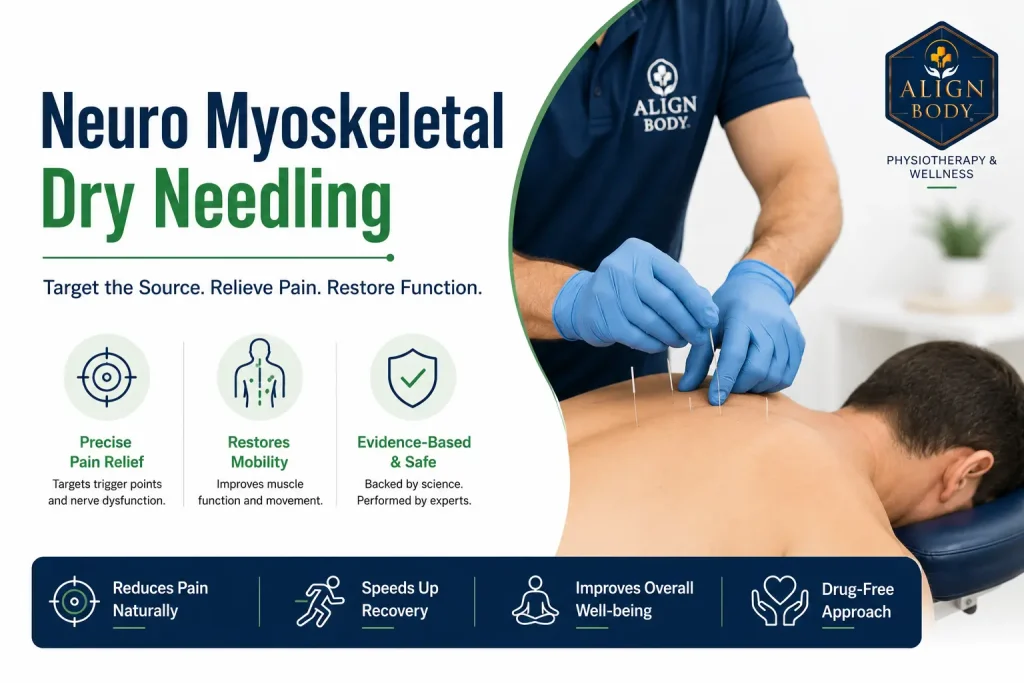
Neuro Myoskeletal Dry Needling (NMSDN) is an advanced form of dry needling that targets neural, joint and deep fascial structures beyond the muscle trigger points that standard dry needling focuses on. Standard dry needling treats muscle knots. NMSDN treats the wider system of nerves, connective tissue and joint capsules that generate and maintain pain. NMSDN requires additional training beyond entry-level dry needling and is more useful for chronic, complex or nerve-mediated pain, while standard dry needling remains effective for straightforward myofascial trigger points.
Every week a patient asks me some version of this question: “Is dry needling the same as acupuncture? And what makes what you do different from what my last clinic offered?”
The short answer is that dry needling is not acupuncture. Neuro Myoskeletal Dry Needling is not standard dry needling. They share the same tool (a thin filiform needle) but the philosophy, targets, training required and clinical outcomes differ substantially.
I am Dr. Richa Gupta, founder of AlignBody Physiotherapy Clinic in Delhi. This post explains what Neuro Myoskeletal Dry Needling actually is, how it differs from what most clinics offer as “dry needling,” what conditions benefit most from the advanced approach and what to look for when choosing a practitioner.
First: What Standard Dry Needling Is
Standard dry needling, recognised by the American Physical Therapy Association as part of physiotherapy scope of practice since 2009, is a technique in which a physiotherapist inserts a thin filiform needle through the skin to stimulate myofascial trigger points. The primary target is the taut band of muscle fibres that contains the trigger point.
The mechanism is well described. The needle triggers a local twitch response in the muscle fibres, interrupts the motor end-plate noise responsible for maintaining the knot, reduces spontaneous electrical activity in the trigger point, increases local blood flow and stimulates the release of endorphins and other pain-modulating chemicals. The result, in a standard case, is meaningful reduction in muscle pain and stiffness within 24 to 72 hours.
Standard dry needling is well-evidenced for common muscle-driven conditions and is widely available at physiotherapy clinics across India. Read our patient-experience guide: does dry needling hurt? and our detailed timing guide: how long dry needling takes to work.
What Neuro Myoskeletal Dry Needling Adds
Neuro Myoskeletal Dry Needling (NMSDN) takes the same needle and applies it to a broader set of tissue targets, based on the understanding that pain and movement dysfunction rarely have only a muscle-trigger-point cause. The full picture usually involves interconnected contributions from muscles, neural pathways, joint capsules and fascial planes.
NMSDN specifically targets:
- Neural tissue and nerve pathways: gentle needle stimulation near irritated or entrapped nerve segments to reduce nerve-mediated pain and improve neural mobility
- Joint capsule structures: needling of the connective tissue around joints where restricted joint movement contributes to symptoms
- Deep fascial planes: layers of connective tissue that carry pain and restriction beyond what surface trigger point work reaches
- Periosteal points: gentle needle contact with periosteum (the outer bone layer) at specific attachment sites
- Autonomic nervous system regulation: paraspinal needling at specific spinal levels can influence the sympathetic nervous system component of chronic pain conditions
The mechanism includes everything standard dry needling does, plus additional effects on neural sensitisation, fascial glide, joint capsule mobility and autonomic tone. For chronic pain conditions where the muscle trigger point is only one part of a wider pattern, this broader approach often produces outcomes that trigger-point-only needling does not.
What each technique actually targets:
Standard Dry Needling vs NMSDN: The Direct Comparison
| Standard Dry Needling | Neuro Myoskeletal Dry Needling | |
|---|---|---|
| Primary target | Muscle trigger points (taut bands) | Muscle + neural + joint capsule + deep fascia |
| Depth of intervention | Muscle layer, targeted at trigger point | Multiple tissue layers depending on presentation |
| Assessment before treatment | Palpation of trigger points | Full neuromusculoskeletal assessment including neural, joint and movement analysis |
| Best for | Localised muscle pain, myofascial trigger points, acute muscle spasm | Chronic pain, nerve-mediated pain, joint pain with muscle involvement, complex cases |
| Practitioner training | Entry-level dry needling certification (typically 40 to 80 hours) | Advanced dry needling training with additional anatomy, neurology and technique modules |
| Session length | 15 to 30 minutes typically | 30 to 45 minutes typically due to broader assessment and multiple target areas |
| Sessions typically needed | 3 to 6 sessions for standard trigger point cases | 4 to 8 sessions for chronic complex presentations |
| Adjunctive techniques | Standard needling alone | Often combined with electrical stimulation (intramuscular electrical stimulation), functional movement work and manual therapy |
Acupuncture vs Dry Needling vs NMSDN
These three often get mixed up in patient conversations, so here is the honest comparison.
| Acupuncture | Standard Dry Needling | NMSDN | |
|---|---|---|---|
| Origin | Traditional Chinese Medicine (2,000+ years) | Western physiotherapy (modern trigger point science) | Advanced Western physiotherapy (evolved from standard DN) |
| Underlying philosophy | Restoring energy flow along meridians | Neurophysiological modulation at trigger points | Neurophysiological modulation across neuromusculoskeletal system |
| Point selection | Traditional meridian points | Anatomically defined muscle trigger points | Muscle, neural, joint and fascial targets based on individual assessment |
| Number of needles | Typically many (15 to 30 per session) | Fewer, precisely placed (3 to 10 per session) | Variable based on presentation (3 to 15 per session) |
| Session focus | Balancing whole body energy | Specific musculoskeletal problem area | Specific presentation with attention to neural and joint contributions |
| Practitioner background | Licensed acupuncturists | Trained physiotherapists | Advanced-trained physiotherapists |
None of these is objectively “better” as a category. Acupuncture has genuine value for many conditions and remains a valid Traditional Chinese Medicine practice. Dry needling and NMSDN have different mechanisms of action and different clinical applications. Which is right for you depends on the specific problem you have and the practitioner you can access.
When Each Approach Is More Appropriate
| Condition | Standard Dry Needling | NMSDN |
|---|---|---|
| Acute muscle strain | Good fit | Not needed in most cases |
| Simple neck stiffness with trigger points | Good fit | Not needed in most cases |
| Tension headaches with trigger point pattern | Good fit | Considered if standard DN incomplete |
| Chronic neck pain with radiating symptoms | Partial benefit | Better fit due to neural component |
| Cervical spondylosis with muscle involvement | Partial benefit | Better fit due to multi-tissue pattern |
| Sciatica with muscular contribution (piriformis, glutes) | Some benefit | More thorough; targets neural pathway irritation |
| Chronic frozen shoulder | Partial benefit | Better fit due to joint capsule component |
| Persistent lower back pain (over 3 months) | Partial benefit | Often more effective for the sensitisation and autonomic component |
| Post-surgical scar or restriction | Limited scope | Fascial and neural release techniques better suited |
| Complex regional pain syndrome (CRPS) | Generally not appropriate | Specialist assessment needed; NMSDN sometimes helpful as part of programme |
Notice the pattern. For simple, localised muscle problems, standard dry needling is often enough. For anything that has become chronic, involves nerve symptoms, involves joint capsule restriction or has an autonomic component (which most chronic pain does), NMSDN offers targets that standard dry needling does not reach.
Which approach is right for you? A self-check:
Standard dry needling likely enough if:
- Pain is localised to one specific muscle area
- Symptoms are recent (under 3 months)
- No radiating pain, numbness or tingling
- You can clearly feel tender “knots” on palpation
- Pain responds to gentle self-massage of the tender area
NMSDN more appropriate if:
- Pain has been present more than 3 months
- You have radiating symptoms, numbness or tingling
- Joint stiffness accompanies the muscle problem
- You have tried standard dry needling with only partial success
- Multiple areas of the body are involved
- There is a post-surgical or post-injury component
What a NMSDN Session Actually Involves
A first NMSDN session at our clinic typically runs 45 to 60 minutes and involves the following:
Assessment (15 to 20 minutes): A full neuromusculoskeletal assessment goes beyond finding trigger points. We check joint range of motion, neural mobility (specific nerve tension tests), movement patterns, muscle activation quality and fascial glide across the region of complaint. This assessment determines which combination of targets is appropriate.
Treatment (20 to 30 minutes): Needle insertion is done in phases. Muscle trigger points are addressed first, then relevant neural or joint capsule points, then any fascial or periosteal work indicated. In appropriate cases we combine needling with intramuscular electrical stimulation (a low-current signal through the needle) to enhance the neuromuscular effect. This combination has evidence for faster pain reduction and functional improvement in chronic myofascial pain.
Post-treatment (5 to 10 minutes): Movement testing to confirm improvement, explanation of expected response over the following 24 to 48 hours and specific exercises to reinforce the new tissue state.
Subsequent sessions are typically shorter (30 to 45 minutes) as the assessment refines what needs to be addressed.
What Response to Expect
The immediate response to NMSDN is often more comprehensive than after standard dry needling, but it can also take a slightly longer period to fully settle because the intervention reaches more tissue.
Immediately after (0 to 2 hours): Feeling of local muscle heaviness at needled sites, possible mild soreness. Some patients feel tired for a few hours, similar to after a strong exercise session.
Day 1 (24 hours): Some patients feel obvious improvement in the presenting complaint. Others feel a mild flare of the underlying pain for 24 to 48 hours before improvement begins. Both patterns are normal.
Days 2 to 4: Peak benefit typically emerges. Reduced pain, improved range of motion, better neural mobility, reduced trigger point tenderness on re-examination.
Weeks 1 to 2: The improvement holds if you complete the associated exercise programme. Without exercise reinforcement, gains can partially regress within 2 to 3 weeks.
Training and Practitioner Requirements
Standard dry needling in India requires the practitioner to be a qualified physiotherapist with entry-level dry needling certification, typically 40 to 80 hours of hands-on training with a recognised training body. This qualifies practitioners to treat straightforward musculoskeletal trigger points safely.
NMSDN requires additional advanced training on top of entry-level dry needling. This includes further education in applied neuroanatomy, joint capsule and periosteal techniques, neural mobilisation combined with needling, intramuscular electrical stimulation protocols and complex case management. In practical terms, a practitioner offering genuine NMSDN should have significantly more training hours and clinical experience than someone offering standard dry needling.
In India, where dry needling itself is a relatively recent addition to physiotherapy practice, NMSDN is offered by relatively few clinics. If a clinic is offering it, ask specifically about the practitioner’s advanced training background and how they distinguish it from what a standard dry needling clinic offers.
Safety and Side Effects
NMSDN carries the same generally low risk profile as standard dry needling when performed by a properly trained practitioner. Common minor effects include local soreness for 24 to 48 hours, small areas of bruising and occasional brief post-session fatigue. Serious complications (such as pneumothorax when needling around the thoracic region) are extremely rare in trained hands and are avoided through appropriate anatomical technique.
The specific safety considerations that matter more for NMSDN than standard dry needling relate to the wider tissue targets. Needling near nerve pathways requires precise anatomical knowledge to avoid direct nerve contact. Needling near joint capsules requires understanding of joint anatomy to work safely at the capsular level. This is why the advanced training requirement exists.
NMSDN is not appropriate for patients on high-dose blood thinners without medical clearance, patients with severe needle phobia, active local infection at the needling site or pregnancy in specific body regions. A proper assessment identifies these before treatment begins.
Combining NMSDN with Other Physiotherapy
NMSDN is rarely a standalone treatment. In our clinic it is one part of a broader physiotherapy plan that typically includes:
- Myofascial release therapy for wider fascial restrictions
- Targeted exercise programmes to reinforce and maintain the tissue changes
- Joint mobilisation techniques where indicated
- Movement retraining for movement pattern dysfunction
- Laser therapy or other modalities for adjunctive tissue healing where appropriate
- Patient education about self-management and prevention
Combining NMSDN with these other elements is what produces lasting change rather than temporary symptom relief. Any clinic offering NMSDN in isolation without a broader programme is treating a symptom rather than a condition.
Conditions Where We See the Biggest NMSDN Benefit
Based on our clinical experience treating thousands of patients in Delhi NCR, NMSDN produces its most meaningful outcomes for:
- Chronic cervical pain with radiating symptoms. Read our related guides on neck pain and cervical stiffness and cervical spondylosis.
- Persistent shoulder pain including frozen shoulder and impingement. See our shoulder pain guide.
- Chronic lower back pain that has failed to respond to standard treatment. Read why lower back pain hurts for the underlying mechanisms.
- Sciatica with muscular contribution from piriformis or glute involvement. See our sciatica treatment guide.
- Tension-type headaches that have become chronic and have a cervical and autonomic component
- Post-injury or post-surgical restrictions where the muscle, fascial and joint components have all been affected
Frequently Asked Questions
Is Neuro Myoskeletal Dry Needling more painful than standard dry needling?
The immediate sensation of needle insertion is broadly similar between the two, since the same fine filiform needles are used. NMSDN may involve slightly more needle insertions across a wider range of tissue targets, so the overall session sensation can feel more comprehensive. Most patients describe it as intense rather than sharp. The local twitch response feels the same for both techniques. Practitioners adjust intensity to what each patient can comfortably tolerate.
How many NMSDN sessions do I need?
For chronic complex conditions the typical course is 4 to 8 sessions spaced weekly at first, then reducing to every 2 to 3 weeks. Simpler cases may resolve in 3 to 4 sessions. If there is no meaningful improvement after 3 sessions, the plan should be reassessed rather than continued on autopilot. NMSDN, like all physiotherapy, is not an indefinite maintenance service. The goal is resolution of the presenting problem within a defined course.
Can I have NMSDN if I have already had standard dry needling elsewhere?
Yes. Many patients come to us after standard dry needling produced partial improvement that has not resolved the underlying problem. In these cases NMSDN often addresses the elements that standard dry needling did not reach: neural, joint capsule or fascial contributions. The previous treatment is not counter-indicated. The assessment at the first visit determines what additional tissue targets to include.
Does NMSDN work for chronic pain conditions like fibromyalgia?
Evidence is limited but growing. Some patients with fibromyalgia and chronic widespread pain do benefit from gentle NMSDN as part of a broader pain-management programme, particularly for the autonomic and central sensitisation components. Treatment intensity is modified for these patients (fewer needles, gentler technique) because the nervous system in chronic widespread pain conditions is more sensitised. NMSDN is not a first-line treatment for these conditions but can be a useful addition when standard approaches have plateaued.
Is dry needling safe if I am on blood thinners?
Modified dry needling is generally possible for patients on low-dose or single-agent blood thinners, but the assessment and consent conversation should specifically address this. Higher-force or deeper needling may be avoided to reduce the small risk of bruising or internal bleeding. Patients on multiple blood thinners or very high-dose anticoagulation should have medical clearance before starting a course. Tell your practitioner at the first visit if you are on any anticoagulant.
How do I find a NMSDN-trained practitioner in Delhi?
Direct questions to ask when calling any clinic that advertises dry needling: is the practitioner specifically trained beyond entry-level dry needling? Do they offer neural, joint capsule and fascial techniques beyond trigger points? Do they use intramuscular electrical stimulation when appropriate? Do they combine dry needling with a broader physiotherapy programme rather than as a standalone service? A clinic that welcomes these questions is more likely to offer genuine NMSDN. At AlignBody we offer NMSDN as one component of our full physiotherapy service, delivered by advanced-trained practitioners.
Is NMSDN covered by health insurance in India?
Coverage varies significantly between insurers and policies. Most Indian health insurance policies do not cover routine outpatient physiotherapy including dry needling. Some corporate health plans and international insurers do include physiotherapy sessions as part of accident rehabilitation cover. We recommend patients check with their insurer directly about their specific policy. At AlignBody we can provide detailed invoices with treatment codes that support any insurance claim you wish to submit.
Neuro Myoskeletal Dry Needling is not a marketing rebrand of standard dry needling. It is a distinct, more advanced approach that treats the wider system of tissues that generate and maintain pain, rather than only the muscle trigger points that standard dry needling addresses.
For simple muscle-driven problems, standard dry needling remains an excellent, evidence-based tool. For chronic, complex, nerve-mediated or joint-involved presentations, NMSDN offers targets and mechanisms that standard trigger-point-focused work does not reach.
The choice between the two is not a hierarchy but a matching of technique to problem. A good clinician assesses your specific presentation and selects the appropriate combination.
If you have a pain problem that has not responded to standard dry needling or if you want a comprehensive assessment that maps whether your presentation would benefit from the advanced approach, book at AlignBody. Our Delhi clinics at Jagriti Enclave (East Delhi) and Vasant Vihar (South Delhi) offer both standard dry needling and NMSDN as part of full physiotherapy programmes.
Has your dry needling so far only targeted muscle trigger points? Or has your practitioner also addressed the neural, joint and fascial contributions to your pain? That answer largely determines whether NMSDN could help you further.