Laser Therapy for Pain: How It Works and What It Treats
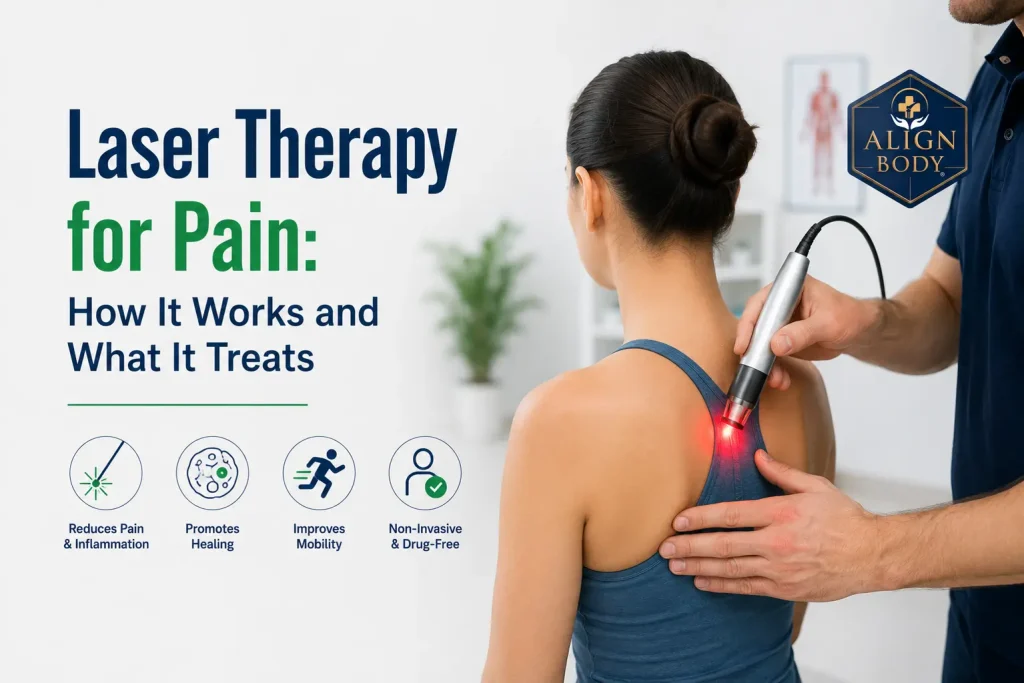
Laser therapy in physiotherapy (also called LLLT or photobiomodulation) uses specific wavelengths of light to stimulate cellular repair, reduce inflammation and relieve pain. It is non-invasive, painless and drug-free. The light penetrates the skin and is absorbed by the mitochondria in cells, triggering a healing response that works at tissue level. It treats musculoskeletal pain, nerve pain, joint conditions and soft tissue injuries. Most patients need 6 to 12 sessions for chronic conditions.
Most patients who come to AlignBody for laser therapy ask the same first question.
“Is it like a surgical laser? Will it burn?”
It is not. It does not burn, cut or heat the tissue. It does not hurt. You may feel nothing at all during the session, or a very mild warmth over the treatment area. What it does at a cellular level, invisibly, is where the real explanation lies.
I am Dr. Richa Gupta, founder of AlignBody Physiotherapy Clinic in Delhi. Laser therapy is one of the modalities we use alongside physiotherapy and exercise rehabilitation for patients with chronic pain, soft tissue conditions and slow-healing injuries. This post explains exactly what it is, how it works and what it can and cannot do.
What Is Laser Therapy in Physiotherapy?
Laser stands for Light Amplification by Stimulated Emission of Radiation. In physiotherapy, the type used is called Low-Level Laser Therapy (LLLT), also known as photobiomodulation (PBM) or cold laser therapy. These three names describe the same treatment.
The key difference from a surgical laser is intensity. Surgical lasers generate heat deliberately. They cut or ablate tissue. Therapeutic lasers in physiotherapy are low-intensity by design. They emit no heat, cause no tissue damage and pass through the skin to interact with cells at a biological level without any physical disruption.
Wavelengths used in clinical physiotherapy typically range from 600 to 1,000 nanometres (nm). in the red and near-infrared spectrum. These specific wavelengths have the ability to penetrate skin and soft tissue to depths of 5 to 6 centimetres depending on tissue type, which is where most musculoskeletal pain originates.
How Laser Therapy Works: The Cellular Mechanism
This is the part most clinic websites skip, because it involves biology. But understanding it is what helps you understand why the treatment actually works. and why it is more than just “light on skin.”
Step 1: Light is absorbed by the mitochondria
When the laser light reaches the target tissue, it is absorbed by a protein complex called cytochrome c oxidase inside the mitochondria, the energy-producing organelles within every cell. This absorption is highly specific to the wavelengths used in LLLT, which is why other light sources (torches, infrared lamps) cannot replicate the same effect.
Step 2: ATP production increases
The absorbed light energy accelerates the production of ATP (adenosine triphosphate). the molecule cells use as fuel for all biological processes. Cells that are injured, inflamed or chronically dysfunctional typically have reduced ATP production. The laser light restores this energy supply, allowing the cells to function and repair at a normal rate again.
Step 3: A cascade of healing responses is triggered
The increased cellular energy initiates a chain of biological responses:
- Reduced inflammation: Laser therapy decreases the production of pro-inflammatory mediators and increases the production of anti-inflammatory ones. This is particularly relevant for chronic conditions where inflammation has persisted well beyond the acute injury phase.
- Accelerated tissue repair: Fibroblast activity increases, stimulating new collagen production and faster healing of damaged tendons, ligaments and muscle fibres.
- Pain signal modulation: LLLT reduces the sensitivity of nerve endings (nociceptors) in the treated area and decreases the production of substance P. the neuropeptide that transmits pain signals. This produces genuine pain relief rather than just masking symptoms.
- Improved circulation: Laser therapy promotes local vasodilation, increasing blood flow and oxygen delivery to the treated tissue. which is particularly relevant for areas with poor vascular supply like tendons and cartilage.
Why this matters for chronic pain specifically: In chronic conditions, the tissue is often stuck in a state of incomplete healing. Normal inflammatory resolution has not occurred. Cells are not producing adequate ATP. The repair cycle has stalled. Laser therapy re-initiates the healing cascade in this stalled tissue. which is why it can produce improvements in conditions that have been present for months or years and have stopped responding to other treatment.
What Conditions Does Laser Therapy Treat?
At AlignBody, laser therapy is used for a wide range of musculoskeletal and pain conditions. Here is a breakdown by category:
| Condition Category | Specific Conditions Treated | Evidence Level |
|---|---|---|
| Neck pain | Cervical spondylosis, mechanical neck pain, cervicogenic headache, tech neck | Strong. Lancet evidence for chronic neck pain reduction |
| Back pain | Chronic lower back pain, lumbar muscle pain, facet joint irritation | Good. multiple RCTs support use alongside physiotherapy |
| Shoulder conditions | Rotator cuff tendinopathy, frozen shoulder (thawing stage), subacromial impingement | Moderate. effective as adjunct to exercise rehabilitation |
| Knee pain | Knee osteoarthritis, patellar tendinopathy, post-surgical knee pain | Good. Clinical Rehabilitation evidence for osteoarthritis |
| Soft tissue injuries | Muscle strains, ligament sprains, tendinopathies, sports injuries | Good. accelerates tissue healing and reduces recovery time |
| Nerve pain | Peripheral neuropathy, nerve irritation, carpal tunnel syndrome | Moderate. reduces nerve sensitivity and pain transmission |
| Myofascial pain | Trigger points, chronic muscle tension, myofascial pain syndrome | Strong. 2017 systematic review confirmed effectiveness |
| Joint conditions | Osteoarthritis (hip, knee, finger joints), rheumatoid arthritis flares | Good. particularly for pain relief and range of motion |
What Happens During a Laser Therapy Session at AlignBody?
Understanding what to expect before your first session reduces anxiety and helps you get the most from treatment.
Assessment first
Before any laser therapy session, we perform a clinical assessment to confirm the diagnosis, identify the specific treatment zone and determine whether laser therapy is the appropriate modality or whether another approach would be more effective for your presentation. Laser therapy is not appropriate for every condition, and a proper assessment determines this before treatment begins.
Positioning and preparation
You will be positioned comfortably. seated, lying face down or lying on your back depending on the treatment area. No gel is required for laser therapy (unlike ultrasound). The skin in the treatment area should be clean and free from creams or oils. You will be given protective eyewear to wear during the session as a standard safety precaution.
Treatment delivery
The physiotherapist applies the laser handpiece directly to the skin over the treatment area. The device is moved slowly across the target zone in a grid pattern to ensure even coverage. The session is completely painless. You may feel a very mild warmth in the treated area or nothing at all. Sessions typically last 10 to 20 minutes depending on the size of the treatment area and the number of zones being treated.
After the session
There is no downtime. You can return to normal activities immediately. Some patients feel a mild temporary increase in local soreness in the first 24 hours. a normal tissue response. Others notice immediate reduction in pain and improved movement. Both are normal patterns and do not indicate success or failure of the session.
How Many Sessions Do You Need?
| Condition Type | Sessions Needed | Session Frequency | Expected Outcome |
|---|---|---|---|
| Acute soft tissue injury (under 4 weeks) | 3 to 6 sessions | Every 2 to 3 days | Faster healing, reduced pain and swelling |
| Subacute pain (4 to 12 weeks) | 6 to 8 sessions | 2 to 3 times per week | Significant pain reduction and improved function |
| Chronic pain (3 months or more) | 8 to 12 sessions | 2 to 3 times per week initially | Progressive improvement over 4 to 6 weeks of treatment |
| Osteoarthritis (ongoing management) | 10 to 15 sessions initially | 2 to 3 times per week | Pain relief and improved mobility; maintenance sessions as needed |
| Nerve pain | 8 to 15 sessions | 2 to 3 times per week | Gradual reduction in nerve sensitivity and pain frequency |
Laser therapy works cumulatively. A single session produces a biological response but not lasting structural change. The effects build across a course of treatment. This is why completing the full recommended course. rather than stopping after 2 or 3 sessions. is important for achieving meaningful results.
Laser Therapy vs Shockwave Therapy: How to Know Which One You Need
Both are non-invasive, drug-free treatment modalities used for chronic pain and tissue conditions. Patients frequently ask which one they should have. The honest answer is that they work through different mechanisms and are best suited to different presentations.
| Feature | Laser Therapy (LLLT) | Shockwave Therapy (ESWT) |
|---|---|---|
| Mechanism | Photochemical: light absorbed by cells triggers biological healing | Acoustic energy: mechanical force triggers tissue microtrauma and regeneration |
| Sensation during treatment | Painless. mild warmth or nothing at all | Therapeutic discomfort. tapping or pressure at treatment site |
| Best for | Inflammation, nerve pain, osteoarthritis, wound healing, acute injuries | Chronic tendinopathy, calcific deposits, plantar fasciitis, heel spurs |
| Tissue depth | Up to 5 to 6 cm depending on wavelength and tissue type | Focused energy at specific depth. up to 12 cm with focused ESWT |
| Sessions needed | 6 to 15 sessions | 3 to 6 sessions |
| Can be combined? | Yes. frequently combined for complex conditions | Yes. frequently combined for complex conditions |
For conditions like chronic tendinopathy or plantar fasciitis, shockwave therapy typically leads the treatment plan with laser therapy used as an adjunct for pain management and tissue healing support. For conditions involving nerve pain, osteoarthritis or inflammatory states without calcification, laser therapy often takes the primary role.
At AlignBody, the modality selection is always based on your specific clinical presentation. not on which treatment happens to be available.
Is Laser Therapy Safe? Who Should Not Have It?
Laser therapy has an excellent safety record when administered by a trained clinician. It is non-ionising radiation. completely different from X-rays or nuclear radiation. and produces no carcinogenic risk at the therapeutic intensities used in clinical practice.
It is contraindicated in the following situations:
- Active cancer or suspected malignancy in the treatment area. laser therapy promotes cellular growth and blood supply, which could theoretically stimulate tumour activity
- Pregnancy. avoid treatment directly over the abdomen and lower back during pregnancy as a precautionary measure
- Eyes. the laser must never be directed at or near the eyes. Protective eyewear is provided for this reason
- Over pacemakers or implanted electronic devices. avoid direct treatment over device sites
- Active skin infections or open wounds at the treatment site
- Epilepsy. pulsed laser modes may trigger photosensitive responses in some individuals
All contraindications are screened during the assessment before any laser therapy session at AlignBody.
How Laser Therapy Fits Within a Physiotherapy Programme
Laser therapy is rarely used in isolation at AlignBody. It is most effective as part of a combined treatment approach.
For a patient with chronic lower back pain, for example, a typical programme combines laser therapy to reduce the inflammatory and pain component with manual physiotherapy to address joint restrictions and muscle tightness, followed by a progressive strengthening exercise programme to rebuild the spinal stabilisers. The laser therapy does not replace the exercise component. it creates the conditions in which the exercise rehabilitation becomes more effective.
You can read more about how physiotherapy manages back pain in our guide on physiotherapy treatment for back pain relief and our detailed article on why lower back pain hurts.
For patients with significant electrophysiological pain components, laser therapy is often combined with electrotherapy modalities such as TENS or therapeutic ultrasound. different mechanisms working on the same pain condition from different angles.
Frequently Asked Questions
Does laser therapy actually work or is it a placebo?
The evidence base for LLLT is well-established for specific conditions. A 2017 systematic review and meta-analysis confirmed that laser therapy is an effective treatment for reducing pain in adult patients with musculoskeletal disorders. A review in The Lancet found LLLT significantly reduces chronic neck pain. Clinical Rehabilitation studies support its use for knee osteoarthritis. The mechanism of action. photon absorption by mitochondrial cytochrome c oxidase. is documented in multiple peer-reviewed studies at Harvard Medical School and is not a theoretical construct.
Is laser therapy the same as an infrared lamp or heat lamp?
No. An infrared heat lamp produces non-coherent, non-collimated broad-spectrum light that heats surface tissue. Laser therapy produces coherent, collimated, monochromatic light at specific therapeutic wavelengths that penetrates deep into tissue without generating heat. The biological mechanism of action is entirely different. Home infrared devices cannot replicate clinical LLLT.
How quickly does laser therapy work?
Some patients notice improvement after the first 2 to 3 sessions. Others see meaningful change only after session 6 to 8. For chronic conditions, the full course of 8 to 12 sessions is typically required before assessing outcomes. Laser therapy works cumulatively. Each session builds on the previous one. Stopping after 2 sessions because improvement is not yet obvious is the most common reason patients underestimate its effectiveness.
Can laser therapy be combined with other physiotherapy treatments?
Yes. and combining it with other treatment modalities generally produces better outcomes than laser therapy alone. At AlignBody, laser therapy is commonly combined with manual therapy, dry needling, IASTM and progressive exercise rehabilitation in the same overall programme. The modalities complement each other by addressing different aspects of the same condition simultaneously.
Is laser therapy covered by health insurance in India?
Coverage varies by insurer and policy. Most standard health insurance policies in India cover physiotherapy sessions but may or may not specifically include advanced modalities like laser therapy. We recommend checking directly with your insurance provider about modality coverage before your first session. Our team at AlignBody can provide documentation of the treatment for your insurer if required.
What is the difference between laser therapy and electrotherapy?
Laser therapy uses light energy (photons) to trigger a cellular healing response. Electrotherapy uses electrical current in various forms. TENS for pain modulation, therapeutic ultrasound for deep tissue heating, interferential current for muscle stimulation. Both are non-invasive physiotherapy modalities. They work through different mechanisms and are appropriate for different clinical situations. Some presentations benefit from both within the same treatment programme.
Laser therapy is not a miracle treatment. It is a well-evidenced, non-invasive physiotherapy modality that works through a documented biological mechanism to reduce pain, decrease inflammation and accelerate tissue healing in conditions where those processes have stalled or become chronic.
What it offers most patients who have been managing chronic pain with medication or who have not responded adequately to manual physiotherapy alone is a drug-free, side-effect-free way to re-initiate the healing process at a cellular level.
If you are in Delhi NCR and want to know whether laser therapy is appropriate for your condition, book an assessment at AlignBody. Our East Delhi clinic (Jagriti Enclave) offers laser therapy as part of our full physiotherapy service.