Dry Needling Side Effects: What to Expect After Your Session
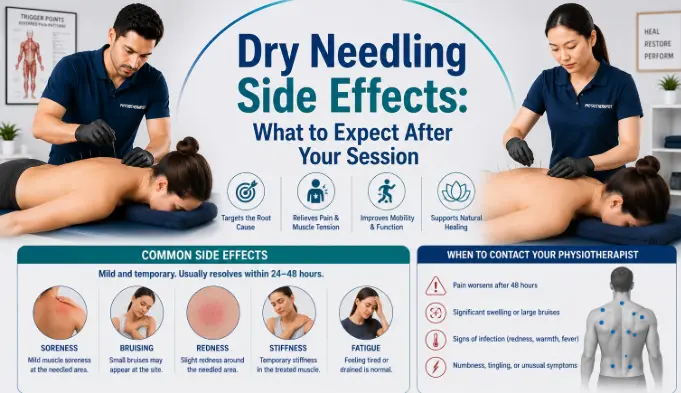
The most common dry needling side effect is muscle soreness at the treated area lasting 24 to 48 hours. Minor bruising occurs in about 10 to 20% of sessions. Light-headedness during treatment is uncommon but possible. Serious side effects like infection or pneumothorax are extremely rare when proper technique and sterile needles are used by a trained physiotherapist.
Knowing what to expect after dry needling helps you prepare properly and recognise the difference between normal post-treatment responses and something that needs attention. A lot of patients are surprised by how sore the treated muscles feel the next day and worry something has gone wrong. In most cases it has not.
This guide covers every side effect associated with dry needling therapy, how common each one is, how long it lasts and when you should contact your physiotherapist.
Normal Post-Needling Responses
1. Muscle Soreness
Up to 70% of patients experience localised muscle soreness at the treated area after dry needling. This soreness feels similar to the deep ache after intense exercise or a deep tissue massage. It typically develops within a few hours of treatment and peaks at 24 hours. It resolves completely within 24 to 48 hours in most patients.
This soreness is caused by the local tissue response to needle insertion, the release of the trigger point and the minor muscle trauma that stimulates the healing cascade. It is a sign that the tissue has responded to treatment.
2. A Local Twitch Response During Treatment
When a needle hits an active trigger point, the muscle often produces a brief involuntary contraction called a local twitch response. This feels like a sudden jump or cramp in the muscle and can be intense and surprising. It is completely normal and is actually a positive clinical sign that the correct trigger point has been identified and engaged.
3. Temporary Symptom Increase
In chronic conditions where trigger points have been present for a long time, symptoms sometimes increase in the first 24 hours before improving. This is a normal inflammatory response. It does not mean the treatment has made things worse. It typically settles within 48 to 72 hours.
Common Side Effects
Minor Bruising
Minor bruising at needle sites occurs in approximately 10 to 20% of dry needling sessions. It is more common when needling superficial areas close to blood vessels, in patients taking anticoagulant medication and in fair-skinned patients. Bruising typically resolves within three to seven days. It is not harmful.
Light-Headedness or Vasovagal Response
A small number of patients (approximately 1 to 5%) experience light-headedness during or immediately after dry needling. This is a vasovagal response: the nervous system’s response to needle insertion causes a temporary drop in blood pressure and heart rate. It typically resolves within a few minutes with rest.
To reduce the risk: do not attend your session on an empty stomach. Eat a light meal one to two hours before treatment. Inform your physiotherapist if you have a history of fainting with needles.
Temporary Fatigue
Some patients feel unusually tired after a dry needling session, particularly after treatment of larger muscle groups or multiple sites in one session. This typically resolves within a few hours. Drinking adequate water and avoiding strenuous activity on the day of treatment helps.
Rare Side Effects
Infection
Infection from dry needling is extremely rare and almost always associated with reuse of needles or failure to maintain sterile technique. At AlignBody, all needles are individually packaged, single-use and sterile. They are opened in front of you and disposed of in a medical sharps container immediately after use.
Nerve Irritation
Temporary nerve irritation can occur if a needle inadvertently contacts a peripheral nerve. Patients using dry needling for pain in areas like the back, neck, shoulder or knee should be aware of this. This produces a sharp shooting sensation during needling. The physiotherapist immediately adjusts the needle position. Persistent nerve symptoms lasting more than 48 hours should be reported.
Pneumothorax
Pneumothorax (a collapsed lung) is a very rare but serious potential complication when needling near the lung apex in the upper back or shoulder region. Unlike dry needling vs acupuncture, both involve needles but use very different techniques and depths. It is almost exclusively associated with inadequate training and incorrect technique. At AlignBody, all practitioners hold postgraduate dry needling certification. Signs include sudden chest pain and shortness of breath after needling near the upper back. Seek emergency care immediately if these occur.
After Your Session: What to Do
- Drink plenty of water throughout the day
- Apply a cold pack to sore areas if needed for the first few hours
- Gentle movement and stretching is helpful during the soreness phase
- Avoid intense exercise or heavy lifting on the day of treatment
- Do not apply heat to bruised areas in the first 24 hours
When to Contact AlignBody After Dry Needling
- Redness, warmth or swelling at a needle site persisting beyond 72 hours or worsening
- Numbness or weakness that develops after treatment and does not resolve within 24 hours
- Pain at the treatment site that is severe and worsening after 48 hours
- Any chest symptoms after needling near the upper back or shoulder — seek emergency care immediately