How Long Does Posture Correction Take? A Realistic Timeline
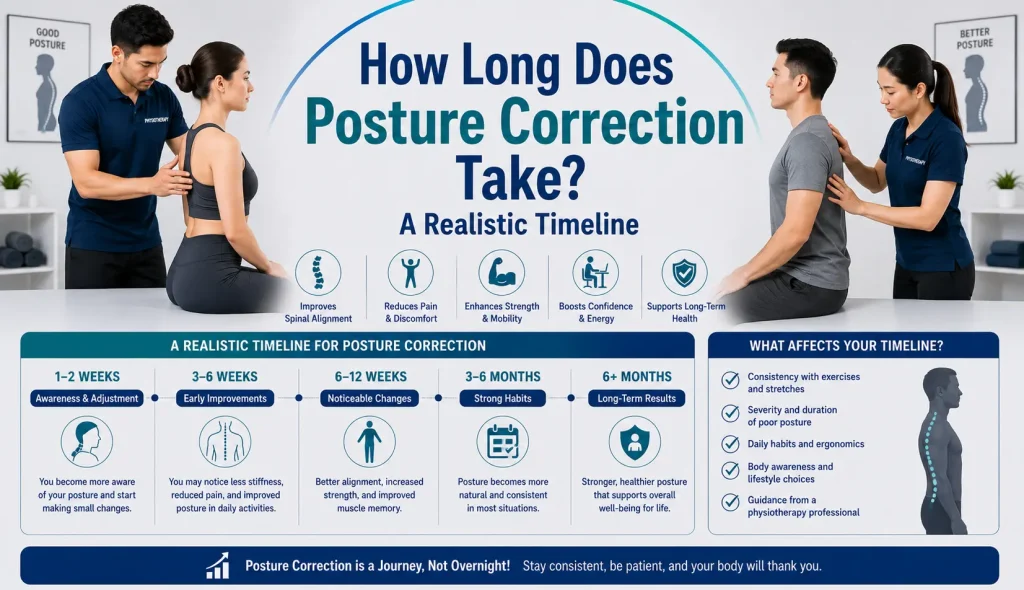
Noticeable improvement in posture typically takes four to eight weeks of consistent physiotherapy and daily exercises. Full correction of established postural patterns takes three to six months. The timeline depends on how long the poor posture has been present, how consistently you do your exercises and whether you address the underlying causes such as your work setup and daily movement habits.
This is one of the most common questions patients ask when they start posture correction physiotherapy. They want to know how long they need to commit to this and when they will see real change.
The honest answer is that posture correction takes longer than most apps and online guides suggest. Quick fixes do not work. But with the right approach, real and lasting change is achievable for most people. If you are wondering whether can physiotherapy fix bad posture, the answer for most cases is yes. This guide explains what a realistic timeline looks like and what affects how quickly you progress.
Why Posture Correction Takes Time
Your current posture is the result of years or decades of habitual positioning. The muscles that pull you into a forward head posture or rounded shoulders have been in that shortened position for a long time. The neural pathways that control your muscle activation patterns have been reinforced repeatedly. The connective tissue has adapted to support the habitual positions.
Changing all of this requires neurological reprogramming as much as physical strengthening. Your brain needs to learn new movement patterns. Your muscles need to develop new strength and flexibility ratios. Your connective tissue needs time to remodel. None of this happens in two weeks.
A Realistic Posture Correction Timeline
Weeks 1 to 4: Awareness and Initial Mobility
In the first month, the focus is on developing awareness of your current posture, releasing the tight structures that are pulling you out of alignment and beginning the strengthening exercises that will eventually hold you in better alignment. Explore the best posture correction exercises for men and women you can do at home alongside your sessions.
You may not look significantly different in the mirror at four weeks. But you should notice that you can sit or stand taller for longer periods before fatigue sets in. The muscles needed for good posture are getting stronger even if the habit is not fully established yet.
Weeks 4 to 8: Visible Improvement
Between four and eight weeks with consistent physiotherapy and daily home exercises, most patients begin to notice visible changes. Forward head posture is less pronounced. Rounded shoulders start to sit back further in a resting position. The muscles that maintain good alignment are becoming strong enough to do so without conscious effort for increasing periods of time.
People around you often notice the change before you do. Comments like “you seem taller” or “you’re standing differently” are common at this stage.
Months 2 to 6: Pattern Establishment
This is the most important phase. The exercises are progressing. The structural changes are continuing. But the critical work in this phase is establishing the new posture as your default rather than something you have to think about consciously.
Good posture becomes habitual when the muscles required to maintain it are strong enough to do so without effort and when the neural pathways controlling those muscles have been reinforced enough times through practice that the new position feels natural. This typically takes three to six months of consistent work.
Beyond 6 Months: Maintenance
After six months of consistent work, most patients with adult-onset postural problems have achieved significant and visible correction. The work at this stage shifts from active correction to maintenance: continuing with a reduced exercise programme (which may include Pilates therapy) and maintaining the ergonomic and movement habit changes that support good alignment.
Factors That Affect Your Posture Correction Timeline
| Factor | Effect on Timeline |
|---|---|
| How long you have had poor posture | Longer duration means more established patterns and longer correction time |
| Your age | Younger patients typically respond faster. Connective tissue is more adaptable in younger people |
| Consistency with home exercises | Daily home exercises produce significantly faster results than clinic sessions alone |
| Addressing the cause | Fixing your workstation setup and daily habits matters as much as the exercises |
| Severity of postural deviation | Mild forward head posture corrects faster than severe kyphosis or significant scoliosis |
| Presence of pain | Significant pain can slow exercise progression but physiotherapy addresses both simultaneously |
Common Posture Problems and Their Correction Timelines
Forward Head Posture
Forward head posture (where the head sits forward of the shoulder line) is one of the most common and most responsive to treatment. With proper chin tuck exercises, deep cervical flexor strengthening and thoracic extension work, most patients see significant improvement in six to ten weeks and substantial correction in three to four months.
Rounded Shoulders
Correcting rounded shoulders requires lengthening the shortened chest and anterior shoulder structures while strengthening the rhomboids, lower trapezius and serratus anterior muscles. The structural changes typically take four to six months but patients notice the improvement from around eight weeks.
Anterior Pelvic Tilt
Anterior pelvic tilt (an exaggerated lumbar curve caused by tight hip flexors and weak glutes) responds well to physiotherapy. Hip flexor stretching combined with glute and core strengthening typically produces visible improvement within six to eight weeks and substantial correction within four to five months.
Kyphosis (Hunched Upper Back)
Established kyphosis in adults takes longer to address than other postural problems. Significant improvement is achievable but expectations need to be realistic. A three to twelve-month programme with thoracic mobility work, posterior chain strengthening and targeted movement habit changes is typically needed. You can also read more about core strengthening exercises for back pain that support this process.
What Posture Correction Actually Involves
Real posture correction at AlignBody physiotherapy clinic is not about wearing a posture brace or doing ten minutes of exercises per day. It involves a structured programme of targeted exercises, hands-on physiotherapy to release restricted tissue and mobilise stiff joints, ergonomic and lifestyle changes to remove the habits that are perpetuating the problem and gradual progression as strength and mobility improve.
You will also need to change how you sit, stand and move during your day. Without that, even the best exercise programme is fighting against the eight hours of poor positioning at your desk every day.
Book a Posture Assessment at AlignBody, DelhiEast Delhi: Jagriti Enclave | South Delhi: Vasant Vihar | +91 9310 014 226