Frozen Shoulder: Stages, Exercises & Recovery Time

✓ Quick Answer
Frozen shoulder (adhesive capsulitis) is a condition where the capsule around the shoulder joint becomes inflamed, then thickened and tight, so the arm becomes painful and stiff in every direction. It usually passes through three stages, freezing, frozen and thawing, and most people recover most of their movement within 1 to 3 years. Physiotherapy cannot skip the stages, but the right exercises at the right stage reduce pain, protect the movement you still have and help you regain the rest sooner.
The three stages of frozen shoulder
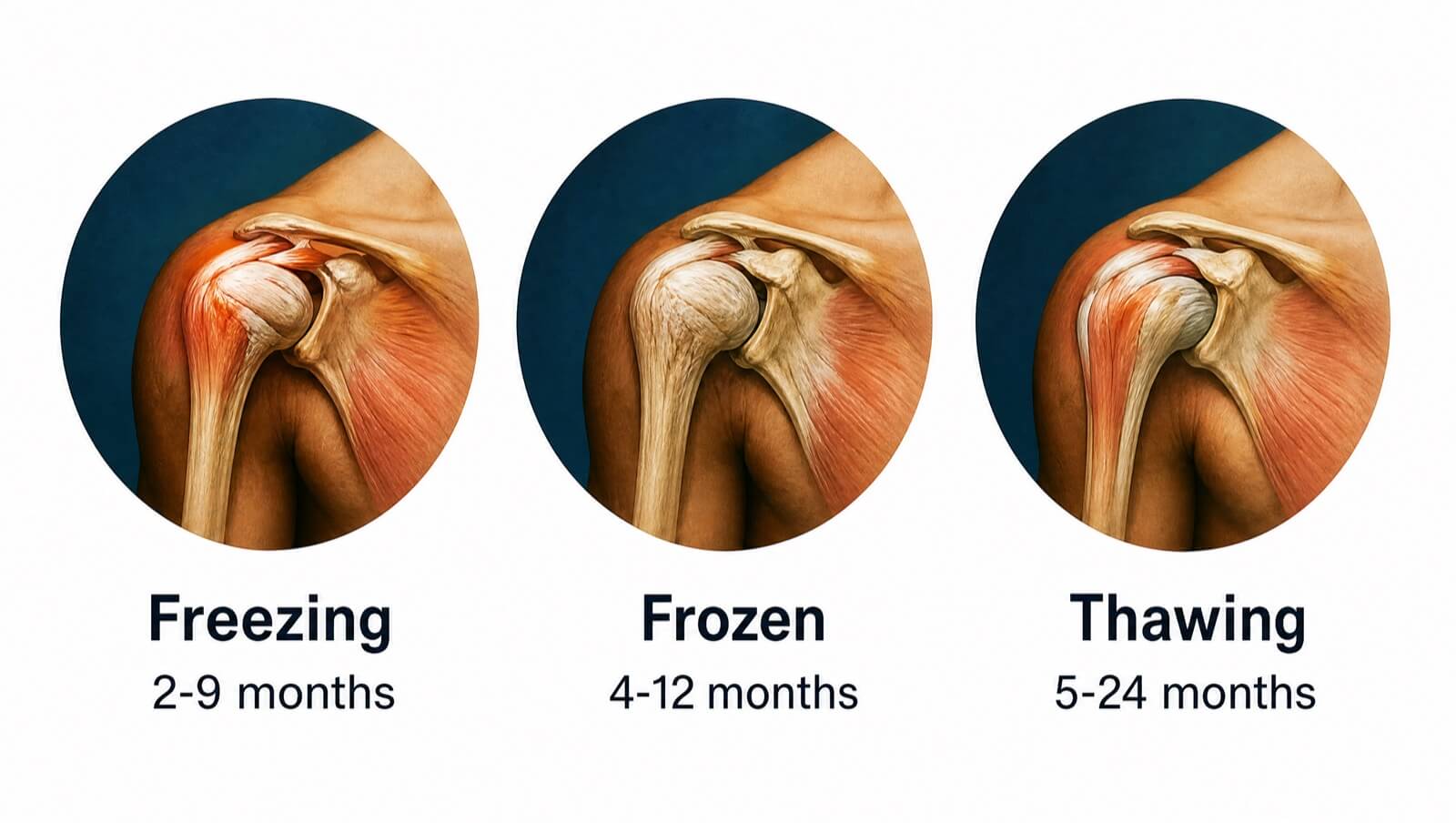
1. Freezing (painful)
Typical length: About 2 to 9 months
What you feel: Pain that builds, often worse at night and when lying on that side. Movement starts to reduce.
Treatment focus: Pain control, gentle movement within comfort, sleep positions
2. Frozen (stiff)
Typical length: About 4 to 12 months
What you feel: Pain eases, but the shoulder is very stiff. Reaching up, behind your back or out to the side is hard.
Treatment focus: Progressive stretching, joint mobilisation, keeping the arm in use
3. Thawing (recovery)
Typical length: About 5 months to 2 years
What you feel: Movement gradually returns. Pain is usually low.
Treatment focus: Stronger stretching and strengthening to restore full use
These durations are typical ranges, not fixed timelines. The stages overlap, and some people move through them much faster. The NHS guide to frozen shoulder notes that it can take months or years to get better.
What causes frozen shoulder, and who gets it
The exact cause is not fully understood. The joint capsule becomes inflamed and then develops scar-like thickening that shrinks the space the joint can move in. It is more common:
- Between the ages of 40 and 60, and more often in women
- In people with diabetes. A meta-analysis in the Muscles, Ligaments and Tendons Journal (Zreik et al., 2016) found frozen shoulder in about 13 percent of people with diabetes, several times the rate in the general population
- With thyroid disease
- After a period of keeping the arm still, for example after a fracture, surgery or a stroke
If you have diabetes and new shoulder pain with stiffness, mention it early. Keeping blood sugar well controlled is part of looking after the shoulder.
Is it frozen shoulder or something else?
Many shoulder problems hurt. Frozen shoulder stands out because the shoulder is stiff even when someone else tries to move it for you. With a rotator cuff problem or impingement, the arm is usually painful to lift yourself but moves more freely when supported. Turning the arm outwards with the elbow at your side (external rotation) is often the first and most restricted movement in frozen shoulder.
Our shoulder pain guide compares frozen shoulder and impingement in more detail. An assessment confirms which one you have, because the treatment is different.
Frozen shoulder exercises by stage
Do these slowly. In the freezing stage, stay within a range that causes only mild discomfort. Forcing a painful shoulder at this stage usually flares it up. In the frozen and thawing stages you can stretch further into tightness, as long as pain settles within an hour or so.
Freezing stage: keep it moving, gently
Pendulum
How: Lean forward with your good hand on a table. Let the sore arm hang and swing it in small circles
Dose: 1 minute each direction, 2 to 3 times a day
Table slide
How: Sit at a table, rest your hand on a towel and slide it forward, then back
Dose: 10 slow repetitions
Supported elbow bend and straighten
How: Keep the elbow, wrist and hand moving so they do not stiffen too
Dose: 10 repetitions, several times a day
Frozen and thawing stages: stretch into the tightness
Stick-assisted outward rotation
How: On your back, elbow at your side bent to 90 degrees. Use a stick in the other hand to push the sore hand outwards
Dose: Hold 20 to 30 seconds, 5 times
Wall or finger walk
How: Face a wall and walk your fingers up as high as is comfortable, then step closer
Dose: 5 to 10 repetitions
Towel stretch behind the back
How: Hold a towel behind your back, top hand pulling the sore hand gently upwards
Dose: Hold 20 to 30 seconds, 5 times
Cross-body stretch
How: Use the good arm to bring the sore arm across your chest
Dose: Hold 20 to 30 seconds, 5 times
Resistance band rotations (thawing stage)
How: Elbow at your side, rotate outwards and inwards against a light band
Dose: 2 sets of 10 to 15
Frozen shoulder treatment options
Physiotherapy
Physiotherapy combines a stage-matched home exercise plan with hands-on joint mobilisation, soft tissue release and advice on sleeping, dressing and work positions. A Cochrane review of manual therapy and exercise for frozen shoulder (Page et al., 2014) found that physiotherapy alone may be less effective than a steroid injection in the short term, and that the two together may work better than either. That is why we often work alongside your doctor rather than instead of them.
Steroid injection
A corticosteroid injection into the joint can reduce pain, especially in the freezing stage. It works best when followed by exercise to use the pain-free window. Your doctor will advise whether it suits you, particularly if you have diabetes, as steroids can raise blood sugar for a few days.
Hydrodilatation, manipulation and surgery
If the shoulder stays severely stiff despite months of good care, an orthopaedic doctor may suggest stretching the capsule with fluid (hydrodilatation), manipulation under anaesthesia or keyhole release. Physiotherapy straight afterwards is essential to keep the movement gained.
Supporting therapies
Heat before stretching, myofascial release for the surrounding neck and upper back muscles, which tighten as you compensate, and electrotherapy for pain can make exercise easier. They support the exercise plan rather than replace it.
Mistakes that slow recovery
Forcing painful stretches in the freezing stage. This often makes the inflammation, and the night pain, worse.
Stopping all movement. A sling for weeks speeds up the stiffness.
Stopping exercise when pain eases. The frozen stage is when stretching makes the biggest difference.
Hitching the shoulder up to lift the arm. This trains a pattern that strains the neck. A physiotherapist can correct it early.
How to sleep with frozen shoulder
Night pain is one of the hardest parts of the freezing stage. Try lying on your back with a pillow under the elbow of the sore arm, or on your good side hugging a pillow so the sore arm is supported in front of you. Avoid lying on the painful side.
Frequently asked questions
How long does frozen shoulder last?
Typically 1 to 3 years from start to finish across the three stages, although many people regain most of their movement sooner. Some people are left with a small loss of movement that rarely affects daily life.
What are the best exercises for frozen shoulder?
In the painful freezing stage: pendulum swings and table slides within comfort. In the frozen and thawing stages: stick-assisted outward rotation, wall walks, towel stretches behind the back and cross-body stretches, building to resistance band strengthening.
Can frozen shoulder heal on its own?
It usually does improve on its own over time, but recovery can take years and some stiffness may remain. Treatment aims to control pain, shorten the stiff phase and restore as much movement as possible.
Is frozen shoulder linked to diabetes?
Yes. People with diabetes are several times more likely to develop frozen shoulder, and it may affect both shoulders and last longer. A 2016 meta-analysis found it in about 13 percent of people with diabetes.
Should I keep moving a frozen shoulder?
Yes, gently. In the painful stage, move within comfort rather than through sharp pain. In the stiff stage, stretch more firmly. Complete rest makes the stiffness worse.
Can frozen shoulder come back?
It rarely returns in the same shoulder. Some people, especially those with diabetes, later develop it in the other shoulder.
Get the right diagnosis early
Frozen shoulder, rotator cuff problems and referred pain from the neck can look similar at first. Getting the diagnosis right in the freezing stage means the right treatment from the start, and less time lost.
See our shoulder pain treatment in Delhi, book at our Jagriti Enclave clinic in East Delhi or our South Delhi clinic in Vasant Vihar, or ask about physiotherapy at home if travelling is difficult. You can also contact AlignBody directly.
Reviewed by Dr. Richa Gupta, Physiotherapist, AlignBody. This article is general information and does not replace individual clinical assessment. Sudden shoulder pain with chest pain, breathlessness or sweating can be a sign of a heart problem and needs emergency care.