Dry Needling for TMJ Dysfunction Treatment Guide
✓ Quick Answer
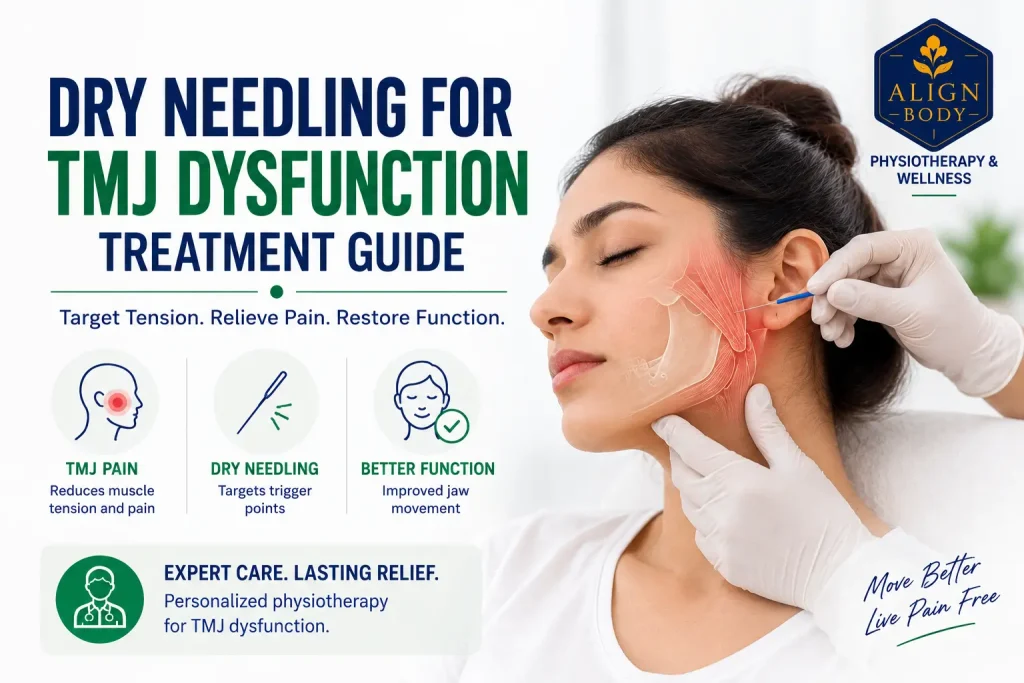
Dry needling for TMJ dysfunction targets myofascial trigger points in the masseter, temporalis and pterygoid muscles. The Khayamzadeh 2025 systematic review (10 RCTs) confirmed dry needling as highly effective. Davydenko 2024 documented 63.51% VAS pain reduction plus 57.09% trigger point reduction. Sessions typically last 20-30 minutes with results within 2-4 weeks.
Every week our clinic sees patients across Delhi NCR presenting with facial pain concerns with TMJ pain, jaw tightness and restricted mouth opening. Notably, in our clinical experience myofascial trigger points drive most muscular TMJ cases, making dry needling exceptionally effective. Explore our point dry needling therapy in Jagriti Enclave for targeted TMJ care.
Written By
Dr. Richa Gupta
Founder, AlignBody Physiotherapy Clinic. APBC-certified (USA, Thailand). Diploma in Osteopathy (Ontario).
14+ years clinical practice, Delhi NCR
What Is Dry Needling for TMJ Dysfunction
Firstly, dry needling (DN) uses thin filiform needles inserted into myofascial trigger points (MTrPs) within taut muscle bands. Additionally, for temporomandibular joint dysfunction, needles target hyperirritable spots in masticatory muscles causing jaw pain and dysfunction. Furthermore, the Khayamzadeh 2025 systematic review published in Clinical and Experimental Dental Research (DOI 10.1002/cre2.70214), conducted per PRISMA guidelines, analysed 10 RCTs confirming DN as a highly effective TMJ intervention. To learn dry needling fundamentals first, read our guide on what is dry needling therapy.
Target Muscles for TMJ Dry Needling
Notably, three primary masticatory muscles typically require dry needling for TMJ dysfunction, identified through palpation and pressure pain threshold testing. Consequently, addressing all involved muscles delivers superior clinical outcomes.
Primary target muscles for TMJ dry needling:
Masseter: primary jaw closer, most commonly needled muscle.
Temporalis: fan-shaped muscle above the ear.
Lateral pterygoid: jaw protrusion and opening.
Medial pterygoid: jaw closing and lateral movement.
Secondary muscles: sternocleidomastoid, upper trapezius, suboccipitals.
Evidence Base: 2025 Systematic Review Findings
Key evidence for dry needling in TMJ:
Davydenko 2024 (Ukrainian Dental Almanac): 63.51% VAS pain reduction (p<0.05), 57.09% trigger point reduction.
Reis et al. 2017: VAS scores dropped 8.3 to 2.3 post-masseter DN (p<0.05).
Dunning et al. 2024: DN plus spinal manipulation outperformed splint therapy (p<0.001) at 3-month follow-up.
Ferreira et al. 2023: DN increases masseter muscle oxygenation.
Özden et al. 2018 (CRANIO): confirmed efficacy for myofascial TMD.
How Dry Needling Works for TMJ
Typically, in our clinical experience and in our patient outcomes, dry needling produces effects through four mechanisms. Also, the needle entry triggers cascading neurochemical reactions beyond mechanical release.
4 dry needling mechanisms in TMJ:
Trigger point deactivation: disrupts taut band pathology.
Local twitch response (LTR): resets muscle spindle function, verified by electromyography (EMG).
Increased oxygenation: improved local blood flow.
Descending inhibition: central pain modulation activated.
Dry Needling Techniques for TMJ
Overall, our clinic uses multiple validated needling approaches based on muscle depth and patient tolerance. Specifically, three main techniques dominate current TMJ practice.
3 TMJ dry needling techniques:
Superficial dry needling: 5-10mm depth, gentle approach for masseter myofascial pain.
Deep dry needling (DDN): reaches deeper trigger points in temporalis.
Intraoral needling: access lateral pterygoid via mouth (advanced technique).
Pistoning technique: gentle in-out movement to elicit LTR.
Furthermore, for advanced spine-related TMJ presentations, our neuro-myoskeletal dry needling in Jagriti Enclave integrates cervical spine treatment. For chiropractic-focused TMJ management, see our detailed guide on chiropractic for TMJ jaw pain clicking treatment.
Session Protocol and What to Expect
TMJ dry needling session structure:
Assessment (10 min): palpation, MFIQ questionnaire, mouth opening measurement, VAS (visual analog scale) baseline.
Preparation (5 min): skin cleansing, sterile needle selection, pressure algometer baseline.
Needling phase (15-20 min): 3-6 needles per muscle, retained 10-15 min.
Post-treatment (5 min): gentle stretching, hydration advice.
Follow-up: 2-3 sessions per week initially, 4-6 sessions total.
Also, for questions about session experience, read our guides on does dry needling hurt and how long dry needling takes to work.
Dry Needling vs Other TMJ Treatments
Importantly, Dunning et al. 2024 RCT demonstrated dry needling combined with spinal manipulation outperformed interocclusal splint therapy, pharmacological management and non-thrust mobilisation at 3-month follow-up. Also, understanding the difference between dry needling and other interventions helps patients choose the right approach.
TMJ treatment comparison:
Dry Needling
Targets trigger points directly, rapid results, 4-6 sessions.
Interocclusal Splint
Dental night guard, night-time use, slower symptom change.
Pharmacological
NSAIDs, muscle relaxants, symptomatic only.
Manual Therapy
Non-thrust mobilisation, less targeted than DN.
Furthermore, the Fernández-de-las-Peñas 2021 meta-analysis confirmed dry needling combined with other therapies delivers superior outcomes for myofascial trigger points. For the acupuncture comparison, read our dry needling vs acupuncture guide.
Safety and Side Effects
Overall, dry needling for TMJ has an excellent safety profile when performed by trained practitioners. Additionally, we see most side effects as mild and transient.
TMJ dry needling safety profile:
Common (mild): post-treatment soreness 24-48 hours.
Occasional: minor bruising at insertion site, especially in myogenous TMD patients.
Rare: temporary jaw fatigue, mild fatigue.
Contraindications: bleeding disorders, needle phobia, active infection.
For complete safety information, read our detailed guides on is dry needling safe and dry needling side effects.
Recovery Timeline and Prevention
Across our Delhi practice, we see four common TMJ recovery patterns after dry needling shaped by our clinical experience. Also, at AlignBody we track most patient improvement by session 3-4 with significant results.
TMJ dry needling recovery pattern:
Session 1-2 (Week 1)
Initial pain reduction, muscle tension release.
Session 3-4 (Week 2)
Improved mouth opening, sustained pain relief.
Session 5-6 (Week 3-4)
Functional restoration, exercise integration.
Maintenance (monthly)
Prevention protocol, stress management.
Frequently Asked Questions
Does dry needling really help TMJ pain?
Yes, the Khayamzadeh 2025 systematic review of 10 RCTs confirmed dry needling as highly effective for TMJ dysfunction. Also, Davydenko 2024 documented 63.51% pain reduction in VAS scores after dry needling sessions.
How many dry needling sessions do I need for TMJ?
Typically, 4-6 sessions over 3-4 weeks resolve most TMJ cases. Also, chronic conditions may require 8-10 sessions plus maintenance visits every 4-6 weeks for sustained relief.
Which muscles are needled for TMJ dysfunction?
Generally, the masseter, temporalis and pterygoid muscles are the primary targets. Additionally, secondary muscles like sternocleidomastoid and upper trapezius may be needled based on referred pain patterns.
Is dry needling for TMJ painful?
Typically, mild discomfort during needle insertion resolves within seconds. Also, the therapeutic local twitch response feels like a brief cramp. Most patients tolerate the treatment well, especially when diagnosed via the Research Diagnostic Criteria for TMD (RDC/TMD).
Can dry needling replace mouth guards or dental splints?
Ideally not as complete replacement, but dry needling addresses muscular components while splints address occlusal factors. Additionally, combined care often delivers superior outcomes per current evidence.
What are the risks of jaw dry needling?
Generally, risks include mild soreness (common), minor bruising (occasional) and rarely temporary jaw fatigue. However, when performed by trained practitioners, complications are extremely rare.
Should I combine dry needling with other TMJ treatments?
Yes, Dunning et al. 2024 confirmed dry needling combined with spinal manipulation delivers superior outcomes versus dry needling alone. Also, at AlignBody we integrate cervical treatment plus stress management for comprehensive care, especially for bruxism-related presentations.
In summary, dry needling offers evidence-based effective treatment for TMJ dysfunction through direct trigger point deactivation in masticatory muscles. Book at our point dry needling clinic in Jagriti Enclave East Delhi or dry needling therapy in South Delhi for expert TMJ care. Also read our related guides on dry needling fundamentals and chiropractic for TMJ.