Slip Disc Treatment in Delhi: Non-Surgical Options That Actually Work
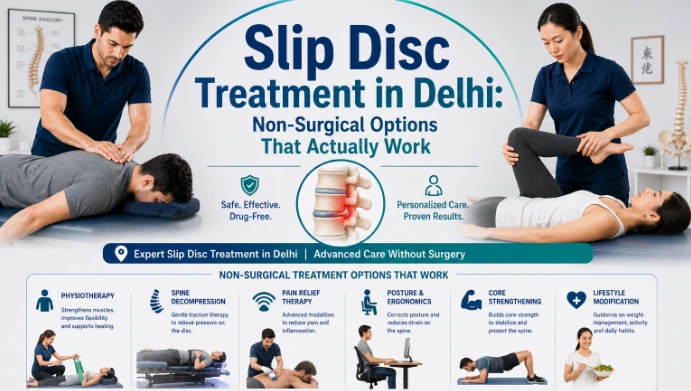
Slip disc treatment in Delhi without surgery includes physiotherapy with McKenzie method exercises, manual therapy, traction, dry needling and shockwave therapy. Most patients with a slip disc recover fully with physiotherapy over six to twelve weeks. Surgery is only necessary in a small minority of cases where nerve compression causes severe weakness or loss of bladder or bowel control.
Being told you have a slip disc is alarming. The pain can be severe and the fear that you need surgery is very real. Most people who search for slip disc treatment in Delhi do so when the pain has become bad enough to interfere with work, sleep or daily movement.
The good news is that the evidence is clearly on the side of non-surgical treatment. The majority of disc herniations and bulges improve significantly with physiotherapy. This guide explains what options are available in Delhi, what the evidence says about each and what to expect from treatment at AlignBody.
What Is a Slip Disc?
A slip disc is a common term for a disc herniation or disc prolapse. The discs between your vertebrae each have a tough outer ring and a softer gel-like centre. When the outer ring develops tears or weakens, the inner material can push outward. Depending on the direction and severity of this protrusion, it may press on a nearby nerve root causing pain, numbness or weakness that radiates down the leg or arm.
The lower back levels (L4-L5 and L5-S1) are most commonly affected. Cervical disc problems at C5-C6 and C6-C7 are the next most common. Many people are confused about the difference between the two conditions — you can read our detailed breakdown here: Slip Disc vs Herniated Disc. Thoracic slip discs are much rarer.
Does a Slip Disc Heal Without Surgery?
Yes, in most cases. This is one of the most important things to understand about disc problems. Research consistently shows that disc herniations can reduce in size over time and that the immune system actually contributes to resorption of the herniated material. A 2019 meta-analysis found that disc herniation resorbed spontaneously in approximately 66% of patients over time.
Clinical recovery rates with physiotherapy are high. Studies comparing surgical and non-surgical treatment for lumbar disc herniation typically find similar outcomes at two years, with surgery providing faster short-term relief but equivalent long-term results. Given that surgery carries its own risks, physiotherapy is the recommended first-line treatment for most slip disc presentations. At AlignBody we regularly see patients who have been told they need surgery and who recover fully with physiotherapy.
Non-Surgical Slip Disc Treatment Options in Delhi
1. Physiotherapy with McKenzie Method
The McKenzie method is the most evidence-based approach for disc-related back and neck pain. It involves identifying the specific direction of movement that reduces your pain and centralises your symptoms. For most lumbar disc bulges, extension-based exercises (pressing up onto the elbows or hands while lying face down) reduce disc pressure and help the herniated material retract.
A McKenzie-trained physiotherapist assesses your directional preference and builds your exercise programme around it. This is not generic back pain exercise — it is targeted treatment based on how your specific disc responds to specific movements. Core strengthening is also an essential part of the recovery process. See our guide on core strengthening exercises for back pain to understand what exercises are safe and effective.
2. Manual Therapy and Spinal Mobilisation
Manual therapy involves hands-on techniques that reduce pain, improve spinal mobility and address the muscle spasm that often develops around a disc injury. At AlignBody, manual therapy is used alongside exercise rather than as a standalone treatment. It helps patients move better so they can engage with their exercise programme more effectively. To understand how this fits into the broader picture, read our post on how physiotherapy helps in orthopedic conditions.
3. Spinal Traction
Traction applies a gentle distraction force to the spine, temporarily increasing the space between vertebrae and reducing pressure on the affected disc and nerve. Mechanical traction under the guidance of a physiotherapist is used selectively for patients with significant nerve root compression who have not responded to other approaches.
4. Dry Needling
Dry needling releases the severe muscle spasm that often surrounds a disc injury. The paraspinal muscles lock down around a disc herniation as a protective response. This muscle tension is useful early on but can worsen nerve compression over time. Dry needling at the trigger points in these muscles provides significant relief and allows patients to start moving more freely.
If you want to understand this treatment in more detail before your session, read: What is dry needling treatment? and Is dry needling safe?
5. Shockwave Therapy
Shockwave therapy is increasingly used in physiotherapy for disc-related conditions, particularly when there is chronic muscle involvement or when tendon structures adjacent to the spine have been affected by altered movement patterns. It is more commonly used for soft tissue conditions like plantar fasciitis and tendinopathies but has clear application in chronic back pain management.
Useful reads: Shockwave therapy vs physiotherapy and Is shockwave therapy safe?
6. TENS and Electrotherapy
Transcutaneous electrical nerve stimulation can help manage pain during the acute phase by modulating pain signals through the gate control mechanism. It is not a cure but provides symptomatic relief that allows patients to participate in their rehabilitation. AlignBody has a dedicated electrotherapy clinic in East Delhi with trained therapists for this.
When Is Surgery Actually Needed for a Slip Disc?
Surgery for a slip disc is appropriate in a minority of cases. The specific indications are:
- Progressive weakness in the leg or foot (foot drop) that does not improve with physiotherapy
- Cauda equina syndrome: loss of bladder or bowel control, saddle anaesthesia (numbness around the inner thighs and genitals). This is a surgical emergency
- Severe unrelenting pain that does not respond to six to eight weeks of proper physiotherapy
- Significant functional limitation from nerve compression that is not improving
If none of these apply to you, there is no clinical indication for surgery and physiotherapy should be given a proper chance first. Slip disc very commonly causes shooting pain down the leg — if this is your main symptom, read our dedicated guide on sciatica pain treatment in Delhi.
How Long Does Slip Disc Treatment Take in Delhi?
| Severity | Expected Recovery Timeline | Treatment Frequency |
|---|---|---|
| Mild (pain only, no radiation) | 4 to 6 weeks | 2 to 3 sessions per week initially |
| Moderate (radiating pain, mild numbness) | 6 to 10 weeks | 2 to 3 sessions per week for first 4 weeks, then weekly |
| Severe (significant radiation, weakness) | 10 to 16 weeks | 3 sessions per week initially, review at 8 weeks |
| Chronic (symptoms more than 3 months) | 12 to 20 weeks | Individualised programme with regular review |
Slip Disc Treatment Cost in Delhi
The cost of physiotherapy for a slip disc in Delhi varies significantly between clinics. At AlignBody, your initial assessment includes a full clinical evaluation, directional preference testing and a written exercise plan. Session rates vary depending on the treatment modalities used.
Compared to the cost of surgery (including hospital stay and recovery time away from work) and the risk profile of surgical intervention, physiotherapy is dramatically more cost-effective for the majority of patients. Most patients require between 10 and 20 sessions for a full recovery. For patients who find travelling difficult in the early stages, physiotherapy at home in Delhi is also available.
Exercises to Avoid with a Slip Disc
During active disc symptoms, avoid the following until cleared by your physiotherapist:
- Heavy lifting with any spinal flexion
- Sit-ups and full crunches
- Running and high-impact activities
- Sustained forward bending at work or during exercise
- Rotational exercises under load
Slip Disc Treatment at AlignBody, Delhi NCR
At AlignBody we treat disc problems at our East Delhi clinic in Jagriti Enclave and our South Delhi clinic in Vasant Vihar. For patients in significant pain, home visit physiotherapy is available so you do not have to travel when movement is most difficult.
Your assessment at AlignBody includes a full clinical history, directional preference testing, neural tension testing and a specific exercise prescription from your first session. We do not use generic exercise programmes. Every patient with a disc problem leaves their first session with a targeted home exercise plan and a clear understanding of what to do and avoid.
Learn more about us and our clinical approach, or read about the lead physiotherapist Dr. Richa Gupta.
Book a Slip Disc Assessment at AlignBody, DelhiEast Delhi: Jagriti Enclave | South Delhi: Vasant Vihar | Home Visit Available
Call: +91 9310 014 226