Cervical Disc Bulge C5-C6 C6-C7 Treatment Guide
✓ Quick Answer
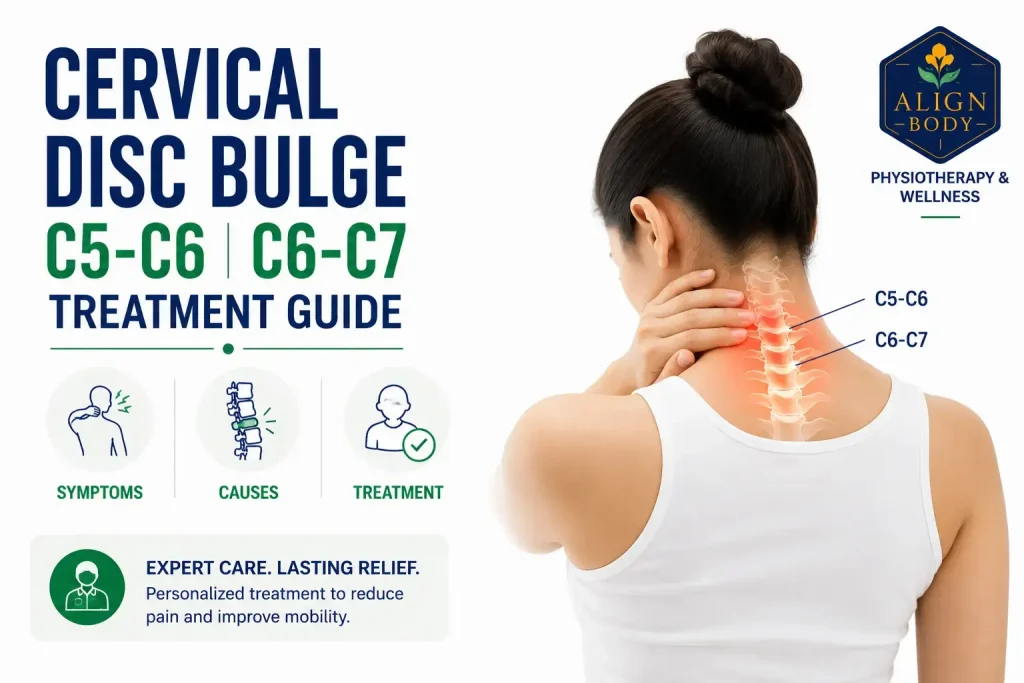
A cervical disc bulge occurs when an intervertebral disc in the neck (C1-C7) protrudes beyond its normal boundary, most commonly at C5-C6 and C6-C7 levels. Khandge et al. 2024 (Cureus DOI 10.7759/cureus.68163) documented C5-C6 as the most vulnerable level. This condition is medically termed cervical radiculopathy when nerve root compression occurs. Symptoms include neck pain, arm radiation, numbness in thumb/index/middle finger plus grip weakness. Conservative treatment resolves 80-90% of cases.
Every week our clinic sees patients across Delhi NCR who visit us with neck pain complaints with neck pain traced to cervical disc bulge. Notably, in our clinical experience most cervical disc bulge cases respond well to physiotherapy, chiropractic care and dry needling without surgery. Explore our disc bulge physiotherapy service in Delhi for personalised care.
Written By
Dr. Richa Gupta
Founder, AlignBody Physiotherapy Clinic. APBC-certified (USA, Thailand). Diploma in Osteopathy (Ontario).
14+ years clinical practice, Delhi NCR
What Is Cervical Disc Bulge: Anatomy Explained
Firstly, a cervical disc bulge is protrusion of an intervertebral disc in the neck beyond its normal vertebral boundary. Additionally, the cervical spine has seven vertebrae (C1, C2, C3 through C7) separated by intervertebral discs containing a soft nucleus pulposus surrounded by tough annulus fibrosus. The normal cervical lordosis (natural inward curve) supports head weight and shock absorption. Notably, mechanical neck pain accounts for 85% of neck pain presentations, with disc bulge being a leading cause. Furthermore, when annular fibres weaken from age, poor posture or trauma, the disc bulges outward and may compress nearby nerve roots, disrupting the Panjabi neutral zone of spinal stability. To understand the differences between related conditions, read our guide on slip disc vs herniated disc.
C5-C6, C6-C7, C4-C5: Which Level Bulges Most
Cervical disc bulge prevalence by level:
C5-C6: most common (weight bearing + movement zone).
C6-C7: second most common (mobility segment).
C4-C5: third most common (upper cervical).
C7-T1: least common (transition zone).
Cervical Disc Bulge Symptoms by Level
Typically, in our clinical experience symptoms follow the affected nerve root’s dermatomal distribution. Specifically, each cervical level produces distinct symptom patterns.
Symptoms by cervical level:
C4-C5 bulge: shoulder pain, deltoid weakness, no finger tingling.
C5-C6 bulge: thumb and index finger tingling, biceps and wrist extensor weakness, wrist drop.
C6-C7 bulge: middle finger numbness, triceps weakness, grip weak.
C7-T1 bulge: ring finger and little finger numbness, hand intrinsic weakness.
Common: neck stiffness, radiating pain, reduced range of motion.
Nocturnal signs: symptoms worse in morning, sleep disruption.
Also, related conditions like cervical spondylosis can present with overlapping symptoms , see our detailed guide on cervical spondylosis and neck pain and cervical stiffness.
What Causes Cervical Disc Bulge
6 primary causes of cervical disc bulge:
Age-related degeneration: disc dehydration after 30 years.
Forward head posture: screen work, mobile use.
Repetitive strain: occupational neck movements.
Trauma or whiplash: car accidents, sports injury.
Smoking: accelerates disc dehydration.
Genetic predisposition: family history of disc issues.
How Cervical Disc Bulge Is Diagnosed
Overall, at AlignBody we combine and use clinical examination with imaging when needed. Specifically, three clinical tests plus MRI confirm most diagnoses.
Cervical disc bulge diagnostic protocol:
Spurling test: neck extension with rotation reproduces radicular pain.
Distraction test: axial traction reduces symptoms (positive sign).
Neurological exam: reflex testing (biceps C5, brachioradialis C6, triceps C7).
Dermatomal mapping: sensory testing to identify affected nerve root.
MRI (gold standard): confirms bulge location, size and nerve compression per radiological grading.
X-ray + CT scan: assesses bony changes, cervical alignment.
Neck Disability Index (NDI) + NPRS: validated severity and functional assessment scales.
Non-Surgical Treatment Options
Overall, in our clinical experience 80-90% of cervical disc bulge cases resolve with conservative treatment. Furthermore, Khandge et al. 2024 (Cureus) confirmed conservative management as first-line care before considering surgical intervention. Woods and Hilibrand 2015 (Spine Journal RCT) demonstrated physiotherapy outcomes match surgery at 2-year follow-up for most cervical disc herniation patients.
Evidence-based conservative treatments:
Physiotherapy: manual therapy, cervical traction, exercise programme.
Chiropractic care: gentle cervical mobilisation and adjustment.
Dry needling: trigger point release in cervical paraspinal muscles.
McKenzie protocol: cervical extension exercises for centralisation.
Posture correction: ergonomic modification, workstation setup.
Cervical collar: short-term support during acute flare-ups.
Also, in our practice we integrate multi-modal care combining our chiropractic services in East Delhi with neuro-myoskeletal dry needling in Jagriti Enclave for faster recovery.
Best Exercises for Cervical Disc Bulge
6 safe cervical disc bulge exercises:
Chin tucks: 10 reps hourly for postural correction.
Cervical retraction: gentle backward glide, 10 reps 3x daily.
Deep neck flexor activation: supine chin nod, 10 sec hold x 10.
Scapular squeezes: shoulder blade retraction, 15 reps 3x daily.
Median nerve gliding: arm sequence for radicular symptoms.
Isometric neck exercises: hand resistance in 4 directions.
When Surgery Becomes Necessary Red Flags
Importantly, at AlignBody we identify red flag symptoms requiring urgent surgical consultation. Also, surgery is considered only when conservative care fails after 6-12 weeks or when serious neurological signs appear.
Red flags requiring surgical consultation:
Progressive weakness in arms or legs
Loss of bladder/bowel control (emergency)
Myelopathy signs: gait imbalance, hand clumsiness
Severe pain unresponsive to 6-12 weeks conservative care
Surgical options: ACDF, Cervical Disc Arthroplasty (CDA)
Minimally invasive: Unilateral Biportal Endoscopy (UBE)
Recovery Timeline and Prevention
Across our Delhi practice, we see four common recovery patterns based on severity and adherence. Also, most patients return to normal activities within 8-12 weeks combining physiotherapy, chiropractic care and dry needling.
Cervical disc bulge recovery timeline:
Acute phase (0-2 weeks)
Pain management, cervical support, activity modification.
Subacute (2-6 weeks)
Manual therapy, mobility restoration, gentle exercise.
Rehabilitation (6-12 weeks)
Strengthening, postural retraining, functional exercises.
Full recovery (3-6 months)
Return to activities, prevention programme, follow-up.
For detailed timeline information, read our guide on how long disc bulge takes to heal and understand whether disc bulge heals on its own. For comprehensive treatment approach, check our complete herniated disc physiotherapy guide.
Frequently Asked Questions
What is cervical disc bulge exactly?
Typically, cervical disc bulge is protrusion of an intervertebral disc in the neck beyond its normal boundary, commonly at C5-C6 or C6-C7 levels. Also, it may compress nearby nerve roots causing arm pain, tingling, reduced grip strength and weakness.
Can cervical disc bulge heal without surgery?
Yes, 80-90% of cervical disc bulge cases resolve with conservative treatment including physiotherapy, chiropractic care, dry needling and postural correction. Surgery becomes necessary only for severe neurological symptoms or red flag signs.
How long does cervical disc bulge take to heal?
Generally, mild cases improve within 4-6 weeks, moderate cases 8-12 weeks with consistent treatment. Also, full recovery typically takes 3-6 months combining physiotherapy and lifestyle changes.
Which sleeping position is best for cervical disc bulge?
Ideally, back sleeping with a cervical support pillow maintains natural neck curve. Additionally, side sleeping with pillow supporting the head at shoulder height works well; avoid stomach sleeping which extends the neck.
Is chiropractic safe for cervical disc bulge?
Yes, gentle chiropractic mobilisation performed by a trained chiropractor is safe and effective for cervical disc bulge. However, high-velocity manipulation should be avoided in acute or severe cases.
What exercises should I avoid with cervical disc bulge?
Generally, avoid heavy overhead lifting, deep neck flexion, contact sports plus jarring activities. Instead, follow physiotherapist-guided exercises focusing on chin tucks, scapular strengthening and deep neck flexor activation.
When should I see a physiotherapist for cervical disc bulge?
Ideally, at first sign of persistent neck pain with arm radiation, tingling or weakness we recommend consultation. Also, early intervention prevents progression and reduces need for surgery.
In summary, cervical disc bulge responds well to combined conservative treatment when initiated early. Book at our disc bulge physiotherapy Delhi clinic or South Delhi centre for expert assessment. Also explore our chiropractic services in East Delhi and neuro-myoskeletal dry needling in Jagriti Enclave for complete cervical care.