Cupping Therapy for Athletes and Sports Recovery
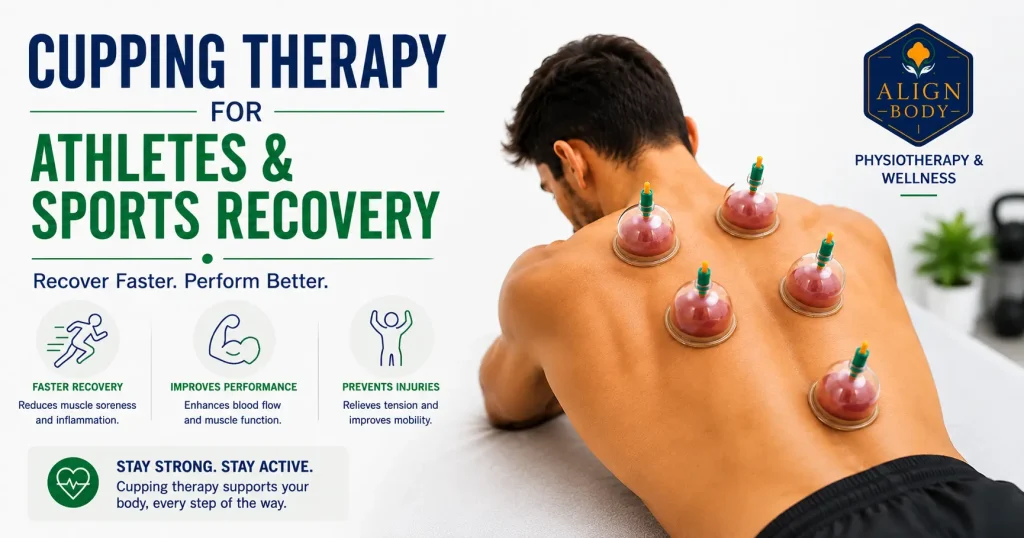
✓ Quick Answer
Cupping therapy for athletes accelerates muscle recovery by reducing DOMS, improving range of motion (ROM) and clearing lactate. Michael Phelps popularised the practice at the 2016 Rio Olympics. Bridgett et al. 2018 and Mohamed et al. 2023 systematic reviews support cupping as a low-risk, high-value recovery modality.
Every match season in our clinic, weekend cricketers, IPL trainees and marathon runners arrive seeking faster muscle recovery. Notably, since Michael Phelps sported cupping marks at Rio 2016, athlete interest across Delhi NCR has surged and our clinical experience shapes each athlete’s plan.
Written By
Dr. Richa Gupta
Founder, AlignBody Physiotherapy Clinic. APBC-certified (USA, Thailand). Diploma in Osteopathy (Ontario).
10+ years clinical practice, Delhi NCR
How Cupping Therapy Helps Athletes Recover Faster
Firstly, cupping helps athletes through four recovery mechanisms rooted in negative pressure physiology. Additionally, in our clinical experience at our clinic, these mechanisms translate to measurable performance gains within 2-3 sessions.
4 sports recovery mechanisms:
DOMS reduction: delayed onset muscle soreness relief via muscle spasm lift.
Lactate clearance: Arslan et al. 2016 documented metabolic recovery boost.
Range of motion: myofascial decompression improves ROM (Warren 2020).
Creatine kinase drop: objective muscle damage marker reduction.
Michael Phelps and the 2016 Rio Olympics Cupping Moment
Notably, though cupping dates back 4,000+ years to ancient Egyptian practice (Ebers Papyrus 1,550 BC) and Traditional Chinese Medicine (TCM), Michael Phelps (19-time Olympic gold medalist) brought it into modern global focus at Rio 2016 with visible circular marks on his shoulders. Similarly, USA gymnast Alex Naddour called cupping “better than any money I have spent” in USA Today interview. Furthermore, US gymnastics, swimming teams, plus Pittsburgh Pirates and New York Mets pitchers adopted cupping for recovery. Trainer Keenan Robinson introduced Phelps to cupping in 2014 through Chinese swimmers using traditional bamboo cups.
Cupping Therapy Evidence Base for Sports Recovery
Overall, four sports-focused systematic reviews anchor cupping’s evidence base for athletes.
Sports cupping evidence:
Bridgett et al. 2018 (J Altern Complement Med): first RCT review on amateur and professional athletes.
Mohamed et al. 2023 (J Back Musculoskelet Rehabil): 2,214 studies screened, 22 met inclusion.
Wood et al. 2020 (J Bodyw Mov Ther): dry cupping for musculoskeletal pain and ROM.
ElMeligie et al. 2024 (Human Movement): umbrella review with AMSTAR2 assessment.
Furthermore, Warren et al. 2020 (Int J Sports Phys Ther) demonstrated myofascial decompression benefits for hamstring flexibility, while wet cupping (hijama) has shown hemoglobin and red blood cell improvements in endurance athletes. A 2025 randomised controlled trial (RCT) in JPTCP with 50 athletes (10-min dry cupping sessions 3x/week for 6 weeks) confirmed cupping reduces DOMS intensity more effectively than static stretching plus ice application. Additionally, Kim et al. 2014 review (135 RCTs, WHO-UMC causality scale) reported zero serious adverse events. Also, Al-Bedah et al. 2016 (BJMMR, 25 PubMed and Cochrane studies) confirmed favourable safety.
Best Cupping Applications for Athletes
Top cupping uses for athletes:
Post-training DOMS: apply within 20 min post-workout for peak effect.
Injury prevention: weekly maintenance during heavy training phases.
Rotator cuff overuse: throwing sports (cricket, baseball, tennis).
Hamstring tightness: myofascial decompression per Warren 2020 RCT.
IT band syndrome, calf tightness: runners’ common issues.
Sport-Specific Cupping Applications
Cupping by sport type:
Cricket (IPL, weekend)
Shoulder, rotator cuff, lower back for bowlers.
Running, marathon
Quadriceps, hamstrings, IT band, calves.
Swimming (Phelps’ choice)
Shoulders, upper back, latissimus dorsi.
Weightlifting, CrossFit
Trapezius (traps), quads, glutes for compound-lift recovery.
When to Use Cupping in Athletic Training Cycle
Typically, in our practice we integrate cupping across four training phases. Instead of a single schedule, we recommend distinct frequency for each phase at AlignBody.
Cupping across training cycles:
Base phase: weekly maintenance for injury prevention.
Build phase: 1-2 sessions per week for accumulating training load.
Peak/pre-competition: 2-3 sessions week before, last session 48-72 hrs prior.
Post-competition: weekly for 2-3 weeks recovery block.
Cupping vs Other Sports Recovery Methods
Compared to ice baths (cold water immersion), cupping targets soft tissue directly rather than systemic cooling. Versus foam rolling (self-myofascial release), cupping reaches deeper fascia without patient effort. Furthermore, alongside massage therapy, cupping offers sustained pressure that manual pressure cannot replicate. In our clinic, we combine cupping (also called myofascial decompression in sports settings) with physiotherapy, myofascial release, dynamic stretching and postural retraining. In our clinical experience, this combination works best for chronic overuse patterns.
Cupping for Delhi Weekend Warriors and IPL Trainees
Across our Delhi practice, four athlete patient patterns emerge for cupping recovery plans shaped by our clinical experience.
4 Delhi athlete patterns:
Weekend cricketer
Monday session after Sunday match, shoulder/back focus.
IPL trainee, semi-pro
Twice weekly during peak IPL season.
Delhi marathon runner
Weekly during training block, tapering pre-race.
Gym enthusiast (CrossFit)
Bi-weekly for compound lift recovery.
Preparation and Aftercare for Athletic Cupping
Firstly, athletes should arrive well hydrated (2-3 litres water prior 24 hrs), eat lightly 2-3 hrs before and skip session if injured or feverish. Additionally, at AlignBody we screen every athlete for contraindications including anticoagulant medication, active skin infections and recent injury. In our practice, we allow 5-7 days between same-area sessions. Also, techniques span dry cupping (static cupping, moving cupping, sliding cupping), flash cupping, fire cupping and wet cupping (hijama) at controlled pressures (-225 to -300 mmHg, 5-10 min per cup, 10-min max per StatPearls NIH), aligned with British Cupping Society guidance since 2008.
✓ 48-hour athletic aftercare:
✓ DO
Extra hydration 500ml-1L post-session
Light active recovery after 24 hrs
Sleep 7-8 hrs for muscle repair
✗ DON’T
Peak intensity training for 24-48 hrs
Ice baths, saunas for 24 hrs
Alcohol for 24 hours post-session
Frequently Asked Questions
Does cupping therapy help athletes recover faster?
Yes, cupping reduces DOMS intensity and improves ROM (JPTCP 2025 RCT, 50 athletes). Additionally, Bridgett et al. 2018 systematic review supports use in amateur and professional athletes.
Is cupping safe for professional athletes?
Yes, cupping is safe when performed properly. Also, Kim et al. 2014 review (135 RCTs) recorded zero serious adverse events. Furthermore, cupping doesn’t violate WADA (World Anti-Doping Agency) anti-doping rules and is legal at Olympic level.
When should athletes get cupping, before or after training?
Typically, athletes benefit most from cupping within 20 minutes post-training or on rest days. Instead of pre-competition, we recommend last session 48-72 hours before event.
How often should athletes get cupping therapy?
Generally, base phase weekly, build phase 1-2 sessions weekly, peak 2-3 sessions week before competition. Also, we allow 5-7 days between same-area sessions per British Cupping Society guidance.
Does cupping help with DOMS?
Yes, cupping reduces DOMS more effectively than static stretching plus ice (JPTCP 2025 RCT). Additionally, it lowers creatine kinase levels (an objective muscle damage marker).
Can cupping improve athletic performance?
Cupping primarily aids recovery rather than direct performance gains. However, better recovery enables higher training volume, indirectly boosting performance across seasons.
In summary, cupping for athletes offers evidence-backed recovery benefits with strong safety profile. Book at our Delhi clinic or South Delhi centre. Related: frequency guide, side effects, first session.