Cupping Therapy Side Effects and Aftercare Guide
✓ Quick Answer
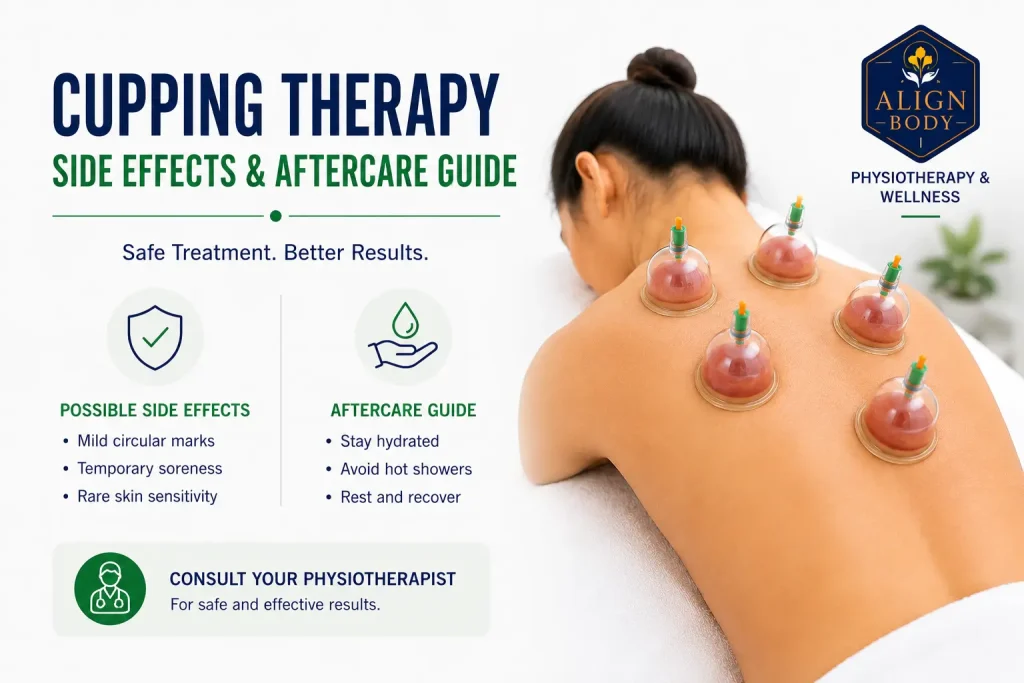
Cupping therapy side effects are mostly mild to moderate. Kim et al. 2014 review of 135 cupping randomised controlled trials found no serious adverse events. Common effects include circular marks, mild soreness, fatigue and lightheadedness, all resolving within 3 to 10 days with proper aftercare.
In our clinic, most patients experience only mild, expected side effects from cupping. Notably, in our clinical experience, serious complications are rare and preventable through practitioner skill, sterile technique and proper aftercare.
Written By
Dr. Richa Gupta
Founder, AlignBody Physiotherapy Clinic. APBC-certified (USA, Thailand). Diploma in Osteopathy (Ontario).
10+ years clinical practice, Delhi NCR
What Are the Common Cupping Therapy Side Effects?
Firstly, common cupping side effects are expected physiological responses at the acupoints treated, not complications. Cupping spans 2,000+ years across Traditional Chinese Medicine (TCM) with 4th century origins (Ge Hong), hijama, Ayurveda and Egyptian practice, plus Persian physician Ibn Sina (Avicenna) in the 11th century.
Common cupping side effects:
Circular marks: petechiae, ecchymosis from capillary vasodilation, fade 3-10 days.
Mild soreness: 24-72 hours, like post-exercise tenderness.
Fatigue: parasympathetic response, resolves 24 hrs.
Lightheadedness: vasovagal, sit up slowly, hydrate.
Skin sensitivity: erythema, pruritus, hyperpigmentation.
Warmth: circulation increase, resolves within hours.
Rare Side Effects and Complications of Cupping
Notably, in our practice, serious complications stay rare when performed properly. Most rare effects concentrate in wet cupping (hijama) rather than dry static cupping.
Rare cupping complications:
Uncommon (1-3%): blistering (from fire cupping), Koebner phenomenon, cellulitis.
Very rare (<0.5%): infection, vasovagal syncope, latex allergy (silicone cups replace).
Extremely rare (<0.1%): anemia, panniculitis, neurological complications (14 world literature cases), subconjunctival hemorrhage from facial cupping.
The Evidence: How Safe Is Cupping Therapy Really?
Overall, four systematic reviews confirm cupping’s favourable safety profile.
Cupping safety evidence:
Kim et al. 2014 (Eur J Integr Med): 135 RCTs, zero serious adverse events (WHO-UMC scale).
Al-Bedah et al. 2016 (BJMMR): 25 studies (6 RCTs), events mild-to-moderate, preventable.
Aboushanab & AlSanad 2018 (J Acupunct Meridian Stud): classification framework.
Mohamed et al. 2023 (J Back Musculoskelet Rehabil): sports rehabilitation focus.
The World Health Organization (WHO) recognises cupping (PRISMA/GRADE frameworks). Additionally, European clinical practice guidelines and Ontario Protocol support it alongside manual therapy, acupuncture and physiotherapy. Chi et al. 2016 RCT recorded Visual Analog Scale (VAS) pain 8.5 to 2.6 (P less than 0.001, single-blind), zero serious events across 60 subjects.
Who Should Not Get Cupping Therapy (Contraindications)
Importantly, at AlignBody we screen every patient for contraindications before treatment.
Cupping contraindications:
Bleeding disorders: hemophilia, thrombocytopenia.
Anticoagulants: warfarin, heparin, antiplatelet meds.
Skin conditions: cellulitis, herpes zoster, active eczema.
Vascular: deep vein thrombosis (DVT), recent MI.
Pregnancy: abdominal, lumbosacral areas at any stage.
Cancer, uncontrolled diabetes: requires medical clearance.
How to Prepare for Cupping to Minimize Side Effects
Typically, proper preparation reduces side effects. In our clinic, we recommend hydration as the biggest predictor of comfortable recovery based on clinical experience.
Key prep: hydrate 2-3 litres water prior, eat lightly 2-3 hrs before, sleep 7-8 hrs, list all medications including anticoagulant, avoid oils or lotions, skip shaving within 4 hrs, avoid alcohol and caffeine day-of, reschedule if sunburned.
Complete Cupping Therapy Aftercare Instructions
Also, at AlignBody we provide written aftercare after every session. Consequently, patients following it report fewer side effects.
✓ 48-hour aftercare protocol:
✓ DO
Hydrate: extra 500ml-1L water day of session
Rest: avoid strenuous activity 24 hrs
Keep warm: cover treated area, avoid AC drafts
✗ DON’T
Saunas, hot tubs, swimming 24-48 hrs
Alcohol for 24 hours post-session
Deep tissue massage or myofascial release 24-48 hrs
Cupping Recovery Timeline: What to Expect Day by Day
Recovery timeline:
First hour: marks visible, warmth, mild fatigue.
Day 1 (24 hrs): marks darken, mild soreness peaks.
Days 2-3: soreness eases, pain relief starts.
Days 3-10: marks fade through purple, green, yellow.
When Cupping Side Effects Need Medical Attention (Red Flags)
Importantly, we teach patients to spot side effects requiring medical care. Additionally, facial cupping needs caution around eyes to prevent subconjunctival hemorrhage. Similarly, upper trapezius cupping near brachial plexus needs careful placement. Home cupping raises risk without professional screening.
⚠ Seek immediate medical care:
Fever >38°C or chills
Expanding redness beyond cup marks
Blistering or open wounds
Numbness or tingling persisting
Marks not fading after 2 weeks
Severe pain or increasing swelling
Managing Cupping Recovery for Delhi and Indian Patients
Across our Delhi practice, aftercare needs vary by environment and season. In our clinical experience across Delhi NCR, we adjust protocols for four common contexts at our clinic.
4 Delhi aftercare patterns:
IT professional (AC exposure)
Keep treated area covered, avoid direct AC drafts.
Delhi summer patient
Extra hydration, avoid sun exposure on marks.
Monsoon patient
Keep treated area dry, watch for skin infection.
Weekend cricketer, IPL fan
Delay next practice 24-48 hrs post-session.
Overall, in our clinical experience, technique choice depends on presentation and duration limits (10-min max per cup, some 5 min protocols) at -225 to -300 mmHg. Additionally, we combine cupping with electroacupuncture for some patients. Techniques span dry cupping (static cupping, moving cupping, sliding cupping), flash cupping, fire cupping and wet cupping (hijama).
Frequently Asked Questions
What are the most common cupping therapy side effects?
Typically, common effects include circular marks (petechiae, ecchymosis), mild soreness 24-72 hours, fatigue and lightheadedness. Most resolve within 3-10 days.
How long do cupping side effects last?
Generally, marks fade 3-10 days, soreness resolves 24-72 hours. Also, wet cupping (hijama) marks may take 2 weeks. Prolonged effects beyond 2 weeks warrant medical evaluation.
Can cupping cause serious damage or injury?
Overall, serious injury is rare. Kim et al. 2014 (135 RCTs) found no serious adverse events. Al-Bedah et al. 2016 confirmed events are mild-to-moderate, preventable through practitioner skill.
What should I not do after cupping therapy?
Avoid saunas, hot tubs, swimming for 24-48 hours. Also, skip alcohol 24 hours and deep tissue massage 24-48 hours.
Can I shower or exercise after cupping?
Yes, warm showers are fine after 4-6 hours. However, avoid strenuous exercise 24 hours to prevent extra muscle stress.
Are cupping side effects worse for beginners?
Typically, first-time patients get slightly more pronounced marks and fatigue. Subsequent sessions show reduced marking as tissues adapt.
In summary, cupping side effects are mostly mild and preventable. For safe treatment in Delhi NCR, book at our Delhi clinic or South Delhi centre. Related: cupping marks, first session, wet vs dry cupping.