Hijama Sunnah Points Complete Body Map Guide
✓ Quick Answer
Hijama Sunnah points are 9 specific body locations where Prophet Muhammad ﷺ performed cupping therapy, documented in Sunan Abu Dawood (3860, 3861) and Sunan Ibn Majah (3483, 3484). The primary points include Yafookh (crown), Al-Akhda’ain (posterior neck), Al-Kahil (upper back), Al-Katifain (shoulders), Al-Waraq (hips) plus feet points, each targeting specific conditions from headaches to sciatica.
Every week our clinic sees patients across Delhi NCR requesting authentic Sunnah-based Hijama therapy. Notably, in our clinical experience following the Prophetic tradition alongside modern hygiene standards delivers the most respected results. Explore our cupping therapy service in Delhi for authentic Hijama sessions.
Written By
Dr. Richa Gupta
Founder, AlignBody Physiotherapy Clinic. APBC-certified (USA, Thailand). Diploma in Osteopathy (Ontario).
14+ years clinical practice, Delhi NCR
What Are Sunnah Points in Hijama Therapy
Firstly, the word Hijama (Arabic: الحجامة) derives from the root ‘hajm’ meaning ‘to suck’, reflecting the therapy’s mechanism. In this article we use ﷺ (peace and blessings of Allah be upon him, PBUH) after Prophet Muhammad’s name per Islamic tradition. Sunnah points refer to specific body locations where Prophet Muhammad ﷺ performed or recommended Hijama (wet cupping). Additionally, these points are documented in authenticated hadith collections. Key sources include Sahih Bukhari (5701, 5697), Sunan Abu Dawood (3860, 3861), Sunan Ibn Majah (3483, 3484) plus Tirmidhi (2051). Furthermore, Ibn al-Qayyim’s Zaad al-Ma’ad (4/52) provides classical scholarly analysis. The Prophet ﷺ said in Sahih Bukhari 5701: “Healing is in three things: drinking honey, cupping and cauterisation with fire.” For beginners, our wet vs dry cupping Hijama guide explains the fundamental differences.
The Prophetic Hadith Foundation
Notably, the most important hadith is narrated in Sunan Abu Dawood 3861: “Indeed the best of remedies you have is cupping, especially on the Al-Akhda’ain and the Kahil.” Consequently, these two points form the foundation of Sunnah-based Hijama practice worldwide.
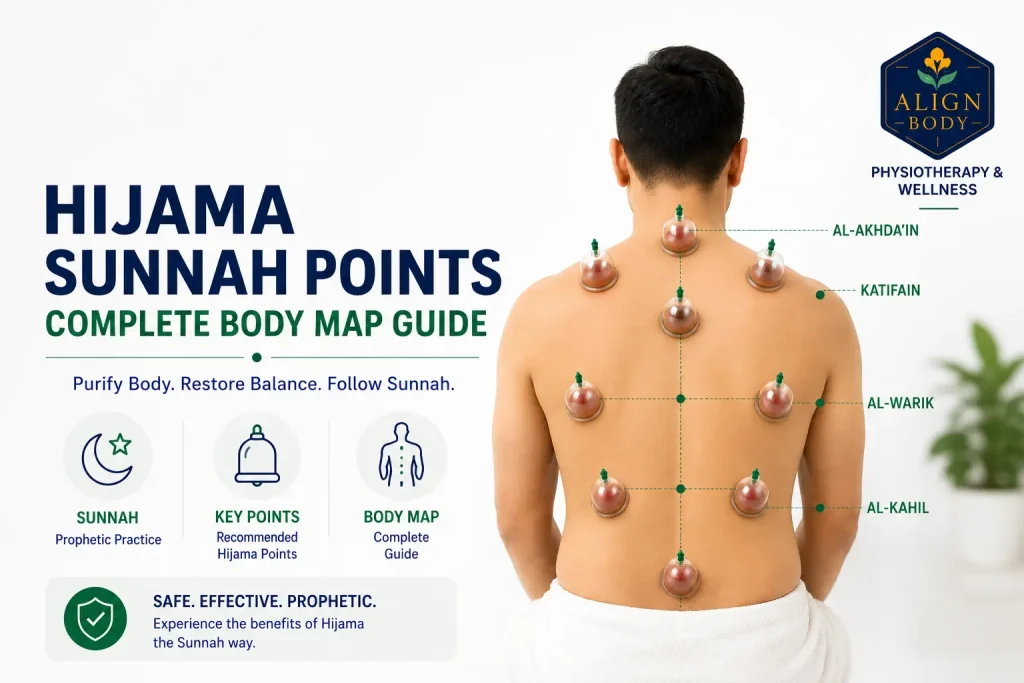
The 9 primary Sunnah Hijama points:
Point 1 – Yafookh: center/crown of head.
Points 2-3 – Al-Akhda’ain: two points below hairline on back of neck.
Point 4 – Al-Kahil: upper back between shoulder blades (most important).
Points 5-6 – Al-Katifain: right and left of Al-Kahil.
Points 7-8 – Al-Waraq: both sides of waist, parallel to navel.
Point 9 – Top of feet: upper surface of both feet.
Yafookh Crown Point Location and Benefits
Overall, at AlignBody we consider Yafookh the “mother of diseases” point per traditional Islamic scholarship. Specifically, this point sits at the top of the head. Prophet Muhammad ﷺ performed Hijama here during his journey to Makkah in Ihram state. Abdullah Bin Bujainah (RA) narrated this in Sahih Bukhari, reinforced by Ibn Abbas (RA).
Yafookh point benefits:
Headaches: chronic and tension-type
Mental clarity: focus and cognition
Neurological issues: brain circulation
Migraine relief: vascular headaches
Al-Akhda’ain Posterior Jugulars Location and Benefits
Typically, in our clinical experience Al-Akhda’ain points work exceptionally well for head and neck conditions. Notably, these points anatomically align with the Feng Chi (wind pool) acupuncture points in Traditional Chinese Medicine (TCM). Also, Anas ibn Malik (RA) narrated this in Sunan Abu Dawood 3860. The Messenger ﷺ was treated with cupping three times on these two veins.
Al-Akhda’ain point benefits:
Migraines and headaches: chronic relief
Vertigo and dizziness: balance restoration
Stiff neck: muscular tension release
Sinus and nasal issues: congestion relief
Tinnitus and blurry vision: sensory support
Insomnia: nervous system calming
Al-Kahil Upper Back The Most Important Point
Furthermore, Al-Kahil is universally considered the most versatile Sunnah point. Notably, during Ghazwah Khyber Prophet Muhammad ﷺ was poisoned. He performed Hijama three times on Al-Kahil (upper back) per multiple hadith. Angel Jibreel specifically advised this point per Ibn Majah 3484.
Al-Kahil point benefits (upper back):
Headache and flu: immune support
Cough and asthma: respiratory relief
High blood pressure: cardiovascular support
Bronchitis: chest congestion
Upper back pain: muscular tension
General wellness: foundational point
For understanding how these points respond to cupping, read our detailed guide on how cupping therapy works.
Al-Katifain Shoulder Points Location and Benefits
Al-Katifain benefits (right and left shoulders):
Shoulder pain and stiffness: targeted muscular release.
Frozen shoulder support: adhesive capsulitis assistance.
Upper arm tension: radiating pain relief.
Postural strain: screen worker fatigue.
Al-Waraq Hip and Waist Points
Importantly, Jaabir Ibn Abdullah (RA) reported that Rasool Allah ﷺ was cupped on his hips for pain relief in that area, establishing Al-Waraq as the primary lower body Sunnah point.
Al-Waraq point benefits (hips, both sides of waist):
Sciatica: nerve pain in leg
Lower back pain: chronic and acute
Hip mobility: range of motion improvement
Menstrual pain: female reproductive support
Piriformis syndrome: deep gluteal pain
Additional Sunnah Points Feet and Haamah
Also, Prophet Muhammad ﷺ recommended Hijama on the upper surface of both feet for foot pain relief. Additionally, Haamah (between shoulders, sometimes equated with Al-Kahil) is mentioned by Abu Kabshah Al Anmari (RA). This appears in Sunan Abu Dawood and Ibn Majah.
Recommended Sunnah days for Hijama:
17th
Islamic month day
19th
Islamic month day
21st
Islamic month day
Ideally scheduled on Monday, Tuesday or Thursday per Prophetic tradition.
Selecting Sunnah Points by Condition
Across our Delhi practice, we see four common condition-based selection patterns shaped by our clinical experience. Also, in our clinical experience combining Sunnah points with modern anatomical knowledge delivers optimal outcomes.
Point selection by common conditions:
Headache/Migraine
Yafookh + Al-Akhda’ain + Al-Kahil.
Back and neck pain
Al-Kahil + Al-Katifain (upper); Al-Waraq (lower).
Sciatica and hip pain
Al-Waraq + feet points.
General wellness
Al-Kahil + Al-Akhda’ain (foundational combo).
Also, we recommend reading our guide on first Hijama session what to expect, understanding cupping marks meaning and duration plus side effects and aftercare. For evidence review see does cupping therapy work.
Frequently Asked Questions
What are the 9 Sunnah points of Hijama?
Typically, the 9 Sunnah points are Yafookh (crown), two Al-Akhda’ain (posterior neck), Al-Kahil (upper back), two Al-Katifain (shoulders), two Al-Waraq (hips/waist) plus feet points. Also, all documented in Sunan Abu Dawood, Sunan Ibn Majah and Sahih Bukhari.
Which is the most important Sunnah point?
Al-Kahil (upper back between shoulder blades) is universally considered the most important. Also, Sunan Abu Dawood 3861 records the Prophet ﷺ saying: “The best of remedies you have is cupping, especially on the Al-Akhda’ain and the Kahil.”
Can I do Hijama on non-Sunnah points?
Yes, modern Hijama practitioners often use additional points for specific conditions based on anatomy and pathology. However, Sunnah points remain the foundation and are typically included in every session.
What are the best days for Sunnah Hijama?
Generally, the 17th, 19th and 21st of the Islamic month, ideally on Monday, Tuesday or Thursday. Also, avoid extreme weather days per traditional guidance.
How many points should be cupped in one session?
Typically, 5-8 points per session works well for most conditions. Additionally, at AlignBody our practitioners select points based on your specific health concern plus body constitution.
Is Hijama safe for women?
Yes, Hijama is safe for women, and we provide female practitioners available at our clinic. Additionally, we accommodate privacy needs and modesty preferences for Muslim women patients.
How often should Sunnah Hijama be repeated?
Ideally, every 3-6 months for general wellness maintenance. Also, read our detailed guide on how often cupping therapy frequency for personalised recommendations.
In summary, Sunnah points provide a time-tested authoritative framework for Hijama therapy backed by authenticated hadith and centuries of practice. Book at our Delhi Hijama clinic or South Delhi centre for authentic Sunnah-based sessions with certified practitioners.