Shockwave Therapy for Achilles Tendinopathy: Evidence & Treatment
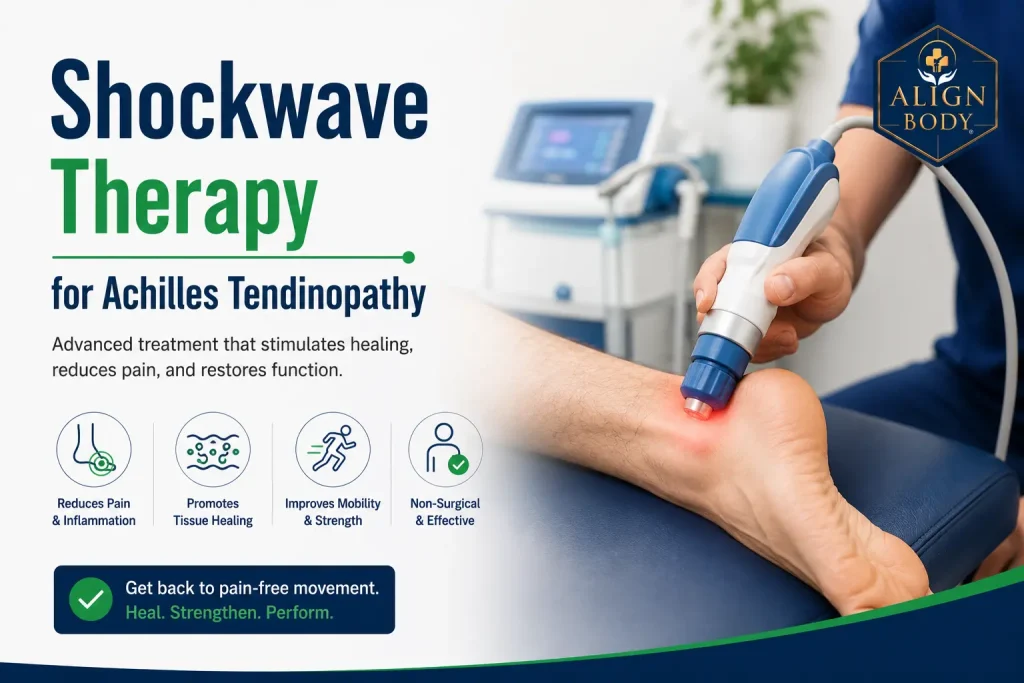
Most musculoskeletal conditions need 3 to 6 shockwave therapy sessions, spaced 5 to 10 days apart. Plantar fasciitis and Achilles tendinopathy typically resolve in 3 to 5 sessions. Calcific shoulder tendinitis may need 4 to 6. Each session lasts 15 to 20 minutes with no downtime. Importantly, the healing response continues for 6 to 8 weeks after your final session, so results build even after you stop attending.
“How many sessions will I need?” is the first practical question patients ask once they decide to try shockwave therapy.
It is the right question. You want to plan your schedule, understand the cost and commitment and know when to expect results. The honest answer is that the number depends on your condition, how long you have had it and how your tissue responds. But the range is much narrower than most patients expect.
I am Dr. Richa Gupta, founder of AlignBody Physiotherapy Clinic in Delhi. I have been using shockwave therapy for over a decade across a wide range of tendon, fascial and soft tissue conditions. This guide gives you the condition-specific session numbers, explains what is happening biologically at each stage and tells you what affects how many sessions you will actually need.
The Standard Shockwave Protocol: What the Evidence Says
The 2025 British Journal of Sports Medicine consensus on extracorporeal shockwave therapy (ESWT) supports a standard protocol of 3 to 5 sessions as sufficient to trigger the cellular healing response in most musculoskeletal tendinopathies. This aligns with the clinical protocols used in randomised controlled trials and systematic reviews published over the past decade.
At AlignBody, the large majority of patients complete a course within this range. Some conditions with deeper tissue pathology or calcific involvement need 4 to 6 sessions. Very few standard presentations need more than 6 sessions in a first course.
Sessions are spaced 5 to 10 days apart. This spacing is not arbitrary. The shockwave stimulus triggers a biological healing cascade that takes several days to build. Sessions closer than 4 days can overlap with and disrupt that cascade. Sessions further apart than 14 days allow the stimulus to dissipate before the next session reinforces it. Once per week is the most commonly used interval in clinical practice and is what we typically recommend at AlignBody.
Sessions Needed by Condition
| Condition | Sessions | Spacing | When to Expect Improvement |
|---|---|---|---|
| Plantar fasciitis (chronic) | 3 to 5 | 5 to 7 days | Significant reduction in morning heel pain by session 3 to 4. Full improvement continues for 6 to 8 weeks post-course |
| Achilles tendinopathy (mid-portion) | 3 to 5 | 7 days | Pain on loading reduces by session 3. Full functional improvement by weeks 6 to 12 |
| Achilles insertional tendinopathy | 4 to 6 | 7 days | Slower to respond than mid-portion. Improvement builds through sessions 4 to 6 |
| Tennis elbow (lateral epicondylitis) | 3 to 5 | 5 to 7 days | Pain with grip reduces by session 2 to 3 |
| Golfer’s elbow (medial epicondylitis) | 3 to 5 | 5 to 7 days | Similar to tennis elbow. Improvement across sessions 2 to 4 |
| Calcific shoulder tendinitis | 4 to 6 | 7 days | Calcium deposit breakdown may cause a temporary flare before improvement. Full improvement by weeks 8 to 12 |
| Patellar tendinopathy (jumper’s knee) | 3 to 5 | 5 to 7 days | Significant reduction in loading pain by session 3 to 4 |
| Greater trochanteric pain syndrome | 3 to 5 | 7 days | Lateral hip pain reduces by session 2 to 3. Full improvement by weeks 6 to 8 |
| Rotator cuff tendinopathy (non-calcific) | 3 to 5 | 7 days | Improvement in range of motion and pain on loading by session 3 |
| Chronic myofascial trigger points | 4 to 6 | 5 to 7 days | Trigger point deactivation across multiple sessions. Combined with manual therapy for best results |
These are clinical averages based on published protocols and our experience at AlignBody. Individual response varies depending on the factors covered later in this post.
What Is Actually Happening at Each Session
Understanding what is happening biologically at each stage helps explain why you cannot compress the treatment into fewer sessions and why results keep building after you finish.
Session 1: Starting the healing cascade
The first session delivers the initial acoustic energy stimulus to the degenerate tissue. The shockwaves trigger neovascularisation (formation of new blood vessels), the release of growth factors including TGF-beta and IGF-1 and the production of nitric oxide that improves local blood flow. Some patients feel immediate pain relief after the first session. Others feel no change or mild temporary soreness. Both are normal. The biological cascade has begun regardless of what you feel.
Sessions 2 to 3: Building the stimulus
Treatment intensity is typically increased as your tissue tolerance improves. The cumulative shockwave stimulus is reinforcing the neovascularisation and collagen synthesis response that began in session 1. Most patients start noticing measurable improvement in pain and function during this phase, often in the days between sessions rather than immediately after them.
Sessions 4 to 5: Consolidating and completing
For patients completing a full 5-session course, sessions 4 and 5 reinforce and complete the therapeutic dose. Not everyone needs session 4 or 5. Your response to sessions 1 to 3 determines whether additional sessions add meaningful benefit. At AlignBody we assess response at session 3 and adjust the plan rather than running a fixed number of sessions regardless of response.
The 6 to 8 weeks after your final session
This is the phase most patients do not know about. The biological healing response triggered by shockwave therapy continues to develop for 6 to 8 weeks after the final session. Collagen synthesis, tissue remodelling and neovascularisation are all still progressing.
This is why patients who stop after 2 to 3 sessions because improvement is not yet obvious are making a significant mistake. The full benefit of a complete course is not realised until 4 to 6 weeks after the final session. Patients who complete the full course and then exercise appropriately during the post-treatment period consistently achieve the best long-term outcomes.
The most common shockwave mistake: Stopping after 2 to 3 sessions because the improvement is not yet obvious. The full benefit of a 5-session course is not experienced until 4 to 6 weeks after the final session. Completing the full course is the single most important thing you can do to get lasting results.
Factors That Affect How Many Sessions You Need
How long you have had the condition
This is the single biggest variable. Plantar fasciitis present for 3 months responds faster than the same condition present for 3 years. Chronic conditions with established tissue degeneration, calcification or scar tissue require the full course and sometimes a repeat course after 3 to 6 months if the initial response is good but incomplete.
Whether the diagnosis is correct
Shockwave therapy works for tendinopathy and calcific conditions. It is not the right primary treatment for bone stress injuries, nerve entrapment conditions or bursitis without a tendon component. If there is no meaningful improvement by session 3, reassessment of the diagnosis is appropriate. This is why every shockwave course at AlignBody begins with a thorough clinical assessment rather than just booking sessions based on a symptom description.
Loading between sessions
Heavy loading of the treated tissue in the 48 hours after a session can disrupt the healing cascade the shockwaves triggered. Low-impact movement is appropriate and beneficial between sessions. Returning immediately to the sport or activity that caused the problem at the same intensity and volume will reduce the effectiveness of the course. This is particularly relevant for our sports physiotherapy patients, where load management between sessions is part of the treatment plan.
Radial versus focused shockwave
Focused shockwave delivers energy to a precise tissue depth and produces stronger outcomes for deep tendon pathology and calcific conditions. Radial shockwave distributes energy more superficially over a wider area. The number of sessions required may differ slightly between the two types depending on your condition depth and severity. Read our detailed comparison: radial vs focused shockwave therapy: what is the difference.
Whether shockwave is combined with physiotherapy
Research consistently shows that shockwave therapy combined with a targeted exercise programme produces significantly better long-term outcomes than shockwave alone. The exercise corrects the biomechanical factors that caused the tendon to degenerate. Without it the healed tendon is re-exposed to the same mechanical stress and the problem recurs. At AlignBody every shockwave course includes a home exercise programme to address the underlying cause.
Shockwave for Specific Conditions: What to Expect
Plantar fasciitis and heel pain
Chronic plantar fasciitis (heel pain present for more than 3 months that has not responded to stretching, rest and insoles) is one of the best-evidenced indications for ESWT. Three to five sessions produce significant and lasting reduction in morning heel pain in the large majority of patients. Read our detailed guide: shockwave therapy for heel pain and plantar fasciitis.
Knee tendinopathy
Patellar tendinopathy (jumper’s knee) responds well to 3 to 5 sessions with concurrent eccentric loading exercises. Iliotibial band syndrome and other lateral knee pain presentations are less well evidenced for shockwave. Read more: shockwave therapy for knee pain and patellar tendinopathy.
Shoulder conditions
Calcific shoulder tendinitis is one of the most dramatic responders to focused shockwave therapy. The acoustic energy breaks down calcium deposits that have sometimes been present for years, producing significant pain relief and restored range of motion. Most patients need 4 to 6 sessions and should expect a temporary flare of pain around sessions 2 to 3 as the calcium begins to fragment. Non-calcific rotator cuff tendinopathy typically requires 3 to 5 sessions. Read more about shoulder pain treatment at AlignBody.
Elbow tendinopathies
Tennis elbow (lateral epicondylitis) and golfer’s elbow (medial epicondylitis) both respond well to 3 to 5 sessions. Tennis elbow has particularly strong evidence for shockwave, with multiple RCTs demonstrating superiority over cortisone injection at 12-month follow-up. The combination of shockwave with eccentric wrist exercises produces the best long-term results for both conditions.
Do You Need a Second Course?
Some patients with very chronic or severe conditions achieve good improvement from a first course but not complete resolution. A second course of 3 to 5 sessions can be performed 3 to 6 months after the first, once the tissue has fully responded to the initial treatment. Starting a second course sooner than 3 months is generally not appropriate as the tissue is still responding to the first course.
For calcific shoulder tendinitis specifically, a second course targeting residual calcium deposits may be appropriate once imaging confirms the initial deposit has partially resorbed.
Shockwave vs Corticosteroid Injections: Which Lasts Longer?
This is one of the most common comparisons patients bring to us, particularly those who have previously had steroid injections. A 2025 review confirmed that corticosteroid injections provide faster short-term pain relief but carry significantly higher recurrence rates and the risk of tendon weakening over time.
Shockwave therapy targets structural regeneration of the degenerate tissue rather than simply suppressing inflammation. For long-term resolution of chronic tendinopathy, ESWT is the more durable choice. Read the full comparison in our guide: shockwave therapy vs physiotherapy: which is right for you.
If you want to understand how physiotherapy supports the shockwave process, read: physiotherapy treatment for pain relief and our guide on physiotherapy for sports injury recovery.
Frequently Asked Questions
How many shockwave sessions for plantar fasciitis?
Most patients with chronic plantar fasciitis complete 3 to 5 sessions, spaced 5 to 7 days apart. Sessions 1 and 2 initiate the healing cascade. Sessions 3 to 5 consolidate and complete it. Most patients see significant reduction in morning heel pain by session 3. Full improvement continues to build for 6 to 8 weeks after the final session. Combining sessions with calf strengthening and plantar fascia stretching exercises produces better long-term outcomes than shockwave alone.
Can I have shockwave therapy more than once a week?
More frequent sessions (closer than 5 days) are generally not recommended. The biological healing response triggered by each session needs adequate time to progress before the next stimulus is applied. Sessions twice per week or closer together can disrupt the cascade and reduce effectiveness. Once per week is the optimal frequency for most conditions and is what we use at AlignBody in the large majority of cases.
Is it normal to feel worse after shockwave therapy?
Yes. A temporary flare of pain in the 24 to 48 hours after a session is a normal and expected part of the treatment response. It is particularly common after the first and second sessions and after sessions targeting calcific deposits in the shoulder. The flare reflects the inflammatory response that the acoustic energy intentionally triggers to drive the healing process. It typically settles within 1 to 2 days. Read more: is shockwave therapy safe?
What if there is no improvement after 3 sessions?
If there is no meaningful change in pain or function after 3 sessions, reassessment is appropriate before continuing. This may mean the diagnosis needs review, the treatment zone is not precisely targeting the affected tissue or a different therapeutic approach should lead the programme. At AlignBody we review response formally at session 3 and adjust the plan accordingly. We do not continue a protocol that is not producing results.
How much does shockwave therapy cost in Delhi?
Session fees at Delhi physiotherapy clinics typically range from Rs. 1,500 to Rs. 3,500 per session depending on equipment quality, clinic setting and the treating clinician’s qualifications. At AlignBody, shockwave therapy sessions are part of a clinical programme that includes a thorough assessment, the treatment session and a home exercise protocol. Contact us at our East Delhi or South Delhi clinic directly for current pricing.
How long does each shockwave session take?
The active treatment component of each session lasts 15 to 20 minutes. Including preparation, clinical assessment and post-treatment review, plan for 30 to 40 minutes per appointment. The preparation time is not overhead. the pre-treatment assessment at each session checks your response and allows us to adjust the protocol for that day’s treatment.
The answer to “how many sessions” is almost always 3 to 5 for most conditions, with 4 to 6 for calcific presentations and complex chronic cases.
What matters as much as the number is completing the full course, spacing sessions correctly and combining the treatment with rehabilitation exercise. Shockwave that is properly assessed, spaced and followed up with exercise produces significantly better and more lasting outcomes than sessions applied in isolation.
If you are in Delhi NCR and want to know whether shockwave therapy is appropriate for your specific condition and how many sessions you are likely to need, book a clinical assessment at AlignBody. Our shockwave therapy clinic in East Delhi is available Monday to Saturday, 9 AM to 7 PM.
How long have you been dealing with the condition you are considering shockwave therapy for? That single factor shapes the answer more than anything else on this list.
ESWT for plantar fasciitis, Achilles tendinopathy, calcific shoulder, tennis elbow and chronic tendon pain.
East Delhi: Jagriti Enclave | South Delhi: Vasant Vihar | +91 9310 014 226