Cupping Therapy Marks: What They Mean and How Long
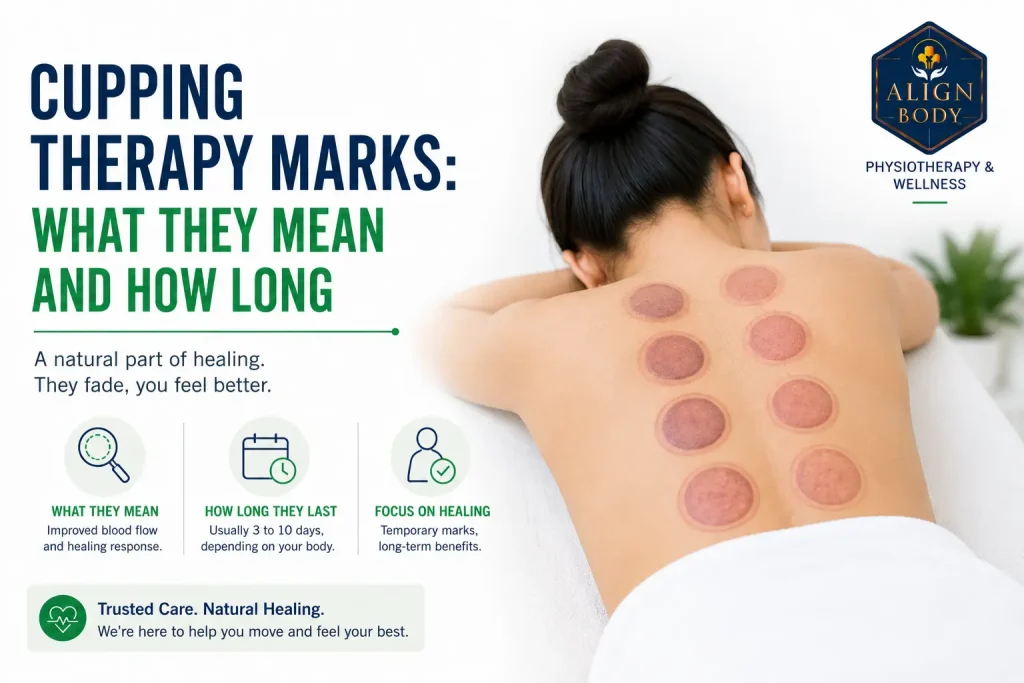
Cupping therapy marks are circular red, purple or darker discolourations that appear on the skin after a session. They are not bruises in the traditional sense (no blunt-force trauma) and they are not toxins being extracted from the body. They are petechiae and ecchymosis, meaning small broken capillaries and pooled blood at the skin surface caused by the suction pressure. Most marks fade within 4 to 10 days, with lighter marks resolving in 2 to 4 days and darker marks lasting up to 2 weeks. Colour depends on suction intensity, tissue state and individual skin type, not on how many toxins came out. The marks are usually painless. Marks that hurt, blister or last beyond 2 weeks warrant clinical review.
You went for cupping to help your back pain. An hour later you glance in the mirror and see 6 circular purple marks across your shoulders. Your first thought is: is this normal? Your second thought is: is this dangerous? Your third thought, if you have a wedding or beach holiday in the next week, is going to be less printable.
Cupping marks are the single most common cause of post-session anxiety we see in the clinic. Almost every first-time patient asks about them either during or after the session. The concern usually comes from a mix of the marks looking dramatic, unclear information online about what they mean and cultural assumptions imported from traditional Chinese medicine or Islamic hijama traditions.
I am Dr. Richa Gupta, founder of AlignBody Physiotherapy Clinic in Delhi. This post gives you the straight clinical answer on what cupping marks actually are, what the different colours actually mean, how long they realistically last, when they are a genuine concern versus completely normal and what to do about them if you have a social event coming up. We use cupping in our clinical practice and see these marks every day, so this is written from the perspective of the physiotherapist who has to explain them to patients, not from the perspective of a wellness site trying to sell you cupping.
What Cupping Marks Actually Are (Clinically)
Cupping works by creating negative pressure (suction) on the skin. The cup pulls the skin and superficial tissues upward into the cup. The suction is strong enough to break some of the smallest blood vessels in the skin (capillaries) and to draw blood and fluid toward the surface. The visible marks are the result.
Two clinical terms describe what you are seeing:
- Petechiae are tiny pinpoint red or purple dots caused by broken capillaries. Under stronger suction, many petechiae form close together and create a solid patch of colour
- Ecchymosis is the medical term for blood pooling under the skin over a larger area, which is what most of the visible circular mark actually is
This is different from a traditional bruise (contusion). A regular bruise happens when blunt force damages tissue and blood vessels. Cupping marks happen from suction pulling blood toward the surface without any impact or crushing injury. The blood is not damaged tissue leaking out; it is blood drawn upward that pools in the superficial layer.
This matters practically because cupping marks are usually painless when touched, unlike a real bruise. If you have marks that genuinely hurt when pressed, something else is going on and that warrants review.
The Toxins Question: Honest Answer
You will read on many cupping websites, especially those rooted in traditional Chinese medicine or Islamic hijama traditions, that darker cupping marks mean more toxins are being pulled out of your body. This is one of the biggest misconceptions in the modern cupping conversation and it deserves an honest answer.
Clinically, there is no evidence that cupping extracts toxins through the skin. The dark colour of a mark reflects the amount of blood drawn to the surface (which depends on suction pressure, session duration and how permeable your capillaries are), not on toxin levels in your body. Your kidneys and liver do the toxin removal work, not your skin surface.
The traditional Chinese medicine framework describes cupping marks as reflecting “stagnation” of qi and blood. Traditional practitioners use mark patterns diagnostically within that framework. Traditional medicine has its own internal logic and cultural meaning that is meaningful to many patients and the value patients derive from it is real. But that is different from a clinical claim about biochemistry.
The practical implication: if a cupping practitioner is telling you your dark marks prove they extracted lots of toxins and you need frequent sessions to “clear” them, treat that claim carefully. The marks fade because your body reabsorbs the pooled blood, not because your toxin load reduces.
Colour Guide: What Each Shade Actually Means
Different cupping traditions interpret mark colours differently. Here is a comparison of the traditional interpretation and the clinical explanation for each shade you might see.
| Mark Colour | Traditional TCM View | Clinical Explanation |
|---|---|---|
| No mark or faint pink | Healthy circulation, minimal stagnation | Suction pressure was low, or your capillaries are less permeable, or the tissue was already well-perfused |
| Light red or bright red | Recent injury, active inflammation, muscle tension | Moderate capillary permeability response. Fresh blood at surface. Fades quickly (usually 2 to 4 days) |
| Dark red or dark pink | Moderate stagnation, established tension pattern | More extensive capillary rupture and blood pooling. Related to suction intensity and duration |
| Purple or deep red-purple | Chronic stagnation, deep-seated pattern | Significant ecchymosis. Deeper tissue involvement. Colour indicates blood age (oxygen loss) not toxin content |
| Dark purple, black or greenish | Severe stagnation, long-standing problem | Larger volume of pooled blood. Also appears in patients on blood thinners, with fragile capillaries or after strong suction |
| Yellow or brown (later) | Body clearing detoxification products | Normal breakdown of haemoglobin as blood is reabsorbed. Same process as any bruise fading |
Two frameworks for reading cupping mark colours. Same colour, different explanations:
Traditional TCM view
Colour = level of “stagnation” or toxin build-up
- Faint pink: healthy circulation
- Red: acute tension, injury
- Purple: chronic stagnation
- Dark purple/black: severe stagnation
✓ Clinical explanation
Colour = amount of blood pooled, not toxins
- Faint pink: low suction or less permeable capillaries
- Red: moderate capillary rupture
- Purple: significant ecchymosis (blood pooling)
- Dark purple/black: larger blood volume, or fragile capillaries, or blood thinners
The darker the mark, the more blood pooled, not the more toxins extracted. Kidneys and liver handle detoxification, not skin.
The most useful practical takeaway is that darker marks do not mean the therapy worked better. Darker marks mean either stronger suction was applied, session was longer, tissue was already congested or you have more permeable capillaries. The colour is not a measure of therapeutic effect.
How Long Do Cupping Marks Actually Last?
Realistic timelines based on what we see across thousands of sessions:
| Mark Type | Typical Fade Time | What Affects Duration |
|---|---|---|
| Faint pink or light red | A few hours to 2 days | Fades quickly with good circulation and hydration |
| Red to dark red | 3 to 5 days | Age, skin type, activity level after session |
| Purple | 5 to 10 days | Individual healing rate, iron status, area of body |
| Dark purple to black | 10 to 14 days | Occasionally up to 2 weeks in older patients or slower healers |
| Yellow-brown fading phase | Last 2 to 4 days of the total timeline | Normal reabsorption. May look worse briefly before disappearing |
Factors that make marks last longer include being older (slower reabsorption of pooled blood), having very fair skin (marks appear more visible for longer), being anaemic, taking blood-thinning medications, having received particularly strong suction, having the marks on areas with slower circulation (upper back and shoulders often last longer than legs) and physical inactivity after the session.
Factors that help marks fade faster include being well-hydrated, gentle movement and walking, adequate sleep, keeping the area warm and not layering additional treatments (heat, sauna, alcohol) in the first 24 hours.
Red Flags: When Cupping Marks Are Actually a Problem
Most cupping marks are entirely normal and require no intervention. However, some presentations warrant clinical review.
See your doctor or physiotherapist if any of these apply:
✗ Marks hurt when touched
Normal cupping marks are painless. Pain suggests actual tissue damage.
✗ Blistering or broken skin
Suction was too strong. Needs wound care to prevent infection.
✗ Marks spread beyond cup area
May indicate bleeding disorder or treatment reaction.
✗ No fading after 2 weeks
Slower healing, possible anaemia or medication interaction.
✗ Fever or swelling after treatment
Possible infection, particularly if hijama (wet cupping) was done.
✗ Bruising easily elsewhere too
Check platelet function and clotting parameters with GP.
Cupping is safe for the vast majority of patients. But sensible caution about the above signs prevents rare complications from being missed.
Aftercare: What Actually Helps Marks Fade Faster
You will read a lot of aftercare advice online. Here is what has actual physiological reasoning behind it versus what is folklore.
What actually helps
- Hydration: drink adequate water for the next 24 to 48 hours. This supports circulation and the reabsorption of pooled blood
- Gentle movement: a 20 to 30 minute walk helps circulation without stressing tissues
- Keep the area warm: avoid air conditioning or cold air directly on the cupped area for 24 hours. This is common advice across all cupping traditions and has physiological basis in maintaining local circulation
- Adequate sleep: tissue repair happens during sleep. Aim for a full night after your session
- Warm compress after 24 hours: in the second and third days, gentle warmth over the marks aids circulation and reabsorption
- Arnica cream: topical arnica has some (though not conclusive) evidence for accelerating bruise resolution. Not harmful to try
What is folklore or unhelpful
- Avoiding all activity: total rest actually slows resolution. Gentle movement is better
- Alcohol restriction beyond 24 hours: alcohol dehydrates and vasodilates so avoiding it for 24 hours is sensible, but complete abstinence for a week is not necessary
- Special “detox” drinks or teas: your kidneys handle detoxification regardless of what you drink. Adequate water suffices
- Aggressive massage of the cupped area: can worsen ecchymosis. Leave the marks alone
- Ice on the fresh marks: unlike a fresh injury, ice does not help cupping marks and may slow the reabsorption process. Warmth is preferred after the first few hours
The Michael Phelps Effect: Why the World Suddenly Knew About Cupping Marks
Cupping went from a niche practice to a globally recognised therapy essentially overnight during the 2016 Rio Olympic Games. Swimmer Michael Phelps appeared poolside covered in dark circular marks and photographs of these marks were shared millions of times. Suddenly people who had never heard of cupping wanted to know what the marks were and whether they should try it.
The Phelps effect had one useful outcome and one unfortunate one. The useful outcome was that cupping became more mainstream in Western sports medicine and physiotherapy contexts. The unfortunate one was that many patients now expect dramatic dark marks as evidence that “it worked” for them. If they get lighter marks or no marks, they feel the therapy failed.
This is not correct. Phelps was being cupped at strong intensity for high-performance athletic recovery in a specific way on tissue that was under significant training load. That is not what a middle-aged office worker with neck pain needs. A therapeutic cupping session for someone with mild musculoskeletal symptoms may leave only faint pink marks or no visible marks at all. The treatment can still be entirely effective for their symptoms.
Judge cupping treatment by whether your symptoms improve, not by how impressive your Instagram photos look afterwards.
Cupping Marks and Indian Patients: Practical Notes
A few observations from our clinical practice specific to Indian patients:
Skin tone considerations. Cupping marks appear differently on different skin tones. On lighter Indian skin (Type III to IV on the Fitzpatrick scale) marks show as red then purple then brown. On darker Indian skin (Type V and above) the same amount of blood pooling can look darker or more grey-brown initially. Post-inflammatory hyperpigmentation may persist for a few weeks after the mark itself has resolved. This is normal and gradually clears. Discuss suction intensity with your practitioner if this is a concern.
Summer humidity and aftercare. Delhi summers create a specific challenge. The traditional advice to “keep the area warm and avoid cold” was developed in cooler climates. In Delhi’s May and June heat, keeping the area warm is less relevant. What is more important in summer is avoiding intense sun exposure directly on fresh marks (this can worsen pigmentation), keeping the area clean if sweating heavily and hydrating adequately given the fluid loss from heat.
Cultural expectations from hijama tradition. Many patients coming from Islamic hijama tradition expect wet cupping specifically and have specific ideas about the therapeutic meaning of marks. These traditions are meaningful and we respect them, but as a physiotherapy clinic we practice dry cupping for musculoskeletal conditions rather than wet cupping. Read our detailed guide on how cupping therapy works for the specific mechanism we use.
Weddings, festivals and social events. If you have a wedding, festival or social event coming up in the next 2 weeks and cupping marks would be visible tell your practitioner before the session. Suction intensity can be adjusted to reduce mark visibility. Cupping can also be delayed until after the event. This is a common conversation in our clinic during wedding season.
Frequently Asked Questions
Do cupping marks hurt?
Normal cupping marks are not painful when touched. You may feel some warmth or tightness in the area for the first day, but true pain suggests either excessive suction pressure or an underlying issue. Unlike a regular bruise which hurts when pressed, cupping marks are usually completely painless. If your marks are genuinely painful, mention this to your practitioner before your next session.
Can I cover cupping marks with makeup or clothing?
Yes, both are fine. Concealer or foundation can hide marks reasonably well by day 2 or 3 when they lighten. Clothing is a simple solution for marks on the back and shoulders. There is no health reason to leave marks uncovered beyond the first few hours after the session. Just avoid tight or abrasive clothing directly on very fresh marks in the first 24 hours.
Will cupping marks leave permanent scarring?
Standard dry cupping does not cause scarring because the skin is not broken. In darker Indian skin tones, some post-inflammatory hyperpigmentation may persist for a few weeks after the mark itself has resolved, but this is not scarring and gradually clears. Wet cupping (hijama) which involves small skin incisions can occasionally leave very small scars, particularly if the incisions were deeper than needed or hygiene was poor. In physiotherapy contexts we use dry cupping, which does not carry a scarring risk.
Is it dangerous if I do not get any marks from cupping?
Not at all. Some patients get very little visible marking and this does not mean the treatment failed. Factors that reduce mark visibility include less permeable capillaries, healthier tissue with good circulation, thinner or younger skin, shorter session times and lighter suction. The therapeutic effect (whatever effect cupping produces) is not measured by mark visibility. If your symptoms improve, the treatment worked regardless of how you look afterwards.
Can I exercise after cupping if I have marks?
Light exercise is fine and actually helpful. Walking, gentle stretching or moderate activity supports circulation and reabsorption. What to avoid for 24 to 48 hours: intense workouts that significantly raise your heart rate, contact sports where the marked areas could be hit, hot yoga or saunas which vasodilate excessively and swimming in chlorinated pools (skin irritation risk on freshly cupped skin).
Can I shower after cupping?
Yes, but wait about 2 to 3 hours after the session and use warm water rather than very hot water. Avoid very cold showers on the cupped area for the first 24 hours. Regular soap and gentle washing is fine. Do not scrub the marked areas. If you had wet cupping (which we do not perform), specific wound care instructions apply and your practitioner should have given them separately.
How many cupping sessions do I need for actual results?
This depends entirely on what you are treating. For acute muscle tension, 1 to 3 sessions may produce meaningful relief. For chronic musculoskeletal conditions, 6 to 10 sessions over 4 to 8 weeks is more typical, alongside other physiotherapy. Cupping is best used as part of a broader treatment plan including manual therapy, exercise and other modalities rather than in isolation. If your practitioner is recommending 20+ sessions without other approaches, ask about the treatment plan reasoning.
Can pregnant women get cupping?
Cupping is generally not recommended during pregnancy, particularly on the abdomen, lower back and specific pressure points thought to induce labour. Some practitioners avoid it entirely during pregnancy while others allow gentle cupping on limbs and upper back in later trimesters. If you are pregnant and considering cupping for pregnancy-related musculoskeletal pain, discuss with both your obstetrician and physiotherapist first. There are safer alternatives for most conditions.
Cupping marks are a normal, expected part of the therapy for most patients. They are petechiae and ecchymosis (broken capillaries and pooled blood) caused by suction pressure, not toxins being extracted from the body. They usually fade within 4 to 10 days and are almost always painless. Different colours reflect the amount of blood pooling and individual tissue response, not the therapeutic value of the treatment.
What matters clinically is whether your symptoms improve, not how impressive your marks look. Judge cupping by outcome, not by aesthetics.
If you have questions about cupping therapy, want a proper physiotherapy assessment before starting cupping or want to understand whether cupping is the right approach for your specific problem, book an assessment at AlignBody. Our clinics run cupping therapy in Delhi and cupping therapy in South Delhi as part of full physiotherapy treatment for musculoskeletal conditions. Read our related guides on how cupping therapy works, myofascial release therapy and what dry needling feels like for related modalities.
Have you been told your dark cupping marks prove toxins were extracted from your body? That claim is not supported by clinical evidence. Marks reflect suction intensity and individual tissue response, not therapeutic value. Judge the treatment by whether your symptoms improve.
Evidence-based cupping alongside full physiotherapy assessment. Clear expectations, honest information, no mythology.
East Delhi: Jagriti Enclave | South Delhi: Vasant Vihar | +91 9310 014 226