Wet Cupping vs Dry Cupping (Hijama): Full Guide
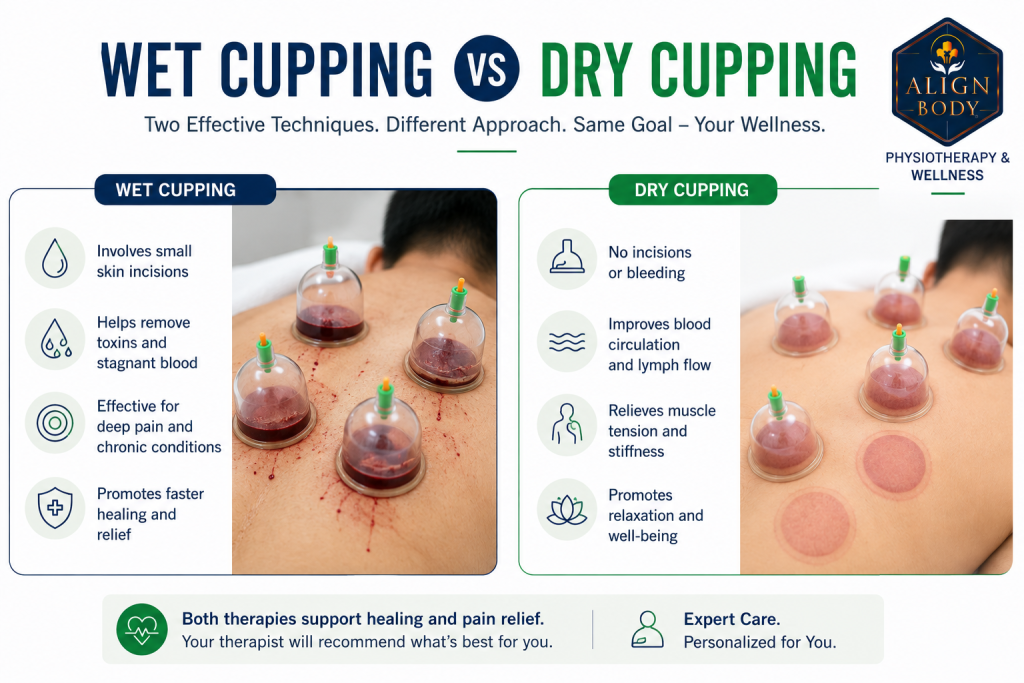
Dry cupping applies suction cups to the skin without breaking the surface. Wet cupping (hijama in the Islamic tradition) applies suction, briefly removes the cup, makes small superficial skin incisions, then reapplies suction to draw out a small volume of blood. Both are used for pain and musculoskeletal complaints. Dry cupping is safer, lower-risk and appropriate for most musculoskeletal conditions. Wet cupping has stronger cultural and religious significance in Islamic tradition and is used more widely across conditions in that framework, but carries higher infection risk and requires strict sterile technique. As a physiotherapy clinic we use dry cupping. Whether wet or dry is right for you depends on what you are treating, your risk tolerance and whether the religious or traditional framework matters to you.
The single most confused topic in the cupping conversation is the difference between wet cupping and dry cupping. Patients arrive at our clinic asking for “hijama” when they actually want dry cupping. Others arrive thinking hijama is dangerous when they have already been getting it safely for years elsewhere. The confusion is understandable because the SERP presents these two therapies through very different lenses: Islamic religious sites, Chinese medicine sites, chiropractic wellness sites and generic health portals each describe them with their own emphasis.
This post gives you a straight physiotherapy perspective on what actually differs between wet and dry cupping, what the research actually shows for each, what safety concerns matter, when one is genuinely more appropriate than the other and how to think about the choice if you are considering cupping for a musculoskeletal problem in Delhi.
I am Dr. Richa Gupta, founder of AlignBody Physiotherapy Clinic in Delhi. We use dry cupping as part of physiotherapy treatment for musculoskeletal conditions. We do not perform wet cupping (hijama). Part of this post explains why. But we treat many patients who have used hijama at other centres and continue to do so alongside physiotherapy and we respect that decision when it is made with clear understanding of what each therapy is.
What Actually Differs Between Wet and Dry Cupping
Both therapies start the same way. A cup, traditionally glass or bamboo but now often silicone or plastic, is applied to the skin. Negative pressure (suction) is created inside the cup either by heat (traditional fire cupping) or by mechanical pump. The skin and superficial tissue are pulled upward into the cup. This is the shared foundation of all cupping.
Dry cupping stops here. The cup remains in place for typically 5 to 15 minutes, then is removed. What remains are the characteristic circular marks (which are petechiae and ecchymosis, discussed in our detailed guide on cupping therapy marks). No blood is drawn from the body. The skin surface remains intact.
Wet cupping (hijama) adds two additional steps. After an initial period of dry cupping to bring blood to the surface, the cup is briefly removed. The practitioner then makes small superficial incisions in the skin, typically 3 to 15 small cuts, using a sterile scalpel or specialised lancet. The cup is then reapplied to the same spot and the suction draws out a small volume of blood, typically 5 to 30 millilitres per cup site. The cup collects this blood. When removed, the incisions are cleaned and dressed.
Wet cupping vs dry cupping at a glance:
Dry cupping
Suction only, no skin incisions
- Session 15-30 min
- Marks fade in 4-10 days
- No external blood
- Essentially no infection risk
- Used by physiotherapy clinics
- Good for musculoskeletal pain
Wet cupping (Hijama)
Suction + small skin incisions
- Session 30-60 min
- Incisions heal in 5-10 days
- Small blood volume drawn out
- Infection risk if not sterile
- Used in hijama centres, TCM clinics
- Religious significance in Islam
The practical differences that matter to the patient:
- Skin integrity: dry cupping does not break the skin. Wet cupping involves small incisions
- Blood exposure: dry cupping produces marks but no external blood. Wet cupping produces external blood that must be handled hygienically
- Session duration: dry cupping typically 15 to 30 minutes total. Wet cupping typically 30 to 60 minutes
- Recovery: dry cupping marks fade in 4 to 10 days. Wet cupping leaves small healing incisions that scab and heal over 5 to 10 days
- Infection risk: dry cupping has essentially no infection risk. Wet cupping carries meaningful infection risk if hygiene standards are inadequate
- Cultural and religious meaning: wet cupping (hijama) has significant religious meaning in Islamic tradition. Dry cupping does not carry the same religious weight
Hijama and the Islamic Tradition
Hijama is the Arabic word for wet cupping and it holds specific religious significance in Islamic tradition. The Prophet Muhammad is recorded in hadith as having received hijama and having recommended it as a beneficial practice. Specific days of the Islamic lunar month (the 17th, 19th and 21st) are traditionally considered auspicious for hijama. Specific locations on the body are recommended based on classical Islamic medical texts.
For Muslim patients, hijama can be a meaningful practice that combines physical treatment with religious observance. This is not a matter of medical evidence; it is a matter of faith, tradition and personal meaning that we respect fully.
What we would flag for any patient considering hijama through this framework:
- The religious recommendation does not override the need for basic safety and hygiene standards
- Prophetic recommendation of a practice does not automatically translate into modern medical validation for specific conditions
- Legitimate hijama practitioners in the Islamic tradition also emphasise safety, sterile equipment and proper training
- Hijama should be received from trained practitioners using single-use sterile equipment, not from informal home-based providers
There is a common misunderstanding among some Muslim patients that hijama has been “medically proven” because it is Prophetic Medicine. The religious value is one framework; the medical evidence framework is separate and, honestly, more limited than religious sites often claim.
The Evidence: What Research Actually Shows for Each
The systematic reviews on cupping are useful reading if you want the actual picture. Here is a summary of what the current evidence base shows.
Dry cupping evidence
Cochrane and other systematic reviews find modest evidence that dry cupping helps with short-term pain reduction for musculoskeletal conditions including neck pain, low back pain and shoulder pain. The evidence quality is typically rated as low to moderate. The pain relief effect is usually modest and short-term, comparable to other manual therapy modalities. There is limited high-quality evidence for the numerous other conditions cupping is claimed to help (migraine prevention, hypertension, respiratory conditions and so on).
Wet cupping (hijama) evidence
Systematic reviews of wet cupping find some evidence of benefit for pain conditions, particularly when used as an adjunct to conventional treatment rather than in isolation. Studies from Middle Eastern and Chinese contexts have investigated wet cupping for a wider range of conditions including migraine, hypertension, carpal tunnel syndrome, some inflammatory conditions and various pain presentations. Evidence quality is generally low, with small studies, methodological limitations and potential publication bias. The claim that wet cupping removes toxins through the extracted blood is not supported by clinical evidence; the small volume of blood removed is not clinically significant in toxin terms.
The honest summary
Both therapies have some evidence for short-term pain relief. Neither has strong evidence for the broader health claims made by traditional practitioners. Both work best as part of a broader treatment plan rather than as stand-alone interventions. Choosing between them is often as much about safety, accessibility and cultural fit as it is about medical evidence.
Safety: The Honest Risk Comparison
Dry cupping is very safe when performed by trained practitioners. The main risks are cosmetic (visible marks lasting 4 to 10 days), minor skin irritation and rarely burns if fire cupping is done improperly. These are minor and self-limiting.
Wet cupping carries genuinely higher risks that must be handled through proper technique and hygiene:
- Blood-borne infection risk: if equipment is not sterile and single-use, hepatitis B, hepatitis C and HIV transmission is theoretically possible. This is not a theoretical concern only in India; poorly regulated hijama practice with reused lancets or shared cups is a real public health concern in some communities
- Local wound infection: if incisions are not properly cleaned or aftercare is poor, local bacterial infection can develop
- Scarring: small superficial scars can result from incisions, particularly with deeper cuts or in patients prone to keloid or hypertrophic scarring
- Anaemia risk: in patients receiving very frequent wet cupping over large body areas, cumulative blood loss can theoretically contribute to iron deficiency. Not a concern for occasional hijama; potentially relevant if wet cupping is done extensively and repeatedly
- Contraindications: wet cupping should not be performed on patients with bleeding disorders, on anticoagulant medications, with severe anaemia, with poorly controlled diabetes (delayed wound healing), during pregnancy in most cases, or on immunocompromised patients
The absolute risk in a single well-performed hijama session is low. The concerning scenarios are informal home-based practice, reuse of equipment across patients, poorly trained practitioners and lack of proper aftercare. These are the situations that produce the rare but serious complications.
Choosing Between the Two for Musculoskeletal Conditions
If you are considering cupping specifically for musculoskeletal pain (back, neck, shoulder, sports recovery), here is how we think about the choice in clinical practice:
Dry cupping is usually the appropriate choice for:
- Muscle tension and myofascial pain
- Sports recovery and athletic performance support
- Chronic musculoskeletal pain alongside physiotherapy treatment
- Patients who want the physical benefits of cupping without the religious framework
- Patients on any medications affecting blood clotting
- Patients with bleeding disorders, immunocompromised patients or diabetics
- First-time cupping patients wanting a lower-risk introduction
Wet cupping (hijama) may be considered for:
- Patients in the Islamic tradition who value the religious dimension
- Certain inflammatory conditions where the Middle Eastern medical tradition has established use patterns
- Patients who have used hijama previously with benefit and want to continue
- Non-Muslim patients specifically drawn to the wet cupping approach who understand and accept the higher risk profile
For most musculoskeletal complaints, dry cupping delivers the physical benefits (increased local circulation, reduced muscle tension, myofascial effect) without the additional risk of skin incisions. The added element of blood removal in wet cupping does not add measurable clinical value for typical musculoskeletal conditions beyond what dry cupping provides. This is why physiotherapy clinics globally, including ours, use dry cupping rather than wet cupping.
The Practical Question: Where to Get Each in Delhi
Delhi has three types of practitioners doing cupping and they differ significantly:
Physiotherapy clinics (including ours) offer dry cupping as part of physiotherapy treatment for musculoskeletal conditions. Cost is usually bundled into a physiotherapy session (Rs. 800 to 2,500). Assessment, treatment planning and integration with other therapies is included. Wet cupping is not typically offered.
Traditional Chinese medicine or acupuncture centres offer both dry and wet cupping within the TCM framework. Sessions Rs. 500 to 2,000 depending on centre. Approach is rooted in TCM theory of qi and blood stagnation.
Hijama centres (many operating in Delhi’s Muslim-majority areas) offer wet cupping within the Islamic tradition. Practitioners may be trained through Islamic hijama certification programmes rather than medical or physiotherapy training. Cost Rs. 500 to 2,000. Quality and hygiene standards vary widely.
The key questions to ask any wet cupping practitioner before receiving treatment:
5 questions to ask any wet cupping practitioner before treatment:
1. Sterile single-use lancets?
Ask to see the sealed sterile package before it is opened. Non-negotiable.
2. How are cups sterilised between patients?
Ideal: single-patient use. Acceptable: proper autoclave sterilisation.
3. What is your training background?
Formal hijama certification, TCM training or medical background. Not informal apprenticeship only.
4. Infection control protocol?
Gloves worn throughout. Skin cleaned before incision. Sharps disposal container visible.
5. Aftercare instructions provided?
Written wound care advice, signs of infection to watch for, when to follow up.
A practitioner who takes offence at these questions is not the practitioner you want.
Good hijama providers welcome these questions and can answer them clearly.
Ramadan, Fasting and Hijama: A Common Question
A specific question that comes up for our Muslim patients: does hijama break the fast during Ramadan? This is a religious question rather than a medical one. The answer varies by scholarly opinion.
The predominant Hanafi position, which most Indian Muslims follow, is that hijama does break the fast during Ramadan. Some other schools of thought differ. Practical implications:
- Most Muslim patients who receive hijama regularly schedule their sessions outside of daylight fasting hours during Ramadan, or during non-Ramadan months
- The traditionally recommended days (17th, 19th, 21st of the Islamic lunar month) can fall during Ramadan, in which case scheduling adjustments are common
- Dry cupping (which does not involve blood removal) is generally considered acceptable during fasting hours by most scholars, though individual religious guidance is recommended
- For post-Ramadan sessions, hydration and nutrition should be prioritised before hijama since fasting depletes both
Consult your local religious authority for definitive guidance. From a physiotherapy perspective, we would suggest that hijama during active fasting hours is not physiologically ideal because dehydration during fasting can increase risk of feeling faint after wet cupping.
Cupping in the Indian Context
A few practical observations from clinical practice in Delhi NCR:
The regulatory environment for hijama is limited in India. Unlike medical practitioners or licensed physiotherapists, hijama practitioners typically do not require formal government licensing. Some hijama centres operate to high standards; others do not. The onus is on the patient to verify practitioner competence and hygiene standards.
Skin tone considerations affect both wet and dry cupping. Post-inflammatory hyperpigmentation is more common in darker Indian skin tones (Fitzpatrick IV to VI) and can persist for weeks after the marks or incision scars themselves have resolved. This is not scarring but does affect cosmetic outcome.
Delhi’s Muslim communities in areas like Old Delhi, Nizamuddin, Jamia Nagar, Zakir Nagar and Batla House have well-established hijama practice. Word-of-mouth recommendations within the community are often the most reliable guide to which practitioners maintain proper standards, but this is not a substitute for asking the direct hygiene and technique questions listed above.
Physiotherapy costs for dry cupping integrated into treatment: Rs. 800 to 2,500 per session in Delhi NCR, with typical programmes of 6 to 12 sessions alongside other physiotherapy modalities depending on the condition being treated.
Frequently Asked Questions
Is hijama the same as wet cupping?
Yes and no. Hijama is the Arabic word for cupping, but in Islamic tradition and in modern usage across Muslim communities, hijama specifically refers to wet cupping. When you see “hijama therapy” advertised in Delhi, it almost always means wet cupping performed within the Islamic tradition. Dry cupping without incisions may or may not be referred to as hijama depending on the practitioner and context.
Which one is more effective for back pain?
The evidence for both is comparable and modest. Some Chinese studies suggest wet cupping may have a slight edge for chronic lower back pain specifically, but the evidence quality is limited. For most patients with back pain, dry cupping delivers meaningful benefit without the added risk of skin incisions and is the more sensible starting point. If dry cupping and other physiotherapy modalities have not produced benefit after adequate trial, wet cupping is a reasonable next consideration for patients open to it.
Can non-Muslims get hijama?
Yes, absolutely. Hijama is a therapy that is culturally rooted in Islamic tradition but is not restricted to Muslim practice. Many non-Muslim patients receive hijama for its physical benefits without engaging with the religious framework. Practitioners are generally happy to provide the treatment regardless of the patient’s faith background.
Does wet cupping actually remove toxins from the body?
The small volume of blood removed during wet cupping (typically 30 to 300 millilitres across a full session) is not clinically significant in terms of toxin removal. Your kidneys and liver handle toxin filtering continuously and the blood filtered through them daily is enormously more than what wet cupping removes. Any therapeutic benefit from wet cupping is much more likely to come from local tissue effects, immune modulation or pain-signal modulation rather than actual toxin extraction. Traditional practitioners may frame the benefit in toxin terms, but this framing does not match clinical evidence.
How often can I get wet cupping?
Traditional practice varies by tradition. Islamic tradition often recommends monthly hijama during specific lunar days. Modern clinical use tends toward less frequent sessions. From a safety perspective, allowing full incision healing (typically 2 to 3 weeks) between sessions on the same body area is important. Frequent extensive wet cupping over multiple body areas can cumulatively contribute to iron deficiency and should be discussed with your practitioner.
Will wet cupping scars fade?
Small, superficial hijama incisions performed properly usually heal without significant visible scarring within 2 to 4 weeks. In darker Indian skin tones, some post-inflammatory hyperpigmentation may persist longer. Deeper cuts, cuts in high-tension skin areas (like the shoulders), or cuts in patients prone to keloid or hypertrophic scarring may produce more visible marks. Discuss cosmetic concerns with your practitioner before the session.
Can I have both wet and dry cupping in the same treatment plan?
Yes. Many patients do. Some patients use hijama monthly for the religious and traditional dimension while receiving dry cupping alongside physiotherapy for specific musculoskeletal complaints. Coordination between practitioners is helpful. Let both know what the other is doing.
Is dry cupping enough for musculoskeletal conditions or do I need wet cupping too?
For the large majority of musculoskeletal conditions we see (back pain, neck pain, shoulder pain, muscle tension, sports recovery, myofascial pain syndromes), dry cupping delivers the physical benefits and does not need to be supplemented with wet cupping. The added risk profile of wet cupping is not justified by additional therapeutic benefit for these conditions. The reasonable exceptions are patients within the Islamic tradition who value the religious dimension or specific inflammatory conditions where wet cupping has established use in Middle Eastern medical traditions.
Wet cupping and dry cupping are related but distinct therapies. Dry cupping is the safer, lower-risk option and delivers most of the physical benefits patients seek from cupping therapy. Wet cupping (hijama) carries meaningful additional cultural and religious significance for Muslim patients and has a wider historical use pattern in Middle Eastern medical tradition, but comes with genuinely higher safety requirements and infection risk if standards are not maintained.
Neither therapy is a stand-alone solution for musculoskeletal conditions. Both work best as part of a broader treatment plan that includes proper assessment, manual therapy, exercise and appropriate lifestyle changes. The strongest predictor of good outcomes is having a clear diagnosis and treatment plan, not choosing between wet and dry cupping.
If you are considering cupping therapy for a musculoskeletal condition and want a proper physiotherapy assessment first, book at AlignBody. Our clinics offer cupping therapy in Delhi and cupping therapy in South Delhi as part of full physiotherapy treatment. Read our related guides on how cupping therapy works, what cupping marks mean, myofascial release therapy and what dry needling feels like for related modalities.
Have you been told wet cupping removes more toxins than dry cupping or that hijama is medically proven because it is Prophetic Medicine? Neither claim matches clinical evidence. Choose your cupping type based on what you are treating, your risk tolerance and whether the religious tradition matters to you. Do not choose based on marketing claims that overstate what either therapy actually does.
Evidence-based dry cupping alongside full physiotherapy assessment. Clear expectations, honest information, no mythology.
East Delhi: Jagriti Enclave | South Delhi: Vasant Vihar | +91 9310 014 226