Tech Neck: Causes, Symptoms and Physiotherapy Treatment
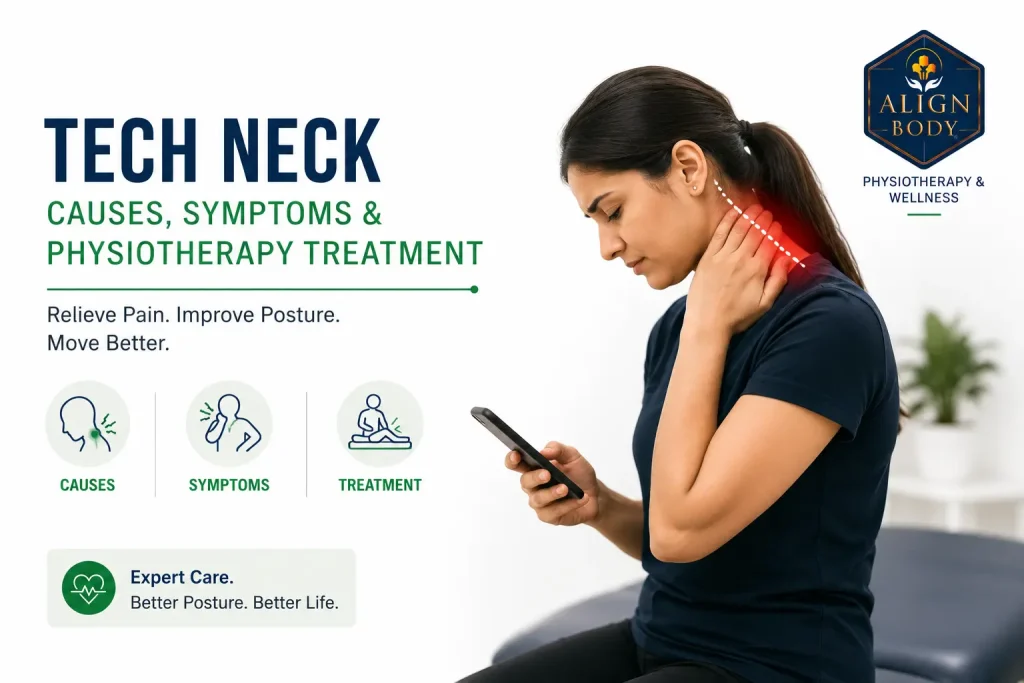
Tech neck (also called text neck syndrome) is neck pain, stiffness and postural strain from prolonged forward head posture while using phones, laptops or tablets. Symptoms include aching neck pain, headaches, upper back and shoulder tension and sometimes tingling into the arms. The condition is highly treatable through physiotherapy focusing on posture correction, strengthening of deep neck and upper back muscles, mobility work and ergonomic adjustments. Most patients notice meaningful improvement within 4 to 8 weeks. If symptoms include arm tingling, weakness or persistent headaches, see a physiotherapist rather than waiting for it to resolve on its own.
Tech neck was a curiosity a decade ago. Today it is one of the most common presentations at our clinic. Students, corporate professionals, work-from-home parents, gamers, delivery drivers checking phone apps between drops. The pattern shows up across almost every demographic that uses screens for more than 3 to 4 hours a day. Which, in 2026, is most of us.
The term itself was coined by Dr. Dean Fishman in 2008 to describe neck pain patterns emerging from smartphone use. Since then, the condition has been formalised, studied and, unfortunately, oversimplified in a lot of clinic content that circulates online. The “60 pound head” statistic gets thrown around constantly. The reality is more nuanced and more useful to know.
I am Dr. Richa Gupta, founder of AlignBody Physiotherapy Clinic in Delhi. This post covers what tech neck actually is, what causes it beyond the surface explanation, how to self-assess whether you have it, when the symptoms suggest something more serious than tech neck, what proper physiotherapy treatment involves and how long realistic recovery takes.
What Tech Neck Actually Is
Tech neck is a functional postural syndrome, not a specific anatomical injury. It describes the cluster of symptoms produced by sustained forward head posture during device use: the head tilted forward, chin poking out slightly, shoulders rolled forward, upper back rounded.
The sustained position produces predictable changes in the tissues around the neck. The deep neck flexor muscles at the front become weak and inhibited. The neck extensors at the back become chronically overworked and tight. The upper trapezius and levator scapulae muscles carry increased load. The pectoral muscles at the front of the chest shorten. Middle back muscles between the shoulder blades become lengthened and weak. Over months and years, this imbalance is what produces the pain, stiffness and functional problems we call tech neck.
It is not just a phone problem. Laptops on low tables, prolonged desk work, extended television watching on couches and any activity that involves sustained head-forward positioning contributes to the same tissue pattern.
The Head Weight Statistic: What It Actually Means
You have probably read that “your head weighs 10 pounds normally but 60 pounds when tilted to 60 degrees.” This comes from a 2014 paper by Dr. Kenneth Hansraj using a computer model of cervical spine biomechanics. The paper found that as head flexion angle increases, the effective force on the cervical spine increases significantly.
Two things are worth being straight about here. First, this is a static computer model, not a measurement of what actually happens in living tissue during real phone use. Real biomechanics involves muscle activation, tissue elasticity and constant micro-movements that a static model cannot capture. The precise “60 pounds at 60 degrees” number should be understood as a rough teaching model, not an exact biological measurement.
Second, more importantly: the actual clinical problem is not really about pounds of force. It is about sustained static loading of tissues that are designed for dynamic movement. The body handles enormous forces during running, jumping and lifting. What it does not handle well is holding any position (however moderate) for hours without variation. The problem is duration and lack of variation, not the specific angle.
The practical implication is different from what the head-weight framing suggests. You do not need to hold your phone at eye level for every glance. You need to break up the sustained position with regular movement, do specific strengthening to counter the pattern and correct the postural habits at your primary work station.
The head-weight statistic reframed:
The famous claim (Hansraj 2014 static model):
What actually matters clinically:
The precise numbers come from a static computer model, not real-world biomechanics. The actual clinical driver is sustained static loading of tissues designed for dynamic movement. Duration and lack of variation matter more than the specific angle.
The practical action:
You do not need to hold your phone at eye level for every glance. You need to break up sustained positions with regular movement, do specific strengthening, and correct habits at your primary workstation.
Common Symptoms of Tech Neck
Symptoms usually build gradually rather than starting from one clear injury moment. Common presentations:
- Neck pain at the back or sides of the neck, often described as aching or burning
- Neck stiffness particularly on waking and after prolonged sitting
- Headaches starting from the base of the skull and radiating forward (cervicogenic headaches)
- Upper back and shoulder tension between and above the shoulder blades
- Jaw tension or teeth grinding
- Eye strain and blurred vision particularly at the end of long screen days
- Reduced neck mobility particularly turning to look over the shoulder while driving
- Tingling or numbness in the arms or hands in more advanced cases (this crosses into nerve involvement territory)
- Fatigue disproportionate to the day’s actual physical activity
- Poor sleep quality as neck tension disrupts positioning at night
Most patients present with 4 to 6 of these symptoms rather than just isolated neck pain. The pattern of tension across neck, upper back, jaw and headaches is what distinguishes tech neck from a specific neck injury.
Tech Neck Self-Assessment: How Bad Is Yours?
A useful self-check to gauge severity before deciding whether professional treatment is worthwhile:
Score 1 point each for symptoms you experience regularly (weekly or more often):
- Aching or burning neck pain
- Morning neck stiffness lasting over 15 minutes
- Frequent headaches starting from the back of the head
- Upper back tension between shoulder blades
- Difficulty turning your head fully to check blind spots while driving
- Pain that worsens through the day of screen work
- Sleep disturbance related to neck discomfort
- Poor mood or fatigue you attribute to the neck pain
Score 2 points each for these more concerning features:
- Tingling, numbness or pins-and-needles in one or both arms
- Weakness in the arms or hands (dropping things, grip weakness)
- Headaches severe enough to affect concentration or work
- Pain that wakes you at night
Your tech neck score, interpreted:
Mild tech neck
Self-manage first: fix workstation, add movement breaks, try basic strengthening. Book physio if not resolving in 3-4 weeks.
Moderate tech neck
Self-management alone unlikely to be enough. Book a physiotherapy assessment for a structured programme.
Significant tech neck
Possible nerve involvement or overlap with spondylosis/radiculopathy. Book physio promptly. If arm neurological symptoms present, medical review may come first.
Interpreting your score
0 to 3: Mild tech neck. Improve your workstation setup, take movement breaks and add basic strengthening. If it does not resolve in 3 to 4 weeks with self-management, book a physiotherapy assessment.
4 to 7: Moderate tech neck. Self-management alone is unlikely to be sufficient. Book a physiotherapy assessment for a proper diagnosis and structured programme.
8 or higher: Significant tech neck with possible nerve involvement or overlap with cervical spondylosis or radiculopathy. Book a physiotherapy assessment promptly. If arm neurological symptoms are present, medical review may be appropriate first.
This is a rough guide, not a diagnostic tool. Symptoms overlap between conditions and clinical assessment gives a much clearer picture.
Tech Neck vs Cervical Spondylosis vs Cervical Radiculopathy
These three related but distinct diagnoses often get confused. The treatment implications differ significantly.
| Tech Neck | Cervical Spondylosis | Cervical Radiculopathy | |
|---|---|---|---|
| What it is | Postural syndrome from sustained forward head position | Age-related degeneration of the cervical spine | Nerve root compression producing arm symptoms |
| Typical age | Any age, increasingly young adults | Usually 40+ years | Any age, more common 40 to 60 |
| Main symptoms | Neck pain, headache, upper back tension | Neck pain, stiffness, sometimes crepitus | Radiating arm pain, tingling, weakness |
| Arm symptoms | Usually absent | Sometimes present | Prominent |
| Reversibility | Fully reversible with treatment | Structural changes not reversible, symptoms treatable | Usually treatable, occasionally requires surgery |
| Primary treatment | Posture correction, strengthening, ergonomic changes | Physiotherapy, lifestyle modification, sometimes medication | Physiotherapy, medical management, occasional surgical opinion |
The three can also overlap. A middle-aged corporate professional with pre-existing cervical spondylosis whose office ergonomics deteriorate may develop tech neck symptoms on top of underlying spondylosis, sometimes with early radiculopathy features. Read our detailed guides on neck pain and cervical stiffness and cervical spondylosis for more on those specific conditions.
Who Gets Tech Neck: Different Population Profiles
Different life patterns produce different tech neck profiles. The treatment approach adjusts accordingly.
Corporate desk workers (25 to 55)
The classic profile. 8 to 10 hours of laptop use, often on badly set up workstations, additional 2 to 3 hours of phone use, poor break habits. Compounded by evening screens (television, personal phone use, gaming). This group tends to develop symptoms over months to years and often has the most stubborn, chronic presentation. Ergonomic assessment and workplace changes are central to treatment.
Students and young adults (15 to 25)
High phone use dominates over computer use. Studies show around 73 percent of university students report significant neck pain related to device use. Symptoms often appear during exam periods when screen time increases. This group typically responds quickly to treatment because tissues are more adaptable, but recurrence is high unless behaviour patterns change.
Work-from-home professionals (post-pandemic profile)
Since 2020, this has become a huge patient group. Home office setups are often poor (kitchen tables, sofas, beds as workstations), fewer natural movement breaks than an office environment, more sustained screen time due to virtual meetings. Longer working days at worse ergonomics. Sometimes the first proper ergonomic assessment they have ever had is when they come to us with tech neck.
Delivery drivers, cab drivers and gig workers
Frequent phone checking between work tasks, prolonged driving posture, physical loading. This group often ignores symptoms until they become severe because their work does not allow time off for treatment. Interventions need to be practical and doable within their working day.
Older adults using tablets and smartphones (60+)
Increasingly a group we see. Underlying cervical spondylosis meets high tablet and phone use during retirement. Symptoms can be more severe because underlying degeneration reduces tissue tolerance. Treatment focuses on gentler mobility work and stronger emphasis on positional adjustments.
Red Flags: When Tech Neck Needs Urgent Medical Assessment
See a doctor promptly if neck pain is accompanied by:
- Progressive weakness in the arms or hands
- Loss of dexterity (buttoning shirts, holding a pen becoming difficult)
- Unsteady gait or balance problems
- Loss of bladder or bowel control (medical emergency)
- Numbness in a saddle distribution or in both legs
- Severe headache unlike your usual headaches
- Fever with neck stiffness
- Unexplained weight loss with neck pain
- Neck pain following significant trauma (fall, accident)
- Symptoms progressing rapidly over days rather than settling
These features change the situation from a physiotherapy question to a medical or neurological urgency.
What Proper Physiotherapy Treatment Involves
Effective tech neck treatment is not a single exercise sheet handed over at reception. It is a structured programme with several components integrated based on the patient’s specific presentation.
Assessment (first session)
A proper first visit takes 45 to 60 minutes and includes: detailed history covering device use patterns and work setup, postural analysis (photographed if useful for showing progress later), range of motion testing in all planes, strength testing of deep neck flexors and mid-back stabilisers, screening for cervical radiculopathy and other differentials, functional testing (turning while driving, looking up, sustained positions), and ergonomic questions about primary work station.
Manual therapy
Joint mobilisation for restricted cervical and thoracic segments, soft tissue work on tight upper trapezius, levator scapulae and pectoral muscles, myofascial release for cumulative tension patterns and sometimes dry needling for trigger points that are not responding to manual work alone. Manual therapy provides short-term relief that allows the exercise programme to progress more effectively.
Deep neck flexor training
The deep neck flexor muscles (longus colli and longus capitis) at the front of the neck are almost always weak and inhibited in tech neck. Retraining these is the single most important exercise component. Chin tucks progressed properly (not the version most patients do incorrectly), pressure biofeedback exercises where available and progressive endurance work.
Upper back and scapular strengthening
Middle trapezius, lower trapezius and rhomboids need targeted strengthening to counter the postural pattern. Prone Y-T-W exercises, band rows, wall angels and progressive resistance work. Read our detailed guide on forward head posture correction exercises for the specific programme structure.
Stretching the tight structures
Upper trapezius, levator scapulae, sub-occipital muscles, pectoralis major and minor. Stretching alone does not fix tech neck (the pain relief is temporary without strengthening), but combined with strengthening it accelerates progress.
Ergonomic and behavioural correction
Work station setup: monitor at eye level, keyboard and mouse positioned to allow relaxed shoulders, chair height allowing feet flat on floor and hip and knee angles at approximately 90 degrees. Phone use behavioural changes: bringing device up to eye level rather than looking down, taking a 30-second neck movement break every 20 to 30 minutes, doing chin tucks periodically through the day.
Patient education
Understanding what tech neck actually is (not “damage to your spine from your phone” but “predictable soft tissue changes from sustained posture”) reduces fear and improves engagement with treatment. Fear-based framing that some clinic content uses often makes chronic tech neck worse by producing muscle guarding.
Realistic Recovery Timeline
| Severity | First Noticeable Improvement | Meaningful Change | Programme Duration |
|---|---|---|---|
| Mild (self-assessment 0-3) | 1 to 2 weeks with self-care | 3 to 4 weeks | 4 to 6 weeks |
| Moderate (self-assessment 4-7) | 2 to 3 weeks with physiotherapy | 6 to 8 weeks | 2 to 3 months |
| Significant (self-assessment 8+) | 3 to 6 weeks | 8 to 12 weeks | 3 to 6 months |
| Chronic (over 2 years present) | 4 to 8 weeks | 3 to 4 months | 6 months to a year with maintenance |
These timelines assume consistent home exercise practice (4 to 5 days per week) and workstation improvements. Patients who do the sessions but not the home work take significantly longer, sometimes twice as long, to see the same results.
Practical Prevention: What Actually Works
The prevention strategies for tech neck that have real evidence behind them, versus the vague “sit up straight” advice:
- Regular movement breaks: stand and move every 20 to 30 minutes of sustained screen work. Set a timer if needed. Even 30 seconds of walking and neck rotations reduces cumulative loading substantially
- Monitor at eye level: laptop stands with external keyboard and mouse are the single most impactful workspace change. A Rs. 500 to 1,500 stand pays back its cost in reduced pain within weeks
- Phone position adjustment: bring the phone up to eye level rather than looking down. Feels awkward for a week, then becomes normal
- Strengthening exercises 3 to 4 times weekly: even 10 to 15 minutes of targeted neck and upper back work is enough to counter typical desk-work loading
- Chin tucks regularly through the day: the single best individual exercise to counter forward head posture
- Attention to sleep position: supportive pillow of appropriate height, avoiding stomach sleeping which forces prolonged neck rotation
- Regular exercise: general aerobic exercise reduces overall muscle tension and improves postural muscle endurance
- Attention to stress: chronic stress produces sustained upper trap and neck tension independent of posture
Read our related guides on what causes poor posture for the underlying mechanisms and postpartum posture correction for pregnancy-related patterns which often overlap with tech neck in new mothers.
Tech Neck in the Indian Context
A few observations from clinical practice in Delhi:
Screen time in India is among the highest globally, particularly in metros. Studies indicate around 73 percent of university students report significant neck pain. Remote-work adoption in tier-1 cities since 2020 has significantly worsened the pattern in the 25 to 45 professional demographic.
Home office setups in Delhi are often particularly poor because Indian homes are not typically designed with dedicated workspace. Laptops on beds, dining tables at wrong heights, kitchen counters used as standing desks. The ergonomic base is often more compromised than in Western contexts.
The combination of long commutes (Delhi Metro or car), high smartphone dependence and cultural comfort with floor sitting, sofa lounging and unsupported reading positions creates a specific Indian tech neck pattern that often needs targeted intervention around each of these positions, not just work desk setup.
Physiotherapy costs for tech neck programmes in Delhi NCR run Rs. 800 to Rs. 2,500 per session, with typical courses of 6 to 12 sessions over 2 to 3 months for moderate cases. Basic ergonomic equipment (laptop stand, external keyboard, external monitor if not provided by employer) is worth the outlay for anyone with sustained tech neck symptoms.
Frequently Asked Questions
Is tech neck permanent?
No, tech neck is fully reversible with proper treatment. Because it is a functional postural syndrome rather than structural damage, the tissue changes that produce symptoms (weak deep neck flexors, tight upper traps and pecs, weakened mid-back) can be reversed through targeted exercise and behavioural change. What can become more difficult to reverse is when tech neck has persisted for years and has coexisted with age-related cervical spondylosis. In those cases, the tech neck component still resolves; the spondylosis component is managed differently.
Will tech neck cause long-term damage to my spine?
Sustained forward head posture over decades does contribute to accelerated wear-and-tear changes in the cervical spine, potentially increasing risk of earlier cervical spondylosis. However, the “your spine is being damaged” framing that some content uses is exaggerated for otherwise healthy adults. Correcting tech neck removes the ongoing loading and allows tissues to normalise. Persistent tech neck for 10 to 20 years is a legitimate concern; occasional tech neck symptoms managed early are not.
Are ergonomic chairs worth the money?
A good ergonomic chair helps but is not the single most impactful workspace investment. The bigger impact typically comes from monitor height (laptop stand or external monitor at eye level) because that is what determines neck position most directly. A basic chair with good lumbar support plus a laptop stand and external keyboard and mouse produces better results than an expensive chair with a laptop on your lap. Prioritise monitor position first, then chair.
Does massage help tech neck?
Massage provides short-term relief but does not fix tech neck. The tightness in upper trapezius and other muscles is the consequence of postural pattern and muscle imbalance, not the cause. Massage feels great and can be a useful adjunct alongside proper treatment, but massage alone (particularly weekly commercial spa massages) does not resolve the underlying pattern. If you keep needing massage to manage the same neck tension, you actually need a structured treatment programme.
Should I use a neck brace or collar?
Generally no. Neck braces produce short-term symptom relief but weaken the neck muscles further, worsening the underlying problem. Braces have specific medical indications (post-surgery, cervical fracture, some radiculopathies) but for general tech neck they are not appropriate. Treatment focuses on active strengthening rather than passive support.
Can tech neck cause tinnitus or dizziness?
Sometimes, though these symptoms warrant medical assessment to rule out other causes first. Upper cervical muscle tension, particularly in sub-occipital and upper trapezius muscles, can produce cervicogenic dizziness (feeling of unsteadiness rather than true spinning). Persistent tinnitus and true vertigo (spinning sensation) need medical evaluation before attributing them to tech neck. A physiotherapist can help identify whether cervical factors are contributing, but this should not be a self-diagnosis.
How much screen time is safe?
There is no universal safe screen time budget. What matters more than total minutes is: how often you take movement breaks, whether your workstation setup is good, whether you vary positions through the day and whether you counter the loading with strengthening exercises. Someone with 10 hours of well-set-up screen time with hourly movement breaks and regular exercise will often do better than someone with 3 hours of poorly-set-up screen time and no counter-activity.
Can children get tech neck?
Yes. And increasingly early. We now see tech neck symptoms in children as young as 10 to 12 with heavy tablet and phone use. The concern with young patients is that postural habits established early become entrenched. Early intervention with attention to device time limits, physical activity and postural awareness is more effective than trying to correct decades of established pattern in adulthood.
Tech neck is one of the most common physiotherapy presentations of the 2020s and one of the most treatable. It is a functional postural syndrome, not permanent damage. The tissue changes that produce symptoms are fully reversible with targeted exercise, manual therapy, ergonomic correction and behavioural adjustment.
The single biggest predictor of successful treatment is not the severity of the presentation but the consistency of home exercise practice and workstation changes. Patients who do the sessions but not the daily work at home progress slowly and often relapse. Patients who commit to the small daily changes recover well and stay that way.
If you have neck pain that fits the tech neck pattern and you have been managing it with painkillers, occasional massages or “hoping it goes away,” book a proper assessment. Book at AlignBody for a structured programme. Our clinics run from Jagriti Enclave in East Delhi and Vasant Vihar in South Delhi and offer full physiotherapy programmes for tech neck, cervical spondylosis and related conditions.
What is the height of your laptop screen right now relative to your eyes? That single answer is often the biggest factor in whether your tech neck resolves or continues.