Does Cupping Therapy Actually Work? Evidence Guide
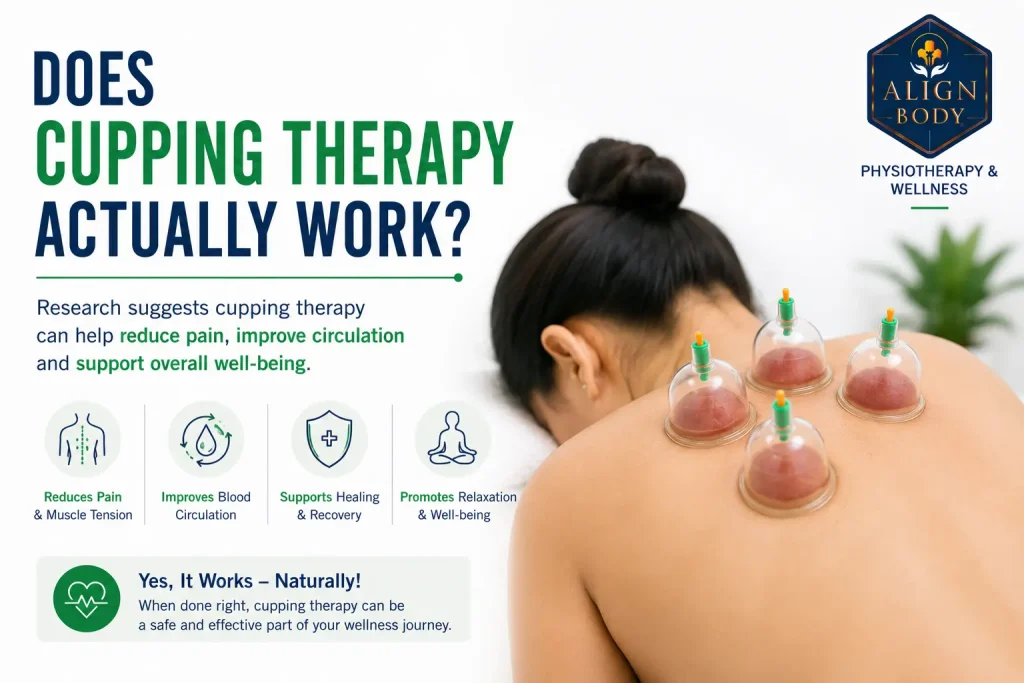
The current evidence for cupping therapy is genuinely mixed. For musculoskeletal pain (especially neck pain, low back pain and knee osteoarthritis) systematic reviews show low to moderate quality evidence of modest pain relief, with a 2024 meta-analysis on low back pain showing high to moderate quality evidence of significant improvement. For migraine, some benefit is shown but evidence quality remains low. For hypertension, diabetes, respiratory infections, cancer support and many other conditions cupping is marketed for, there is no reliable evidence of benefit. Cupping is best positioned as a low-risk adjunct to physiotherapy and evidence-based care for pain conditions, not as a stand-alone treatment for serious medical conditions. If someone tells you cupping definitely works or definitely does not work, they are oversimplifying.
“Does cupping actually work?” is one of the most common questions we get from patients before their first session. It is also one of the most difficult to answer honestly. The truth is more nuanced than either side of the debate suggests. Getting to that nuanced truth requires cutting through both promotional enthusiasm from wellness sites and dismissive skepticism from some medical commentators.
This post is written from the physiotherapist perspective, based on what the current systematic reviews and meta-analyses actually show, updated to 2024 evidence. If you want the honest picture on where cupping has real evidence of benefit, where it does not and how to decide whether it is worth trying for your specific situation, this is that guide.
I am Dr. Richa Gupta, founder of AlignBody Physiotherapy Clinic in Delhi. We use cupping in clinical practice as part of physiotherapy treatment. We also recommend against it for many conditions where marketing suggests it helps but evidence does not support the claim. This post reflects that clinical position.
What the Systematic Reviews Actually Show
The strongest evidence for any therapy comes from systematic reviews and meta-analyses that pool multiple randomised controlled trials. For cupping, the current picture is as follows.
The 2024 low back pain meta-analysis
A 2024 systematic review and meta-analysis published in a peer-reviewed journal analysed 11 studies of cupping for low back pain. The finding: high to moderate quality evidence that cupping significantly improves pain and disability. Cupping produced superior and sustained pain reduction compared with medication and usual care. Effects were seen immediately, at 24 hours and at 2 weeks after treatment. Wet cupping specifically outperformed dry cupping for pain relief. Cupping on acupuncture points outperformed cupping on the general lower back area. This is the strongest positive evidence available for any cupping application.
The 2023 update on cupping for pain
A 2023 update systematic review analysed 72 randomised controlled trials with 5,720 participants across various pain conditions. Cupping alone or combined with other therapy showed benefit in pain relief, quality of life improvement and cure rates. However, all included trials were assessed as having high risk of bias. The overall quality of evidence was rated as low. The conclusion was cautious but favourable: cupping seems to help pain conditions with less harm than drugs, but evidence quality limits confidence.
The 2022 musculoskeletal and sports rehabilitation review
A 2022 systematic review of 22 studies specifically in musculoskeletal and sports rehabilitation contexts concluded that cupping has low to moderate evidence for effectiveness. Evidence was moderate for improving soft tissue flexibility, low to moderate for reducing low back pain and cervical pain and very low to low for other musculoskeletal conditions. Adverse events were very rare.
The 2021 evidence map
A 2021 evidence mapping study of 13 systematic reviews found potential benefits of cupping for low back pain, ankylosing spondylitis, knee osteoarthritis, neck pain, herpes zoster, migraine, plaque psoriasis and chronic urticaria. Evidence quality varied significantly across conditions.
Condition-by-Condition Evidence Ratings
Here is an honest evidence tier grid for the specific conditions cupping is marketed to treat. This is based on current systematic reviews rather than individual trial claims or promotional material.
| Condition | Evidence Level | What This Means Practically |
|---|---|---|
| Low back pain (acute and chronic) | Moderate to high quality | Reasonable trial worth considering as part of broader treatment |
| Neck pain | Low to moderate | May help alongside physiotherapy; unlikely to work alone |
| Knee osteoarthritis | Low to moderate | Modest adjunct benefit; exercise remains first-line |
| Myofascial pain and muscle tension | Low to moderate | Widely used clinically; helps for tension relief short-term |
| Migraine | Low | Some evidence of benefit, particularly wet cupping. Not first-line |
| Sports recovery and soft tissue flexibility | Low to moderate | Reasonable as part of recovery protocol; not miraculous |
| Fibromyalgia | Very low | Limited evidence; may provide short-term symptomatic relief |
| Herpes zoster (shingles) | Low to moderate (wet cupping) | Some evidence in Chinese studies; not standard Western practice |
| Hypertension (blood pressure) | Very low to none reliable | Do not use as blood pressure treatment |
| Diabetes management | No reliable evidence | Not a treatment for diabetes |
| Respiratory infections (colds, flu) | No reliable evidence | No benefit demonstrated; not appropriate |
| Cancer support or cancer treatment | No evidence | Should never replace or delay cancer care |
| Weight loss | No reliable evidence | Marketing claim without evidence support |
| Skin conditions (acne, eczema, psoriasis) | Very low | Some plaque psoriasis evidence; consult dermatologist first |
| Toxin removal or detoxification | No evidence | Kidneys and liver handle detoxification, not skin surface |
Cupping evidence at a glance. Traffic-light summary from current systematic reviews:
✓ Some evidence
- Low back pain (mod-high)
- Neck pain (low-mod)
- Knee OA (low-mod)
- Myofascial pain (low-mod)
- Sports recovery (low-mod)
? Weak / mixed
- Migraine (low)
- Fibromyalgia (very low)
- Herpes zoster (low)
- Plaque psoriasis (low)
- Ankylosing spondylitis (low)
✗ No reliable evidence
- Hypertension
- Diabetes
- Cancer support
- Respiratory infections
- Weight loss
- Toxin removal / detox
Source: Cochrane, PMC systematic reviews (2021-2024). Evidence quality varies from very low to high depending on condition.
The key insight from this grid: cupping has some genuine evidence for what it is traditionally used for in musculoskeletal medicine (pain relief, muscle tension, sports recovery). The extensive list of other conditions it is often marketed for is largely unsupported by reliable evidence.
The Placebo Question: How Much Is Real Effect vs Expectation?
Any honest discussion of cupping evidence has to address the placebo effect. Cupping is a high-placebo therapy: patients see dramatic marks, feel the sensation of treatment, engage with a ritual that has thousands of years of cultural weight and receive practitioner attention and touch. All of these produce measurable placebo effects independent of any biological mechanism cupping might have.
This is not a criticism of cupping. Placebo effects are real physiological effects, not imaginary ones. A patient whose pain reduces after cupping has genuinely experienced pain reduction whether the mechanism was biological cupping effect, placebo response or a combination. What placebo effects do mean is that pain-relief benefits shown in cupping trials may partly or largely reflect what would happen with any intervention that included similar attention, expectation and ritual.
The challenge for cupping research is designing meaningful control conditions. “Sham cupping” (light suction without therapeutic intent) is used in some trials but is imperfect because patients can often tell the difference. This methodological limitation is one reason cupping evidence remains rated as low to moderate quality even when studies show benefit.
Practical implication: if cupping helps your pain, it is helping regardless of whether the mechanism is biological or placebo. But this does mean cupping is unlikely to work for conditions where placebo effects cannot help (blood pressure control, blood sugar regulation, cancer treatment).
Why Cupping Research Has Been So Mixed
Understanding why the evidence is inconsistent helps interpret it honestly. Several factors contribute to the mixed picture.
Trial design challenges. Blinding patients to whether they received cupping is essentially impossible because they can see and feel the marks. This unblindability affects trial quality across all cupping research.
Standardisation issues. Cupping protocols vary enormously across studies. Duration of suction, intensity, location, number of cups, wet versus dry, use of acupuncture points versus general application. All vary widely. This makes pooling results across studies difficult and reduces the strength of meta-analysis conclusions.
Publication bias. Chinese-language cupping trials which make up a large proportion of the evidence base have historically shown higher effect sizes than Western trials. This may reflect genuine differences in practice standards. It may also reflect publication bias where negative studies are less likely to be published in Chinese-language journals.
Short follow-up periods. Most cupping trials measure outcomes at 2 to 8 weeks after treatment. Long-term follow-up data is scarce, so we do not know how sustained the benefits are.
Practitioner variability. Cupping requires skill in application and outcomes vary with practitioner experience. Trials rarely control for this adequately.
The Michael Phelps Effect: Anecdote vs Evidence
The 2016 Rio Olympics photographs of swimmer Michael Phelps covered in cupping marks did more for cupping’s global visibility than any research paper ever has. Phelps swore by cupping. Serena Williams uses it. Many other elite athletes have publicly endorsed it. This has convinced many patients that cupping “obviously works” because top athletes rely on it.
The reasoning here is flawed in ways worth understanding. Elite athletes use many recovery modalities simultaneously. They also have access to nutritionists, physiotherapists, sleep coaches, sports psychologists, ice baths, compression garments, massage and many other interventions. Attributing performance recovery to cupping specifically, rather than to the combined effect of everything, is not scientifically supportable.
Athletes also often endorse practices that later evidence fails to support (magnetic bracelets, some supplements, various recovery gadgets). Anecdotal endorsement, even from elite performers, is not the same as reliable evidence.
None of this means cupping does not help athletes. It may. But the celebrity endorsement should not be confused with scientific evidence of specific efficacy.
When to Try Cupping and When to Skip It
Based on current evidence and clinical experience, here is a practical decision framework.
Cupping: worth trying or skip? A decision framework:
✓ Worth trying if
- You have musculoskeletal pain not resolved by basic care
- You are already receiving physiotherapy
- Primary concern is muscle tension or myofascial pain
- You have chronic low back pain
- You accept modest, possibly short-term benefit
- You can afford sessions without cutting evidence-based care
- You accept cosmetic marks lasting 4-10 days
✗ Skip if
- You want treatment for hypertension, diabetes or serious medical conditions
- You expect it to replace evidence-based treatment
- You expect toxin removal / detoxification
- You are seeking weight loss or general wellness boost
- You have bleeding disorders or take blood thinners
- Budget forces skipping established treatments
- You would delay medical assessment of concerning symptoms
Cupping as Part of Physiotherapy: The Practical Position
Our clinical position on cupping is that it functions well as a low-risk adjunct to physiotherapy for musculoskeletal conditions, particularly for muscle tension, chronic pain and myofascial complaints. We do not present it as a stand-alone cure or as a treatment for conditions where evidence does not support its use.
When we use cupping in treatment, it is typically alongside:
- Detailed assessment of the underlying problem
- Manual therapy for joint restriction and soft tissue tension
- Progressive exercise programmes for strength and mobility
- Movement pattern retraining and postural correction
- Education about the condition and self-management
- Where relevant, other modalities like myofascial release
Cupping in this context contributes a portion of the overall benefit. Patients whose treatment includes cupping typically progress well, but disentangling the cupping-specific contribution from the overall treatment effect is difficult. What we can say is that adding cupping to well-designed physiotherapy for musculoskeletal pain rarely does harm and often adds some short-term benefit.
Cost, Value and the Indian Context
Cupping session costs in Delhi NCR range from Rs. 500 to Rs. 2,500 per session. In physiotherapy clinics it is usually bundled into the session cost. In hijama centres and TCM clinics it is often priced per treatment area.
Value considerations for Indian patients:
Compared to what? A single cupping session at Rs. 1,500 is not expensive. A course of 10 sessions at Rs. 1,500 each is Rs. 15,000. This is significant money. The honest evidence base suggests modest benefit for pain conditions and no benefit for many other conditions marketed. Compare this to the cost and evidence base for structured physiotherapy or evidence-based medical treatment for the same condition.
Insurance coverage. Cupping alone is not typically covered by Indian health insurance. When bundled into physiotherapy treatment by a licensed physiotherapist, treatment may be covered depending on your policy. Standalone hijama and TCM cupping are generally not covered.
Complementary versus primary. Position cupping in your budget and treatment plan as a complementary approach that adds modest benefit. Do not position it as a substitute for primary evidence-based treatment for your condition.
Practitioner selection. A Rs. 500 session with an unlicensed practitioner in unhygienic conditions is not a bargain. A Rs. 2,000 session with a properly trained physiotherapist providing full assessment and treatment plan is significantly better value.
The Bottom-Line Answer
Does cupping therapy work? Here is the honest answer.
For low back pain, moderate to high quality evidence suggests genuine pain relief benefits, with 2024 meta-analysis data showing significant improvement compared to medication and usual care.
For other musculoskeletal pain (neck, shoulder, knee OA, muscle tension), low to moderate quality evidence suggests modest benefit as part of broader treatment, unlikely to be transformative alone.
For migraine, some benefit is shown but evidence quality remains low.
For most other conditions cupping is commonly marketed for (hypertension, diabetes, respiratory infections, cancer support, weight loss, detoxification), evidence does not support the claims.
The therapy is safe when performed properly and low-risk for most patients. It is best used as an adjunct to physiotherapy for pain conditions rather than as a stand-alone treatment or for conditions where reliable evidence is absent.
Frequently Asked Questions
Is cupping evidence-based or pseudoscience?
Neither label fits well. Cupping has legitimate evidence for pain conditions, particularly low back pain, at low to moderate (and in some studies, high to moderate) quality levels. It has no evidence for many of the additional benefits marketed for it. So it is partly evidence-based for specific conditions and partly pseudoscientific claims for others. The label depends entirely on what you are considering it for.
Why do so many athletes use cupping if the evidence is only moderate?
Athletes use many things with modest or unclear evidence because they are looking for any legal marginal advantage. They typically use cupping alongside evidence-based recovery methods (sleep, nutrition, physiotherapy, massage), so attributing their recovery to cupping specifically is difficult. Athletes’ endorsements are not the same as scientific evidence of specific efficacy.
Does cupping work for anxiety or stress?
The physical relaxation response and the ritual attention involved in a cupping session may produce short-term stress reduction similar to any relaxing therapy. There is no specific evidence that cupping treats anxiety or stress conditions in any clinically meaningful way. If stress is a primary concern, more established approaches (regular exercise, cognitive behavioural therapy, mindfulness practice, adequate sleep) have much stronger evidence.
Can cupping help with digestive problems or gut health?
Some traditional medicine frameworks include cupping for digestive complaints. There is no reliable clinical evidence that cupping helps digestive problems. Modern digestive symptoms usually have specific causes that need specific evaluation and treatment. If you have persistent digestive symptoms, please see a gastroenterologist rather than pursuing cupping.
How many sessions until I know if it is working for me?
For pain conditions, most patients who will benefit from cupping notice some difference within 2 to 4 sessions. If you have completed 4 to 6 sessions with no meaningful improvement, additional sessions are unlikely to help. This is different from marketing claims that suggest you need 20 or more sessions to see effects. The honest evidence suggests earlier benefit or no benefit; long extended courses without response are not supported by evidence.
Is cupping safer than painkillers for chronic pain?
For low back pain specifically, 2024 meta-analysis data suggested cupping compared favourably to medication with less potential harm. For most other conditions, this comparison is not well-studied. What is clear is that regular NSAID use for chronic pain carries meaningful cardiovascular, renal and gastric risks, so any effective non-drug option is worth considering. Cupping is one of several non-drug options alongside physiotherapy, exercise, cognitive approaches and lifestyle changes.
What conditions should I never use cupping for?
Cupping should not be used as primary treatment for hypertension, diabetes, cancer, serious infections, mental health conditions, autoimmune diseases requiring immunomodulation or any acute medical emergency. It should not be used on skin with active infections, wounds, dermatological conditions or over major blood vessels or areas with reduced sensation. Avoid during pregnancy on the abdomen and lower back. Avoid in patients on anticoagulants (particularly wet cupping).
If evidence is only moderate, why do you use cupping in your clinic?
We use it because the evidence, though modest, supports use for specific pain conditions we commonly treat. It carries very low risk. Patients often derive benefit even if partly through placebo effects. When used as a component of broader physiotherapy rather than as stand-alone treatment, it adds value at low cost. We are transparent with patients about what evidence supports and does not support and we do not oversell the benefit. That combination of low risk, some evidence, integrated use and honest expectation-setting is a reasonable clinical position.
Does cupping work? The honest answer is: for some pain conditions, yes with moderate evidence. For many other conditions marketed for it, no. This is neither an endorsement of cupping as a miracle therapy nor a dismissal of it as pseudoscience. It is what the evidence currently supports.
If you are considering cupping for a musculoskeletal pain condition and want a proper assessment first, book at AlignBody. Our clinics offer cupping therapy in Delhi and cupping therapy in South Delhi integrated with full physiotherapy programmes. Read our related guides on how cupping therapy works, what cupping marks mean, wet cupping vs dry cupping and why lower back pain hurts for related content.
If someone tells you cupping definitely works for your specific condition, ask them what systematic reviews they are basing that claim on. If someone tells you cupping definitely does not work for any condition, ask them the same question. Both extremes usually reflect ideology rather than evidence.
Evidence-based cupping integrated with full physiotherapy assessment. Honest expectations, no oversold claims.
East Delhi: Jagriti Enclave | South Delhi: Vasant Vihar | +91 9310 014 226