Are Posture Corrector Braces Effective? A Physiotherapist’s Honest Review
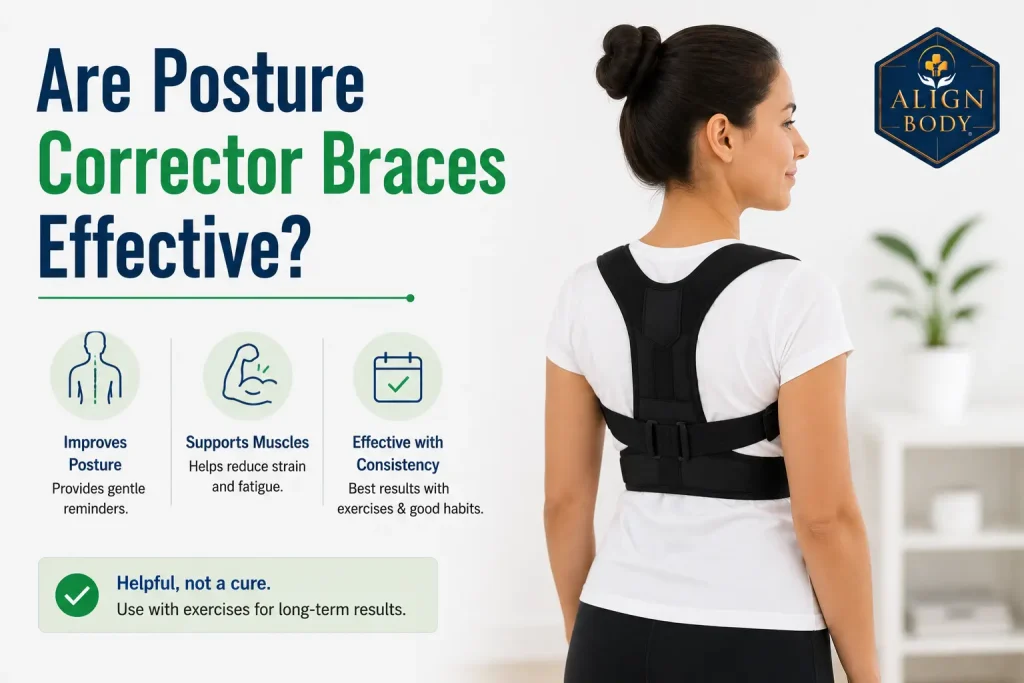
Posture corrector braces can work short-term as a reminder to sit up straight, but they do not fix poor posture on their own. The research is mixed and much of it is manufacturer-funded. Worn for more than 1 to 2 hours a day, braces can weaken the muscles they claim to help. Use one for 20 to 40 minutes daily as a cue for 4 to 6 weeks, alongside a proper strengthening programme. Rigid braces have a place after fracture or in older adults with osteoporosis, but not as a first-line posture fix.
Amazon India lists over 300 posture corrector braces. Prices range from Rs. 250 to Rs. 4,500. Every listing promises to straighten your back, ease your pain and “reverse tech neck” within weeks. In our Delhi clinic we see patients bring these in almost every week.
So the honest question a patient deserves an answer to is: do these actually work? And if they do, which ones, for how long, at what cost and with what risk?
I am Dr. Richa Gupta, founder of AlignBody Physiotherapy Clinic in Delhi. This post reviews the current evidence without any commercial interest in either selling you a brace or telling you they are useless. Braces have a specific, limited role. This guide tells you exactly what that role is.
The verdict at a glance:
What the Research Actually Shows
Here is the honest state of the evidence.
A 2018 study of office workers found that wearing a corrective brace during work hours for 6 to 12 months improved neck and trunk posture. A 2025 review found that corrective braces may help spinal alignment and reduce forward head posture and rounded shoulders when combined with an exercise programme. Kinesiology tape studies show similar short-term postural gains, but researchers consistently conclude that exercise is more effective in the long run.
Against those findings sit some inconvenient facts. A 2023 study found no significant effect on neck alignment, pain or fatigue from postural braces. A 2019 review of 137 studies on posture-correcting shirts found that only 6 were of sufficient quality to draw conclusions. It did not recommend the shirts based on the evidence available.
The evidence problem nobody mentions: A significant proportion of published posture-corrector research is funded, in whole or in part, by companies that manufacture and sell the devices. Wikipedia notes this explicitly. When you read that a study “shows braces work,” check who paid for the study. That single check would change how many products get recommended.
The consensus that emerges when you weight the evidence appropriately: braces produce measurable short-term postural change. They do not produce lasting change on their own. Long-term studies favouring braces are the exception, not the rule.
How Do Posture Braces Actually Work?
Understanding the mechanism explains both what braces can and cannot do.
A brace does not strengthen a muscle. It cannot lengthen a tight muscle. It cannot re-educate a movement pattern. What it does is one thing: it externally holds your body in a corrected position and reminds you when you drift out of it.
That reminder is real. Patients wearing a brace do sit and stand straighter while wearing it. The problem is what happens the moment the brace comes off. The muscles that should hold you in that position have not been trained to do so, because for the hours you wore the brace, the brace did the job for them. As soon as the external support is removed, the same postural collapse returns.
Some research suggests that long-term brace wear can actually make the underlying muscle weakness worse. The muscles that should be holding you upright get less work while the brace is doing it, which can lead to further deconditioning. This is why every credible clinician recommends time limits.
The Types of Posture Braces and What the Evidence Says About Each
| Type | What It Is | What the Evidence Shows |
|---|---|---|
| Soft harness (figure-8, clavicle brace) | Elastic straps that pull the shoulders back over the upper back | Some short-term evidence for reducing rounded shoulders. Popular and cheap (Rs. 500 to 1,500). Poorly tolerated for long wear |
| Full upper back brace with shoulder straps | A more substantial device covering the mid-back with shoulder straps and often a lumbar support | Better tolerance for daily use than harnesses. Some short-term postural benefit. Still no substitute for exercise |
| Rigid thoracolumbar brace | A medical-grade brace prescribed for spinal fracture, severe osteoporosis or post-surgery | Meaningful, evidence-based use for specific medical indications. Not for general posture correction |
| Posture correcting shirts (compression garments) | A shirt with reinforced panels designed to remind you of alignment | 2019 review of 137 studies found only 6 of sufficient quality. Not recommended for posture correction on the available evidence |
| Smart wearables (vibrating posture trainers) | Small clip-on devices that vibrate when you slouch | Small studies suggest short-term posture awareness benefit. Better tolerated than braces because less restrictive. No long-term data on lasting change |
| Kinesiology tape | Not strictly a brace but often used for posture cueing | Similar short-term effects to a brace. Researchers consistently conclude exercise is more effective long-term |
Cost vs Benefit: The Rs. 2,000 Question
Consider two scenarios for the same Rs. 2,000 to 3,000 you might spend on a mid-range posture brace.
Scenario A: You buy a Rs. 2,500 brace. You wear it 30 minutes a day for 3 weeks. It feels supportive when you wear it. After 3 weeks the novelty wears off and it sits in a drawer. Your posture is unchanged. Cost per week of actual benefit: unclear, because you did not develop any lasting change.
Scenario B: You spend the same Rs. 2,500 on a physiotherapy assessment plus one follow-up session. You get a specific diagnosis (which of the seven causes of poor posture applies to you), a targeted home exercise programme and a check-up to confirm you are doing it correctly. You practice the exercises for 20 minutes a day. Over 6 to 8 weeks your posture measurably improves and the change is sustainable because the muscles that hold posture are now trained to hold it.
The same Rs. 2,500. Two very different outcomes.
Scenario A: Brace only
Buy: Rs. 2,500 mid-range brace
Use: 30 min/day for 3 weeks
Result at week 6: Brace in a drawer. Posture unchanged. Muscles untrained.
Lasting benefit: minimal
Scenario B: Assessment + programme
Spend: Rs. 2,500 on physio assessment + follow-up
Do: Targeted daily exercises for 6 to 8 weeks
Result at week 6 to 8: Measurable postural improvement, trained muscles that hold you upright.
Lasting benefit: sustained
Scenario B is what the evidence supports and what almost every credible study on long-term outcomes recommends. This is not a criticism of every brace user. It is a fair comparison of what the same money can buy in the same timeframe.
When a Brace Actually Makes Sense
There are situations where a brace is genuinely appropriate. All of them are limited-duration, specific-purpose uses.
- As a temporary awareness cue in the first 2 to 4 weeks of a posture correction programme. During this window a brace can help you remember what corrected posture feels like while you are learning to hold it actively
- Post-fracture spinal healing. Rigid bracing after a vertebral fracture is standard medical care during the acute healing period
- Advanced osteoporosis with vertebral compression. In older adults with reduced bone density, rigid bracing can provide meaningful pain relief and short-term postural support during medical management
- Post-surgical stabilisation. Where prescribed by the operating surgeon
- Post-partum abdominal support in the first 4 to 6 weeks after delivery as a comfort measure, not a long-term posture solution
Notice that all of these are either short-term uses or medical prescriptions. None of them are “wear this daily forever to correct your slouch.”
Red Flags: When a Brace Is a Warning Sign, Not a Solution
If you have any of these, you need clinical assessment, not a brace:
- Visible asymmetry in the mirror (one shoulder or hip higher than the other) → possible scoliosis
- Fixed forward-flexed posture that does not straighten voluntarily → possible structural kyphosis or osteoporotic changes
- Sudden posture change in an older adult with back pain → possible vertebral compression fracture
- Progressive pain, numbness or tingling into arms or legs → possible nerve compression
- Loss of height documented over time → possible osteoporotic changes
- Postpartum posture change with pelvic pain or leaking urine → assessment matters more than any garment
Reaching for a brace when any of these are present delays proper assessment and can allow a treatable condition to progress. Read our guide on what causes poor posture to understand which of your presentations need clinical attention.
How to Use a Brace Correctly (If You Buy One)
If you decide a brace is right for you as part of a broader programme, here is how to use it without doing more harm than good.
Choose the right type
For general upper back and rounded shoulder posture, a full upper back brace with adjustable shoulder straps is more tolerable and effective than a thin figure-8 harness. Avoid posture correcting shirts as first choice given the poor evidence. Rigid braces should not be self-selected. Those are medical prescriptions.
Follow a progressive wear schedule
| Week | Daily Wear Time | What Else Happens |
|---|---|---|
| Week 1 | 15 to 20 minutes | Begin daily corrective exercises. Wear brace during exercise as a positional cue only |
| Week 2 | 20 to 30 minutes | Add brace during 1 to 2 sitting sessions to reinforce awareness |
| Weeks 3 to 4 | 30 to 40 minutes maximum | Exercise programme continues. Reduce brace use as your muscles take over |
| Weeks 5 to 6 | Only during specific triggers | Wear only during high-slouch activities (long car journey, back-to-back meetings) |
| Week 7 onwards | Occasional or none | Muscle strength should now hold the corrected posture. Brace becomes redundant |
Combine with the exercises the brace cannot do
The brace holds you in position. Your muscles must learn to hold you in position. The exercises that do that are wall angels, rows, glute bridges, dead bugs and thoracic rotations, done daily. Read our detailed guide on the best posture correction exercises and core strengthening for back pain.
The India-Specific Considerations
Delhi’s heat and humidity make prolonged brace wear uncomfortable in a way most Western reviews do not account for. Braces cause sweating and skin irritation, particularly in the pre-monsoon months. This actively pushes users toward the “never wear it” side of the compliance curve, which is not necessarily a bad thing given what we said about long-term wear.
The unregulated Indian e-commerce market for these devices means quality varies enormously. Cheap braces (below Rs. 500) often use thin elastic that stretches within days and stops providing any positional cue. Mid-range products (Rs. 1,500 to 3,000) are generally more durable. Expensive imported braces are not necessarily better; the underlying evidence base for the whole category is not strong enough to justify premium pricing.
Frequently Asked Questions
How long should I wear a posture corrector each day?
No more than 30 to 40 minutes per day for most healthy adults using it as a posture cue. Longer wear risks weakening the muscles that should be holding your posture actively. Progressive wear schedules that start at 15 to 20 minutes and phase out over 6 weeks are far more useful than daily long-duration wear. If you find yourself needing to wear it longer to feel supported, the underlying muscle weakness has not been addressed and that is what needs attention.
Can a posture brace make my posture worse?
Yes, in two specific ways. If worn for many hours daily over months, the muscles that should hold posture actively can become further deconditioned because the brace is doing their job. If a brace masks an undiagnosed structural cause (scoliosis, fracture, osteoporotic changes) it can delay proper diagnosis and treatment. Neither of these means braces are dangerous. Both mean they should be used briefly, purposefully and alongside proper assessment.
Are posture braces safe to wear all day at work?
No. All-day daily wear is exactly the pattern most likely to weaken the muscles the brace is trying to help. If your workplace is driving your posture problems, the solutions are workstation setup, movement breaks every 45 to 60 minutes and a targeted exercise programme. The brace can be a short-term cue in this environment but not the primary intervention.
What is better: a posture brace or physiotherapy?
Physiotherapy, by a significant margin, for long-term improvement. A brace addresses one thing (external support during wear). Physiotherapy addresses the underlying muscle imbalance and movement pattern that cause the poor posture in the first place. The two are not mutually exclusive. In a well-designed programme a brace can play a supporting role for the first 4 to 6 weeks. But if you had to choose one, choose physiotherapy. Read our guide: can physiotherapy fix bad posture.
Do smart posture wearables work better than traditional braces?
Smart wearables (vibrating clip-on devices) work through a different mechanism: they provide feedback rather than external support. Small studies suggest they improve posture awareness in the short term and users tend to tolerate them better because they do not restrict movement. Whether that awareness translates into lasting change without a supporting exercise programme is the same open question that applies to braces. The evidence for long-term posture change from wearables alone is thin.
Can children and teenagers wear posture correctors?
Growing spines require careful assessment before any bracing decision. Adolescent postural changes are common and usually correct with exercise, ergonomic changes to their study and screen setup and simply time. Rigid bracing in children and adolescents is only appropriate for specific medical conditions like adolescent idiopathic scoliosis or Scheuermann’s kyphosis, and those decisions are made by orthopaedic specialists, not by parents buying a brace online. See kyphosis and physiotherapy.
Will a posture corrector help with anterior pelvic tilt?
No. Anterior pelvic tilt is a lower body posture problem driven by tight hip flexors and weak glutes and deep core muscles. Upper back braces do not address any of these. There are lumbar-region belts marketed for this purpose but the evidence for them is weak and the mechanism (external belt support) does not correct the underlying muscle imbalance. Read our full APT guide: anterior pelvic tilt correction exercises. The same principle applies to forward head posture. Braces are a cue, exercise is the fix.
Posture corrector braces are neither miracle products nor scams. They are a limited tool with a limited useful role: a short-term awareness cue during the first 4 to 6 weeks of a proper posture correction programme, for otherwise healthy adults with a straightforward muscle imbalance.
Every long-term study of any consequence concludes the same thing: it is the exercise programme, the movement re-education and the workstation and lifestyle changes that produce lasting posture improvement. The brace holds you in position for the minutes you wear it. Your muscles have to hold you for the rest of your life.
If you want a clinical assessment that tells you honestly whether a brace is right for you and what a specific correction programme for your posture pattern would look like, book at AlignBody. Our posture correction programme runs at both our East Delhi (Jagriti Enclave) and South Delhi (Vasant Vihar) clinics.
Before you buy a brace: have you actually tried 4 weeks of daily targeted strengthening exercises first? The answer to that question determines whether a brace could genuinely help or whether it will just delay real correction.