Cupping Therapy for Back Pain: What Evidence Shows
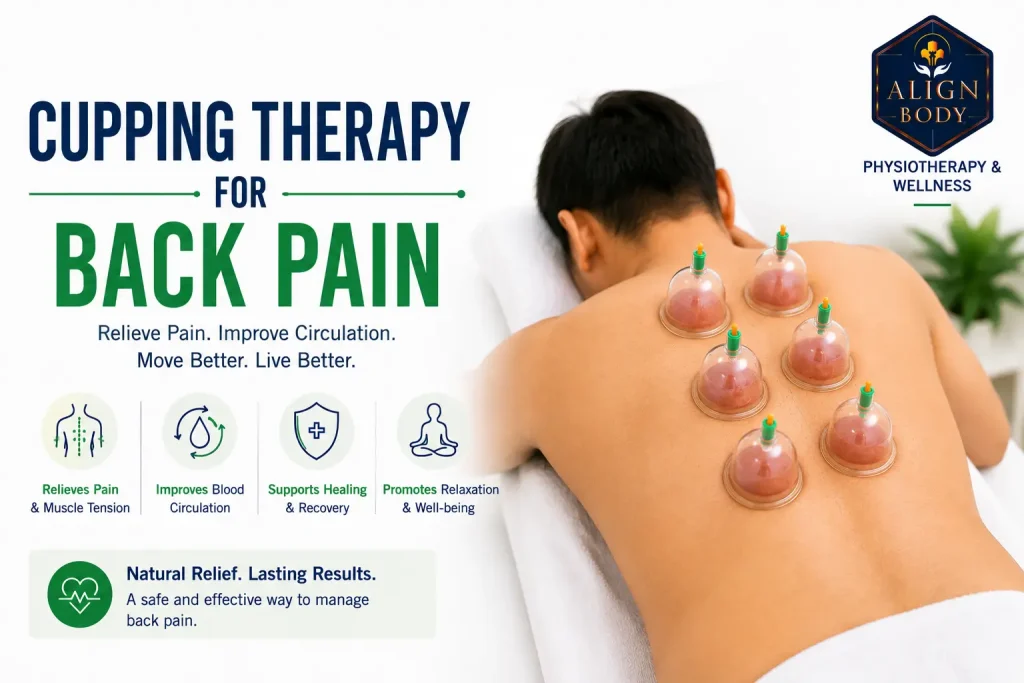
✓ Quick Answer
Yes, cupping therapy helps back pain. 2024 evidence shows significant pain reduction lasting up to 2 weeks after treatment. It works best for muscle-tension and acute mechanical back pain. Most patients notice benefit within 2 to 4 sessions. Best used with physiotherapy assessment, not alone.
At AlignBody, back pain is the single most common condition we treat. Because of this, cupping therapy for back pain is one of the most frequent adjunct treatments we recommend. In fact, cupping’s evidence base is genuinely stronger for low back pain than any other application. Specifically, this post covers what 2024 research shows, which back pain types respond best, when to skip cupping and how it fits into proper physiotherapy treatment.
Session Cost in Delhi NCR
Rs. 800 – 2,500 per session
Rs. 8,000 – 25,000 for a 6-10 session course bundled with physiotherapy
How Cupping Therapy Works to Relieve Back Pain: The Mechanism
Cupping is one of the oldest documented therapies in medicine. For example, Chinese physician Ge Hong documented it in his 4th century medical texts. Ibn Sina (Avicenna) recorded its use in Islamic medical tradition around 1025 CE. Since then, Traditional Chinese Medicine (TCM) has used cupping continuously. Today, the therapy works through several documented physiological mechanisms.
The 6 documented mechanisms through which cupping relieves back pain:
1. Decompression
Negative pressure lift
Lifts tissue upward, opposite of pressure-based massage. Decompresses fascia.
2. Circulation
Blood flow increase
Produces controlled petechiae and ecchymosis. Clears metabolic waste.
3. Myofascial
Fascial separation
Releases adhesions between fascial layers that pressure cannot reach.
4. Neuromuscular
Pain gate + reflex
Competing sensory input reduces pain signals. Reflex inhibition of muscle spindles.
5. Trigger points
Knot release
Localised pressure changes release painful muscle knots along the back.
6. Sympathetic
Relaxation response
Reduces sympathetic nervous system activity and stress-related muscle tension.
Key Benefits of Cupping Therapy for Back Pain
8 evidence-based benefits of cupping therapy for back pain:
✓ Muscle tension release
Decompresses tight paraspinals, trapezius and myofascial restrictions.
✓ Better circulation
Improved oxygen and nutrient delivery to overloaded back muscles.
✓ Pain lasts up to 2 weeks
2024 meta-analysis showed sustained relief after treatment ends.
✓ Improved lumbar mobility
Measurable increases in spinal range of motion after sessions.
✓ Less pain medication
Non-drug relief reduces need for NSAIDs and their side effects.
✓ Very low risk
Marks fade in 4-10 days. Serious adverse events are rare.
✓ Boosts exercise recovery
Reduces pain enough to engage with exercise-based treatment.
✓ Trigger point relief
Particularly effective for muscle knots along the back.
What the 2024 Evidence Shows for Cupping Therapy on Low Back Pain
First, the 2024 systematic review and meta-analysis (registered with PROSPERO, following PRISMA standards, using GRADE evidence framework) included 11 randomised controlled trials sourced from Medline, Embase, Scopus and WANFANG databases. Overall, high to moderate quality evidence showed cupping significantly improves pain and disability, with sustained effects up to 2 weeks. Notably, cupping outperformed medication and usual care.
Cupping for back pain: what the 2024 meta-analysis actually found
Overall effect
d = 1.09
Large effect on pain at 2-8 weeks. High-quality evidence from 11 studies (95% CI 0.35-1.83).
Wet vs dry
Wet: d=1.5 (p=0.008) · Dry: d=1.06 (p=0.14)
Wet cupping reached statistical significance. Direct comparison found no significant difference between types.
Placement matters
Acupoints: d=1.29 · Area: d=0.35
Cupping on acupuncture points significantly outperforms general lower back placement.
Sustained effect
Immediate · 24 hours · 2 weeks
Effects last up to 2 weeks post-treatment. Superior to medication and usual care.
However, context matters here. As the Global Burden of Disease Study shows, back pain is the number one cause of years lived with disability globally. In response, the 2016 NICE guidelines and 2017 American College of Physicians (ACP) guidelines both recommend non-pharmacological approaches as first-line treatment. Therefore, cupping fits within this shift.
Which Types of Back Pain Respond Best to Cupping Therapy
Which back pain type responds best to cupping?
Best response: Acute mechanical + myofascial pain
Recent onset (under 6 weeks), muscle tension, worse with movement. Benefit in 2-4 sessions.
Good response: Subacute + postural back pain
6-12 weeks duration, WFH/desk-related. Best with exercise programme.
Moderate: Chronic non-specific low back pain (lumbago)
Over 3 months, no specific cause. Cupping alone not enough. Must be part of multi-modal treatment.
Not appropriate: Red-flag back pain
Trauma, fever, weight loss, progressive weakness, bladder/bowel changes, severe radiculopathy. Medical evaluation first.
In addition, specific structural conditions have particular relationships with cupping. For example, herniated disc at L4-L5 or L5-S1, spinal stenosis, facet joint dysfunction, SI joint dysfunction, piriformis syndrome (piriformis muscle tightness irritating the sciatic nerve), ankylosing spondylitis and failed back surgery syndrome all respond partially to cupping for the muscle tension component but need proper diagnosis and specific management. However, for fibromyalgia and osteoporosis-related back pain, cupping requires modification and caution. Similarly, for sciatica and radiculopathy, cupping provides symptomatic relief only. Overall, cupping is not first-line treatment for any of these.
When Cupping Therapy for Back Pain Is Not Appropriate
Importantly, certain back pain presentations need medical assessment first, not cupping:
- Trauma: back pain after significant fall or road accident requires imaging
- Systemic symptoms: fever, unexplained weight loss, night sweats may indicate infection, cancer or inflammatory disease
- Cauda equina signs: progressive leg weakness, bladder or bowel changes are medical emergencies
- Severe radicular symptoms with neurological deficit: need imaging before manual therapy
- Anticoagulant medication: wet cupping contraindicated, dry cupping with caution
- Pregnancy: requires modified approach or deferral
- Skin infection, rash or wounds in treatment area
Cup Placement Zones and Types of Cupping Used for Back Pain
Typically, a session uses 6 to 12 cups across multiple zones targeting specific muscles: the erector spinae group (spinalis, longissimus, iliocostalis), multifidus, latissimus dorsi, quadratus lumborum and where relevant the piriformis. In addition, common acupuncture points include BL23 (Shenshu) at the second lumbar vertebra, BL25 (Dachangshu) at the fourth lumbar level and points along the Du meridian (Governor Vessel).
7 anatomical placement zones on the back. Where cups go and why:
Upper trapezius + shoulders
Desk-work tension, cervicogenic headaches, upper back stiffness.
Rhomboids + mid-thoracic
Interscapular pain, postural pain from rounded shoulders.
Paraspinal muscles alongside spine
The long vertical muscles running either side of the spine.
Thoracolumbar junction
Where thoracic meets lumbar spine. Common restriction site.
Lumbar + quadratus lumborum
Deep lower back muscles stabilising pelvis and lumbar spine.
Sacral + gluteal area
Lower back pain with buttock tension or referred patterns.
Bladder meridian acupuncture points
2024 meta-analysis: significantly greater pain relief than general placement.
Generally, cupping techniques used for back pain include stationary dry cupping (most common, 5-15 minutes per cup), sliding or moving cupping (with oil, for large muscle areas), flash cupping (rapid application for stimulation without marks), fire cupping (traditional glass or bamboo cups with brief flame) and wet cupping or hijama (with small incisions, used selectively). At AlignBody, we use dry cupping as our standard practice because of its safety profile.
Cupping Therapy vs Other Back Pain Treatments Compared
Overall, cupping compares favourably with most non-primary treatments but is not a replacement for exercise-based physiotherapy.
| Treatment | Evidence for Back Pain | Best Positioned As |
|---|---|---|
| Exercise therapy | Very strong (all guidelines) | Primary treatment |
| Manual therapy / physiotherapy | Strong | Standard component |
| Cupping therapy | Moderate to high (2024 meta-analysis) | Evidence-based adjunct |
| NSAIDs (ibuprofen, paracetamol) | Strong for acute pain | Short-term adjunct |
| Muscle relaxants | Modest, acute pain | Very short-term only |
| Massage / dry needling / myofascial release | Moderate | Adjuncts |
| Acupuncture / spinal manipulation | Moderate | Adjuncts |
| McKenzie method / Pilates / yoga / CBT | Moderate to strong | Comprehensive plan components |
| Chiropractic / spinal mobilization / TENS / ultrasound | Modest | Selective use |
| Cortisone / epidural steroid injections | Variable by condition | Selective specific presentations |
| Opioids / surgery | For specific severe cases only | Last resort |
How to Prepare Before Your Cupping Session and What to Do After
Before your session
First, wear loose comfortable clothing. Then, eat a light meal 1-2 hours beforehand (not on empty stomach or right after a heavy meal). Also, hydrate well. Importantly, skip alcohol for 24 hours before. Additionally, communicate any new medications, particularly blood thinners. Note your baseline pain levels using the Numeric Pain Rating Scale (NPRS) for tracking progress against minimal clinically important difference (MCID) thresholds. We also use the Oswestry Disability Index (ODI) and Roland-Morris Disability Questionnaire for functional impact.
After your session
First, rest for the first 1-2 hours. Then, continue hydrating for 24-48 hours. Actually, gentle walking is beneficial. However, avoid heavy lifting for 24-48 hours. Specifically, for lower back pain, sleep side-lying with a pillow between the knees. Also, keep the treated area warm and covered. Importantly, skip saunas and hot baths for 24 hours. Finally, continue your prescribed home exercise programme from day 2. Contact your clinic if you notice spreading marks, actual pain (not just tenderness), fever or any concerning symptoms.
Realistic Cupping Therapy Session Protocol for Back Pain
Generally, most patients who benefit notice improvement within 2 to 4 sessions in our clinical experience. Typically, a course is 6 to 10 sessions over 3 to 6 weeks alongside physiotherapy, with 1 to 2 sessions per week initially. Also, suction should be moderate rather than maximum. Cups stay in place 5 to 15 minutes per placement. However, extended courses beyond this without adding other treatments are not supported by evidence.
Cupping Therapy for Back Pain in the Indian Context
In our clinical experience, labour-based back pain is significantly under-treated in Delhi. Specifically, construction, domestic and delivery workers develop back pain from lifting and awkward postures but delay treatment due to cost and work continuity. Also, WFH postural back pain from prolonged sitting on beds and floors is increasingly common. Meanwhile, Delhi winter cold and monsoon dampness worsen back stiffness. Cupping sessions in Delhi NCR run Rs. 800 to 2,500. A 6 to 10 session course costs Rs. 8,000 to 25,000 bundled with physiotherapy and is often partially covered by health insurance when delivered by a licensed physiotherapist. Notably, Michael Phelps at the 2016 Rio Olympics brought cupping global recognition and it is now used across tennis, cricket and mixed martial arts for training-load back pain.
Frequently Asked Questions
How quickly should I feel benefit from cupping for back pain?
Most patients see some improvement within 2 to 4 sessions in our clinical experience. Completing 4 to 6 sessions without meaningful change usually means the treatment plan needs review rather than more sessions.
Is cupping safe if I have a disc bulge?
Generally, cupping is safe with confirmed disc bulges and can help the muscle tension component. However, cupping does not treat the disc itself. If you have significant radicular symptoms (radiating leg pain, weakness, numbness in an L4-L5 or L5-S1 distribution), proper evaluation is needed first.
Should I get wet cupping (hijama) or dry cupping for my back pain?
Overall, the 2024 evidence suggests wet cupping produces slightly larger effect sizes but comes with additional risks. Generally, for most back pain patients, dry cupping is the appropriate starting point. Read our full wet vs dry cupping guide.
Can cupping help with sciatica?
Specifically, cupping provides symptomatic relief for the muscle tension component (particularly piriformis syndrome) but does not treat the underlying sciatic nerve root compression. Proper evaluation including possible imaging is important for significant or progressive nerve symptoms.
Can I exercise after a cupping session?
Yes and this is often encouraged. Light to moderate exercise supports the therapeutic effect. Avoid very intense exercise, contact sports or activities that could bump the cupped area for 24 to 48 hours. Walking, gentle stretching and prescribed physiotherapy exercises are fine.
Does cupping therapy for back pain hurt?
Generally, cupping should not hurt. Most patients describe the sensation as a firm pulling or tightness rather than pain. Suction intensity is adjustable and we adjust down if any cup causes actual discomfort. Also, some tenderness at cup sites for 24 to 48 hours after the session is normal, similar to how muscles feel after deep tissue work. Sharp pain during or after cupping is not normal and should be reported.
How long do cupping marks last on the back?
Typically, cupping marks on the back fade within 4 to 10 days. Colour progresses from red or pink initially through purple or darker shades over 2 to 4 days, then yellow or brown as they fade. Importantly, marks are not bruises from injury but controlled petechiae and ecchymosis from the suction effect. Hydration, gentle movement and avoiding hot baths help them fade faster. Read our detailed guide on cupping marks.
How much does cupping therapy for back pain cost in Delhi?
In Delhi NCR, cupping session costs range from Rs. 800 to Rs. 2,500 per session. When bundled into physiotherapy at licensed clinics like ours, the cost is often partially covered by health insurance. A typical 6 to 10 session course for back pain runs Rs. 8,000 to Rs. 25,000. Standalone cupping at hijama centres and wellness clinics is generally not insurance-covered.
Will cupping fix my chronic back pain permanently?
Cupping does not “fix” chronic back pain. Neither does any single treatment. Chronic back pain needs a comprehensive approach including exercise, movement retraining and multi-modal treatment. Cupping can be a valuable component that reduces pain enough to allow engagement with more definitive treatments.
In summary, cupping therapy for back pain has genuine 2024 evidence supporting its use as part of comprehensive treatment. Specifically, what works: cupping combined with exercise, manual therapy, education and appropriate lifestyle changes. However, what does not work: cupping in isolation or without proper assessment.
Book an assessment at AlignBody. We provide cupping therapy in Delhi and cupping therapy in South Delhi as part of comprehensive physiotherapy programmes tailored to back pain. Read our related guides on how cupping therapy works, the general cupping evidence review, why lower back pain hurts and core strengthening for back pain.
Has your back pain been treated with cupping alone, without any exercise programme or physiotherapy assessment? If yes, the 2024 evidence is clear: cupping works, but not alone.